

What Is Average Daily Rate (ADR)?
Average Daily Rate (ADR) is one of the most important key performance indicators in the hotel and short-term rental industry. It measures the average revenue earned per occupied room over a given period. Because it ignores unsold and complimentary rooms, ADR reflects the actual pricing power of a property and is closely watched by revenue managers, owners, and analysts.
How to Use This Calculator
Enter the total room revenue earned during the period (excluding food, beverage, parking, and other ancillary income), then enter the number of rooms sold — that is, the count of paid, occupied room-nights. The calculator instantly divides revenue by rooms sold to return your ADR.
The Formula Explained
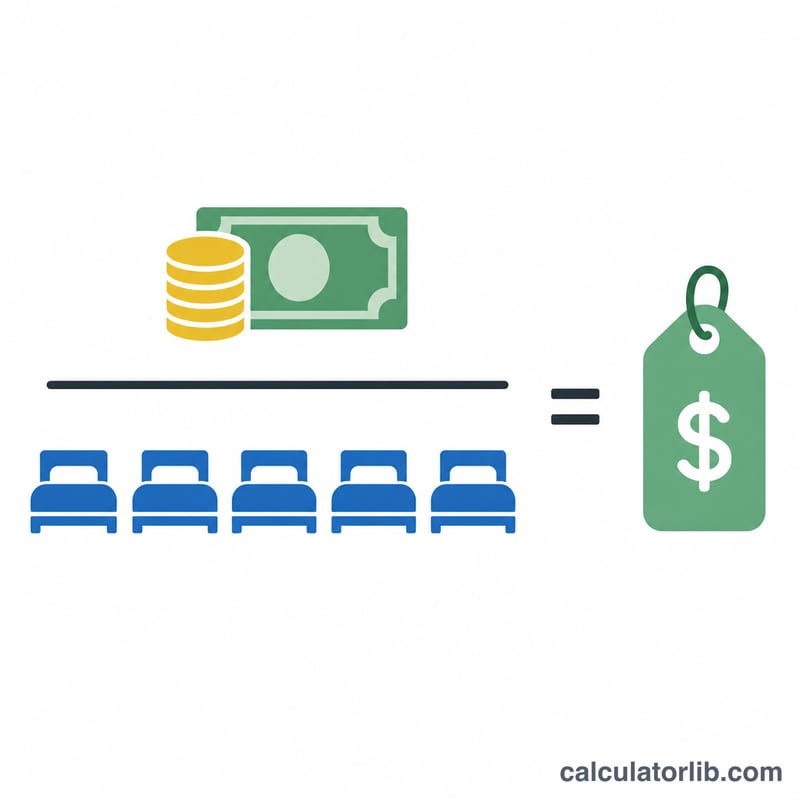
The equation is simply:
$$\text{ADR} = \dfrac{\text{Total Room Revenue}}{\text{Rooms Sold}}$$
Only room revenue belongs in the numerator. Only rooms that were actually paid for and occupied belong in the denominator — vacant rooms and free upgrades are excluded. This is what separates ADR from RevPAR (Revenue Per Available Room), which divides by all available rooms whether sold or not.
Worked Example
Suppose a hotel earned $25,000 in room revenue last night and sold 200 rooms. $$\text{ADR} = \frac{25{,}000}{200} = \$125.00$$ per occupied room. If revenue rises to $30,000 on the same 200 rooms, ADR climbs to $150.00, signaling stronger pricing.
Definitions & Glossary
- Average Daily Rate (ADR)
- The average revenue earned per occupied (paid) room over a given period. Calculated as total room revenue divided by rooms sold: \(\text{ADR} = \dfrac{\text{Room Revenue}}{\text{Rooms Sold}}\). It measures realized pricing, not the rack (list) rate.
- RevPAR (Revenue Per Available Room)
- Total room revenue divided by the number of rooms available, or equivalently \(\text{ADR} \times \text{Occupancy Rate}\). Unlike ADR, it accounts for unsold inventory.
- Occupancy Rate
- The percentage of available rooms that were sold: \(\text{Occupancy} = \dfrac{\text{Rooms Sold}}{\text{Rooms Available}} \times 100\%\).
- Room Revenue
- Total revenue generated from room sales only, before adding ancillary revenue such as food, beverage, parking, or spa. This is the numerator in the ADR formula.
- Rooms Sold
- The number of paid, occupied room-nights in the period. Complimentary and house-use rooms are normally excluded so they do not artificially deflate ADR.
- Rooms Available
- The total room-nights a property could sell in the period — typically physical room count multiplied by the number of nights, less any rooms out of order.
- GOPPAR (Gross Operating Profit Per Available Room)
- Gross operating profit divided by available rooms. It extends beyond revenue metrics to reflect profitability after operating expenses.
- Complimentary Rooms
- Rooms provided free of charge (e.g., promotions, loyalty redemptions, staff or owner use). They are excluded from rooms sold and room revenue in the standard ADR calculation.
ADR Across Different Scenarios
ADR rises when revenue grows faster than rooms sold. The scenarios below hold revenue and volume independent so you can see how pricing power and booking volume each move the metric.
| Scenario | Room Revenue | Rooms Sold | ADR |
|---|---|---|---|
| Baseline | $25,000 | 200 | $125.00 |
| Higher rate, same volume | $30,000 | 200 | $150.00 |
| Same revenue, fewer rooms sold | $25,000 | 150 | $166.67 |
| More revenue and volume | $40,000 | 250 | $160.00 |
Notice that selling fewer rooms for the same total revenue ($25,000 / 150) yields a higher ADR than the baseline — a reminder that a strong ADR can coincide with weak occupancy. Pair ADR with occupancy or RevPAR to see the full picture.
Interpreting Your ADR Result
An ADR is most meaningful in context. Compare it three ways:
- Against your competitive set (comp set): Benchmark your ADR against similar hotels in your market and class. An ADR above the comp set average suggests pricing strength; below it may signal discounting or weaker demand.
- Against your own historical trend: Track ADR over time (year-over-year, season-over-season) to separate genuine rate gains from inflation or seasonal swings.
- Alongside occupancy: A high ADR with low occupancy is not automatically better than a moderate ADR with high occupancy.
The key relationship that ties pricing and volume together is:
$$\text{RevPAR} = \text{ADR} \times \text{Occupancy Rate}$$For example, an ADR of $150 at 80% occupancy produces a RevPAR of $120.00. Because RevPAR incorporates unsold inventory, it often guides revenue decisions more reliably than ADR alone.
Remember what ADR leaves out. It says nothing about how full the hotel is — two properties can share an identical ADR while one sits half empty. It also excludes ancillary revenue (food and beverage, parking, resort fees, spa), so a property optimizing total revenue per guest may accept a slightly lower ADR. For a complete view, read ADR together with occupancy, RevPAR, and ultimately profit-based metrics such as GOPPAR.
FAQ
Is ADR the same as RevPAR? No. ADR uses rooms sold; RevPAR uses rooms available, so RevPAR also captures occupancy.
Should I include taxes or resort fees? Most operators report ADR on net room revenue, excluding taxes. Keep your inputs consistent across periods.
What is a good ADR? It depends entirely on location, brand, and season — compare ADR against your own historical trend and a competitive set rather than a universal benchmark.