
What This Calculator Does
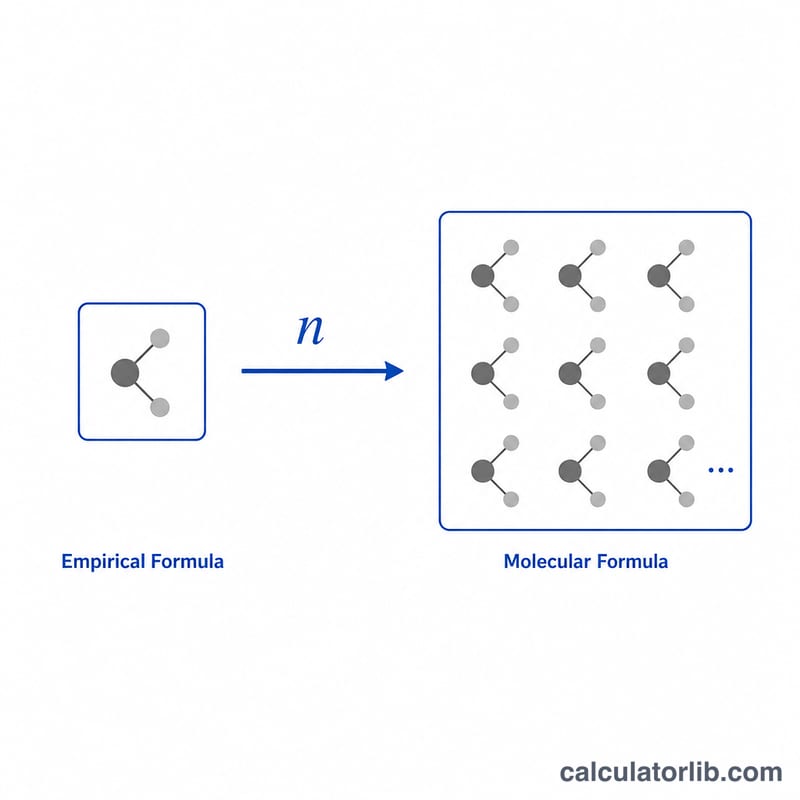
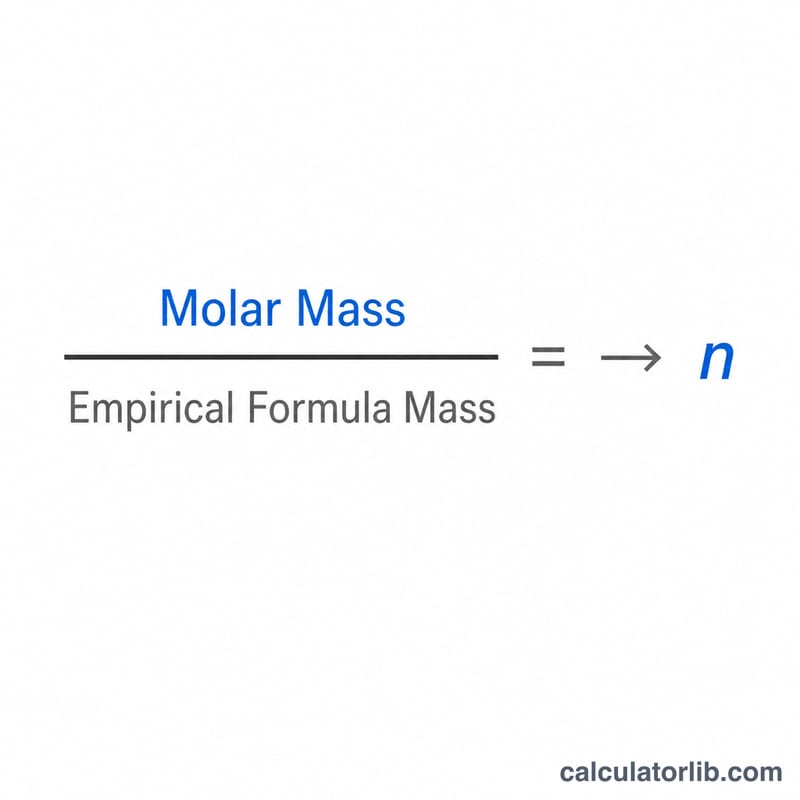
An empirical formula gives the simplest whole-number ratio of atoms in a compound, while the molecular formula gives the actual number of atoms in one molecule. The molecular formula is always a whole-number multiple of the empirical formula. This calculator finds that multiple, n, so you can scale the empirical formula up to the true molecular formula.
How to Use It
Enter two values: the empirical formula mass (the molar mass of the simplest-ratio formula unit) and the actual molar mass of the compound (often found from experiment, such as freezing-point depression or mass spectrometry). The tool divides the molar mass by the empirical mass and rounds to the nearest whole number to give n. Multiply each subscript in your empirical formula by n to write the molecular formula.
The Formula Explained
The core relationship is $$n = \frac{\text{Molecular Molar Mass}}{\text{Empirical Formula Mass}}$$ Because both quantities describe the same kind of "building block," their ratio is theoretically an exact integer. Small rounding in measured masses can produce values like 5.98 or 6.02, so the result is rounded to the nearest whole number: $$n = \frac{\text{Molecular Molar Mass}}{\text{Empirical Formula Mass}} \;\approx\; \text{round}(n)$$ The molecular formula is then (empirical formula) raised to that multiple.
Worked Example
Glucose has the empirical formula CH2O with an empirical mass of about 30.026 g/mol. Its measured molar mass is 180.156 g/mol. Then \(n = 180.156 \div 30.026 \approx 6.0\). Multiplying CH2O by 6 gives the molecular formula C6H12O6.
FAQ
Why isn't n a perfect integer? Experimental molar masses carry uncertainty, so the raw ratio may be slightly off; rounding to the nearest whole number gives the correct multiple.
What if n rounds to 1? Then the empirical and molecular formulas are identical — the simplest ratio is already the true formula (e.g. water, H2O).
Where do I get the empirical formula mass? Add up the atomic masses of the atoms in your empirical formula, or compute it from percent-composition data first.