
What Is the Valence Electrons Calculator?
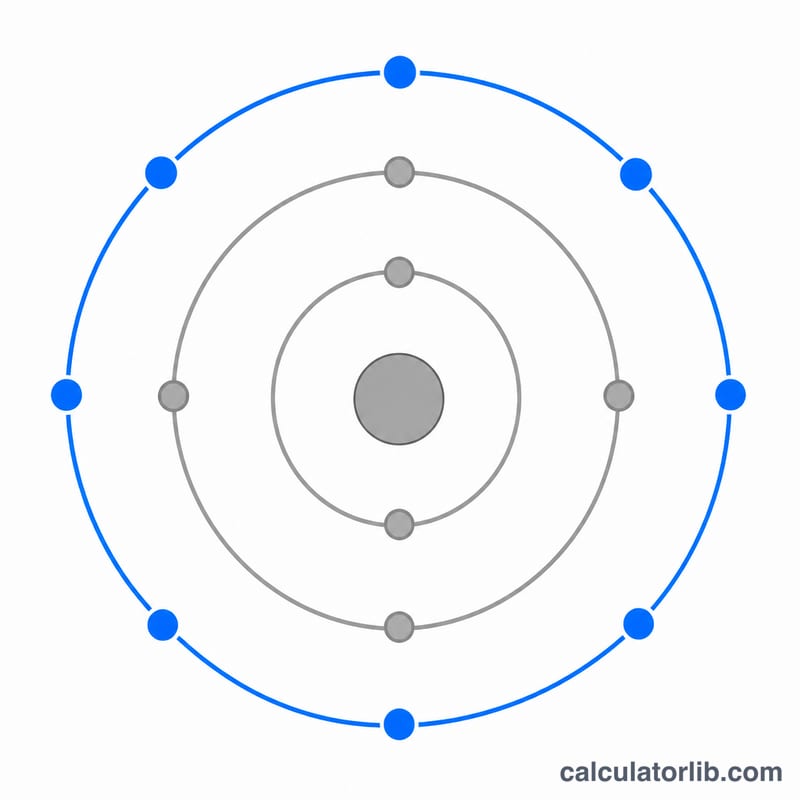
Valence electrons are the electrons in the outermost shell of an atom — the ones involved in chemical bonding and reactivity. This calculator takes the atomic number (Z) of a neutral atom, builds its electron configuration using the Aufbau filling order, and counts the electrons in the s and p subshells of the highest principal quantum number (n). This main-group convention gives 1–8 valence electrons and matches the periodic-table group rule for representative elements.
How to Use It
Enter the atomic number Z (1 to 118) of the element. The tool returns the valence electron count along with the highest occupied shell level n. For example, oxygen has Z = 8, configuration 1s² 2s² 2p⁴, and its highest shell (\(n = 2\)) holds \(2 + 4 = 6\) valence electrons.
The Formula Explained
Electrons fill subshells in order of increasing energy: 1s, 2s, 2p, 3s, 3p, 4s, 3d, 4p, and so on. After filling, we identify the largest principal quantum number n that contains electrons and add the s and p electrons of that level:
$$\text{Valence Electrons} = \left( n_{\max}s + n_{\max}p \right)\Big|_{\,Z\,=\,\text{Atomic Number}}$$
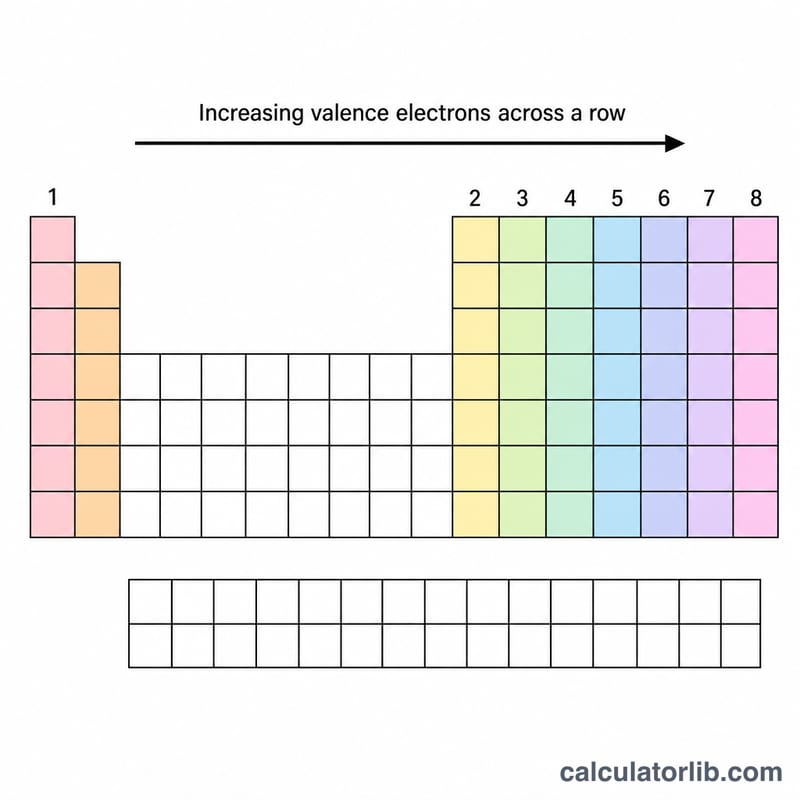
This deliberately excludes inner d and f electrons, so it gives the familiar group-based count for main-group elements (e.g., 1 for Group 1, 7 for Group 17).
Worked Example
Chlorine, Z = 17: configuration 1s² 2s² 2p⁶ 3s² 3p⁵. Highest shell is \(n = 3\), containing 3s² and 3p⁵ → $$2 + 5 = 7$$ valence electrons, consistent with Group 17.
FAQ
Why don't d-block electrons count here? For main-group chemistry, valence electrons are conventionally the outermost s and p electrons. Transition metals have variable valence; this tool reports the simple shell-based count.
What about noble gases? They show 8 valence electrons (helium is the exception with 2), reflecting their full outer shell.
Does it work for ions? No — it assumes a neutral atom with Z electrons. Adjust manually for charged species.