
What is the Battery Capacity Calculator?
This tool converts a battery's rated capacity in milliamp-hours (mAh) into its energy capacity in watt-hours (Wh). While mAh tells you how much charge a battery holds, Wh tells you how much actual energy it stores — which is the fairer way to compare batteries that run at different voltages. The calculator also reports amp-hours (Ah) and kilowatt-hours (kWh).
How to use it
Enter the battery's capacity in mAh (printed on most cells and power banks) and its nominal voltage in volts. A single lithium-ion cell is typically 3.7 V, a USB power bank cell is also 3.7 V internally, and AA NiMH cells are about 1.2 V. Press calculate to see the energy in watt-hours.
The formula explained
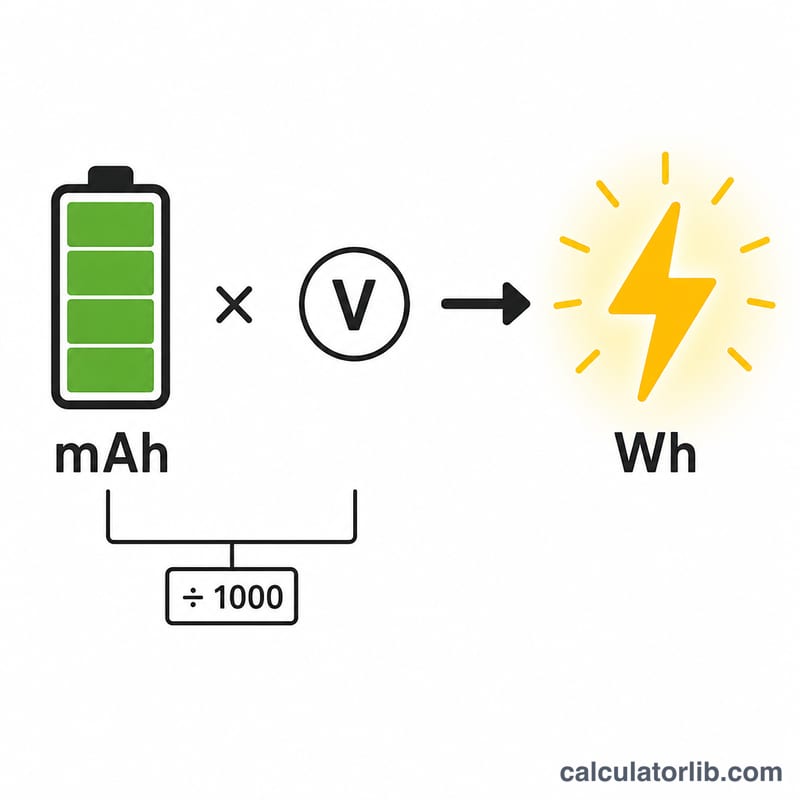
The conversion is simple: $$\text{Wh} = \frac{\text{mAh}}{1000} \times \text{V}$$ Dividing mAh by 1000 converts milliamp-hours to amp-hours, and multiplying by the voltage converts charge into energy. This works because energy (watt-hours) equals charge (amp-hours) times potential difference (volts).
Worked example
A power bank rated 10,000 mAh contains 3.7 V cells. Energy $$= \frac{10{,}000}{1000} \times 3.7 = 10 \times 3.7 = \textbf{37 Wh}$$ Note this is the internal energy; the usable output at 5 V USB will be lower due to conversion losses.
Nominal Voltages of Common Battery Types
To convert a capacity in milliamp-hours (mAh) to energy in watt-hours (Wh) you must multiply by the battery's nominal voltage — the average voltage delivered over a discharge. The label on a cell or pack usually quotes this nominal value. Common figures are listed below.
| Battery / cell type | Chemistry | Nominal voltage |
|---|---|---|
| Li-ion (single cell) | Lithium-ion | 3.7 V |
| Li-po (lithium polymer) | Lithium-ion polymer | 3.7 V |
| 18650 / 21700 cell | Lithium-ion | 3.6–3.7 V |
| LiFePO4 (single cell) | Lithium iron phosphate | 3.2 V |
| NiMH / NiCd (e.g. AA, AAA) | Nickel-metal hydride / nickel-cadmium | 1.2 V |
| Alkaline AA / AAA | Alkaline (zinc-manganese) | 1.5 V |
| Lead-acid (per cell) | Lead-acid | 2.0 V |
| Lead-acid car/SLA pack | Lead-acid (6 cells) | 12 V |
For multi-cell packs, multiply the single-cell nominal voltage by the number of cells in series. For example, a 3-series (3S) Li-ion pack is \(3 \times 3.7 = 11.1\) V, and a 12 V lead-acid battery is \(6 \times 2.0 = 12\) V.
FAQ
Why is my power bank's usable mAh lower than its rating? Power banks are rated at the cell's 3.7 V, but output at 5 V, so usable charge appears roughly 60–70% of the printed number after conversion losses.
What voltage should I use? Use the battery's nominal voltage: 3.7 V for most lithium-ion, 1.2 V for NiMH, 1.5 V for alkaline AA/AAA.
Is Wh the same as kWh? No — \(1 \text{ kWh} = 1000 \text{ Wh}\). The calculator shows both for convenience.