
What Is the Battery Life Calculator?
This tool estimates how long a battery will power a device. It uses the battery's rated capacity in milliamp-hours (mAh), the average current the device draws in milliamps (mA), and an efficiency factor that accounts for real-world losses such as voltage conversion, heat, and the fact that batteries rarely deliver 100% of their rated capacity.
How to Use It
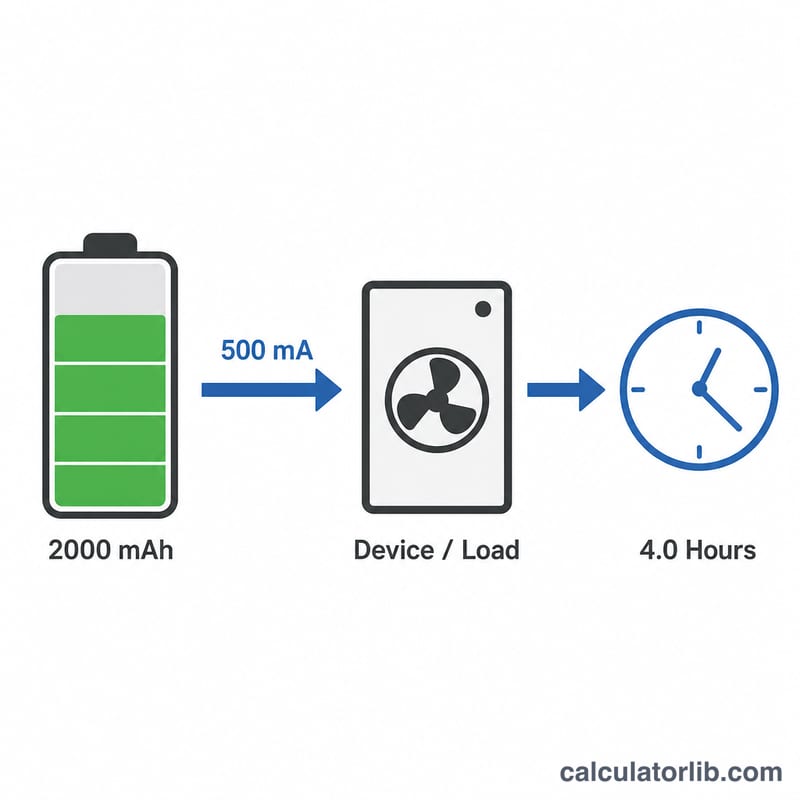
Enter your battery's capacity (printed on the cell or its datasheet), the device's average load current, and an efficiency percentage. If you are unsure of efficiency, 80–90% is a sensible real-world default; use 100% for a theoretical best case. The result shows runtime in hours, a friendly hours-and-minutes breakdown, and the equivalent in days.
The Formula Explained
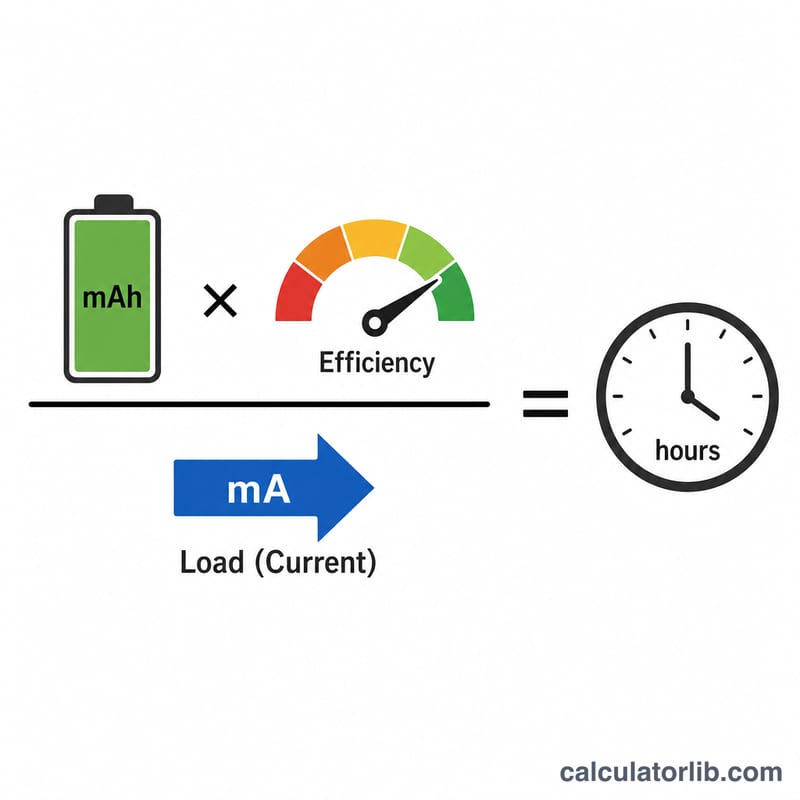
The core relationship is $$\text{Battery Life (h)} = \frac{\text{Capacity (mAh)} \times \dfrac{\text{Efficiency (\%)}}{100}}{\text{Load (mA)}}$$. Because capacity is in mAh and load is in mA, the milliamps cancel to leave hours. The efficiency term (entered as a percentage and converted to a decimal) scales the usable capacity down to a realistic figure.
Worked Example
A 2000 mAh battery powers a device drawing 150 mA at 85% efficiency: $$(2000 \times 0.85) \div 150 = 1700 \div 150 \approx 11.33 \text{ hours}$$ or about 11 h 20 min — roughly 0.47 days.
Typical Battery Capacities & Device Loads
To estimate runtime you need two numbers: the battery capacity (in mAh) and the device load current (in mA). The tables below list common real-world values you can drop straight into the calculator. Note that capacity ratings assume a specific discharge rate and voltage, so treat them as nominal figures.
Common battery capacities
| Battery type | Nominal voltage | Typical capacity (mAh) |
|---|---|---|
| AAA (alkaline / NiMH) | 1.5 / 1.2 V | ~1000 |
| AA (alkaline / NiMH) | 1.5 / 1.2 V | ~2000–3000 |
| 18650 Li-ion cell | 3.7 V | ~2500–3500 |
| Smartphone battery | 3.7–3.85 V | ~3000–5000 |
| USB power bank | 3.7 V (cell rating) | ~10000–20000 |
Typical device load currents
| Device / component | Typical load (mA) |
|---|---|
| Single indicator LED | ~20 |
| Low-power microcontroller (e.g. AVR/ARM) | ~5–50 |
| GPS receiver module | ~50 |
| ESP32 (Wi-Fi active) | ~150–250 |
| Smartphone (screen off / idle) | ~10–50 |
| Smartphone (screen on / active use) | ~300–800 |
For example, a 3000 mAh AA-equipped device drawing a steady 20 mA LED load at 90% efficiency would last 135 hours.
Choosing a Realistic Efficiency Factor
The efficiency factor accounts for energy that never reaches your load — conversion losses, internal resistance, self-discharge, and the fact that you rarely drain a cell to absolute zero. Picking a realistic value keeps your runtime estimate honest. Use the guide below.
| Efficiency | When it applies | Cause of loss |
|---|---|---|
| 100% | Theoretical upper bound only | Ignores all real-world losses; use for quick best-case math |
| 90–95% | Direct battery use, low/moderate current | Minor internal resistance and wiring losses; battery feeds load at its native voltage |
| 80–90% | With a voltage regulator or DC-DC converter | Conversion losses (LDO drops voltage as heat; switching regulators are ~85–95% efficient) |
| 70–80% | High discharge rate or cold temperatures | Peukert effect reduces usable capacity at high current; chemistry slows in the cold; voltage sags below cutoff sooner |
For most battery-powered electronics running through a regulator at room temperature, 85% is a sensible default. Drop toward 75% for power banks driving USB devices (the boost converter to 5 V plus cable losses adds up) or for any project operating outdoors in winter. Reserve 90–95% for circuits powered directly off the cell with light, steady loads.
FAQ
Why use an efficiency factor? No battery delivers its full rated capacity. Temperature, discharge rate, and conversion losses reduce usable energy, so an 80–90% factor gives a more honest estimate.
What if my device current varies? Use the average current over a typical duty cycle. For devices that sleep most of the time, average the active and idle currents weighted by how long each lasts.
Can I use watt-hours instead? This calculator works in mAh and mA. If you only have Wh, convert capacity to mAh by dividing watt-hours by the battery voltage, then multiplying by 1000.