
What is the Battery Charge Time Calculator?
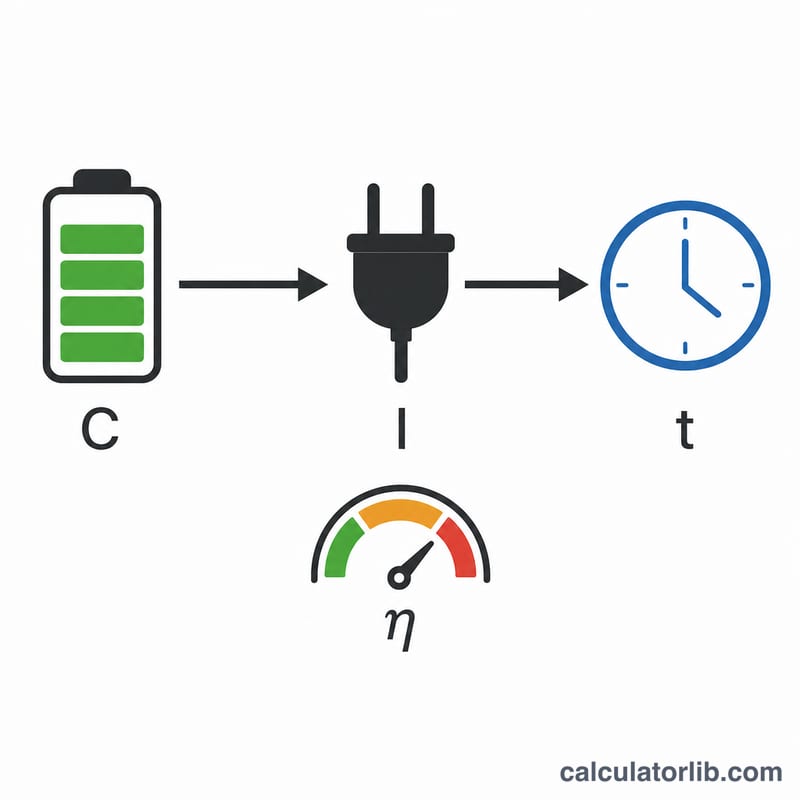
This tool estimates how long it will take to recharge a battery based on three inputs: the battery capacity in amp-hours (Ah), the charging current in amps (A), and the charging efficiency as a percentage. It works for lead-acid, lithium, AGM, and most rechargeable battery chemistries when you know the charger output current.
How to use it
Enter your battery's rated capacity in Ah (for example a 100Ah deep-cycle battery), the charge current your charger delivers in amps, and an efficiency figure. Lithium batteries are typically 95-99% efficient, while lead-acid is closer to 80-85% because some energy is lost as heat and gassing. Press calculate to see the time in decimal hours plus an hours-and-minutes breakdown.
The formula explained
The ideal charge time is simply capacity divided by current: a 100Ah battery charged at 10A would take 10 hours. But no charger is 100% efficient, so we divide by the efficiency factor (\(\eta\), expressed as a decimal). The full equation is $$t = \frac{\text{Capacity (Ah)}}{\text{Current (A)} \times \dfrac{\text{Efficiency (\%)}}{100}}$$ A lower efficiency means a longer real-world charge time.
Worked example
Suppose you have a 100Ah battery, a 10A charger, and 85% efficiency. First, \(100 / 10 = 10\) hours ideal. Then \(10 / 0.85 \approx 11.76\) hours, or about 11 hours 46 minutes of actual charging.
Practical Charging Tips
Use the calculated time as a planning estimate, then apply these practical rules to stay safe and avoid surprises:
- Match the current to the battery's C-rate. Flooded and AGM lead-acid batteries are usually happiest at about 0.1–0.2C (so 10–20 A for a 100 Ah bank), while many lithium (LiFePO4) batteries accept 0.5–1C. Charging much faster than recommended causes heat, gassing, and shortened life.
- Never exceed the manufacturer's maximum charge current. The datasheet figure takes priority over any rule of thumb. If in doubt, charge slower.
- Add buffer time for the final stages. The formula covers the bulk (constant-current) phase. Lead-acid batteries then need an absorption and float stage that can add several hours; lithium has a shorter constant-voltage taper. Plan for extra time beyond the calculated value.
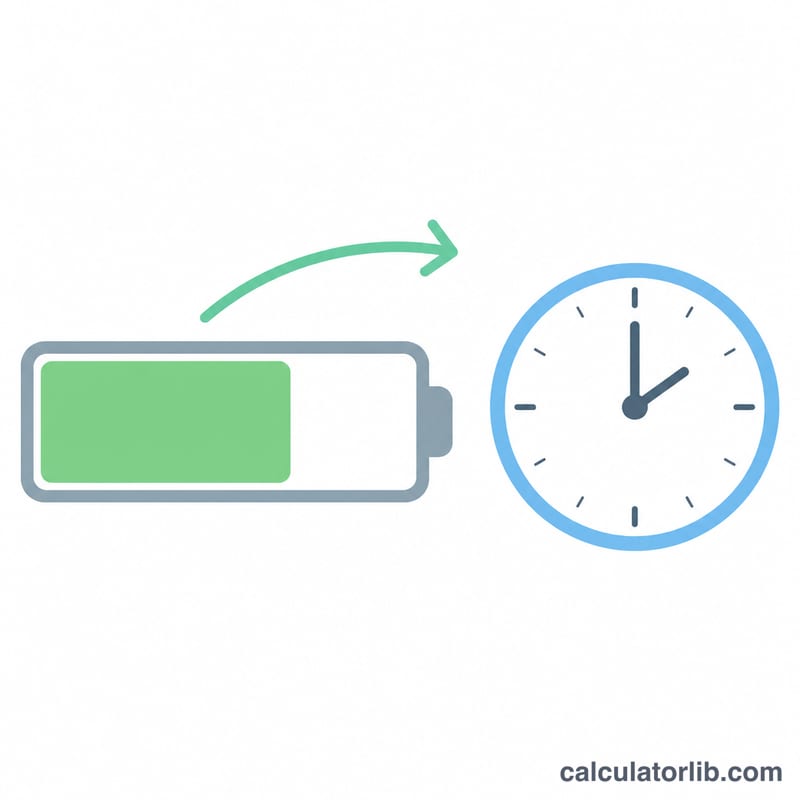
- The result assumes you start from empty. For a partial charge, multiply the time by the fraction of capacity you actually need to replace — e.g. charging from 50% to full takes roughly half the time of a full-from-empty charge.
- Account for real efficiency. Pick the efficiency value for your chemistry (see the table above) so the estimate reflects the current actually wasted as heat.
This is general guidance only — always follow the specific charging instructions and limits supplied by your battery and charger manufacturer.
FAQ
Does this account for the battery's current charge level? No — it assumes you are charging from empty (0%) to full. For a partial charge, multiply the result by the fraction of capacity you need to replace.
What efficiency should I use? Use 95-99% for lithium (LiFePO4), 80-85% for lead-acid/AGM, and check your charger specs if available.
Why not just divide capacity by current? That gives the theoretical minimum. Real chargers waste energy, so dividing by efficiency gives a more realistic estimate.