
What is the Headphone Power Calculator?
This tool estimates how loud a pair of headphones will get from a given amplifier, and how much electrical power and current the amp must supply. It combines Ohm's law with the headphone's sensitivity rating to predict the maximum sound pressure level (SPL) in decibels. It's a quick way to check whether an amplifier or DAC can comfortably drive your headphones before you buy.
How to use it
Enter three values: the amplifier's maximum output voltage (V RMS) into your headphone's impedance, the headphone impedance in ohms, and the sensitivity quoted in dB SPL per milliwatt. The calculator returns the power delivered (in mW and W), the current drawn (mA), and the resulting maximum SPL. Many manufacturers quote sensitivity per mW; if yours is quoted per volt, the per-mW figure is more conservative for power-limited amps.
The formula explained
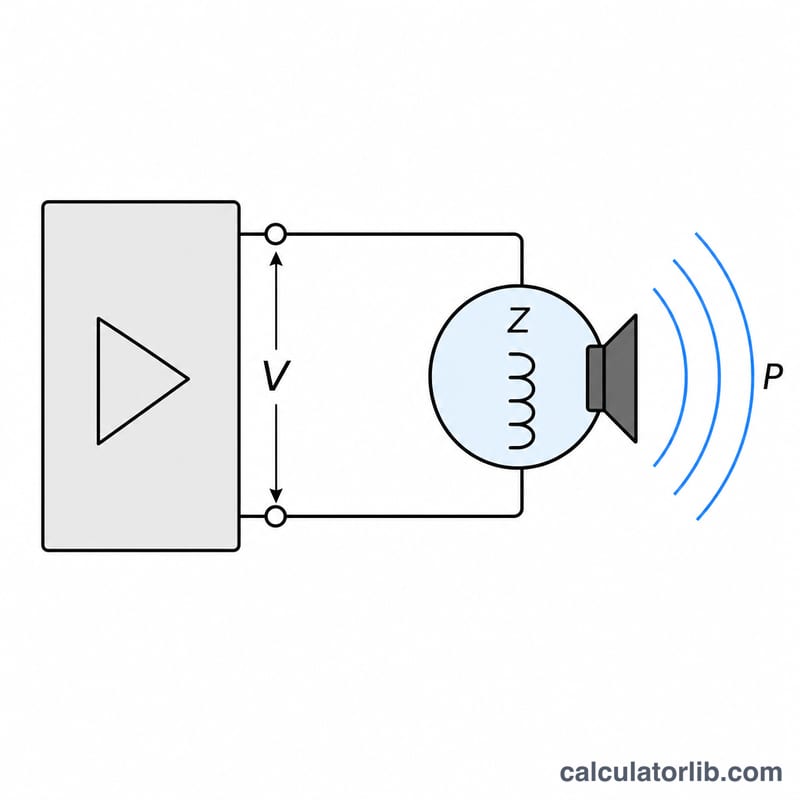
Power follows from Ohm's law: with voltage \(V\) across an impedance \(Z\), the power is \(P = V^2 / Z\). Converting that to milliwatts and feeding it into the sensitivity equation gives
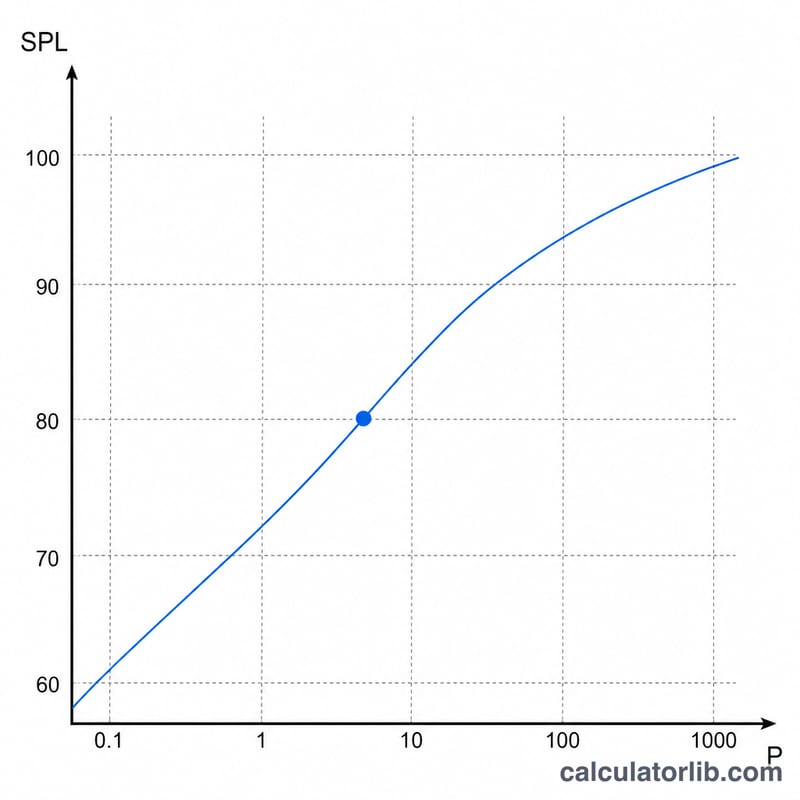
$$\text{SPL} = S + 10\cdot\log_{10}(P_{mW})$$Each time power increases tenfold, SPL rises by 10 dB; each doubling of power adds about 3 dB.
Worked example
Suppose an amp outputs 1 V RMS into a 32 \(\Omega\) headphone with 100 dB/mW sensitivity. Power =
$$P = \frac{1^2}{32} = 0.03125\ \text{W} = 31.25\ \text{mW}$$SPL =
$$\text{SPL} = 100 + 10\cdot\log_{10}(31.25) = 100 + 14.95 = 114.95\ \text{dB SPL}$$Current =
$$I = \frac{1}{32} = 31.25\ \text{mA}$$That is plenty loud — sustained levels above 85 dB risk hearing damage, so this combination has ample headroom.
FAQ
What SPL is safe? Brief peaks of 110+ dB are fine for headroom, but average listening should stay near 70–80 dB to protect hearing.
Why does my amp seem underpowered? High-impedance (250–600 \(\Omega\)) or low-sensitivity headphones need more voltage to reach the same SPL. Increase the output voltage in the calculator to see the effect.
Is per-mW or per-V sensitivity better? Both describe the same driver; per-mW is handy for power calculations, while per-V suits voltage-limited sources. Use whichever your spec sheet provides.