
What Is the Well Volume Calculator?
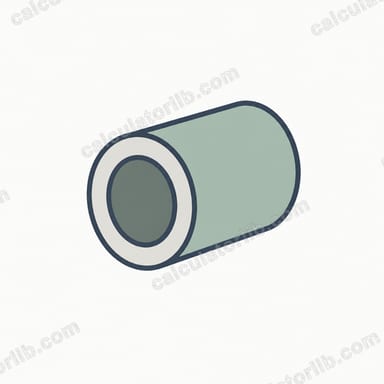
This calculator estimates how much water is currently stored in a well by treating the water column as a cylinder. Using the well's inside diameter and the depth of standing water, it returns the volume in both US gallons and cubic feet. Knowing your well volume is useful for shock chlorination (disinfection), estimating yield, sizing a pump, or planning maintenance.
How to Use It
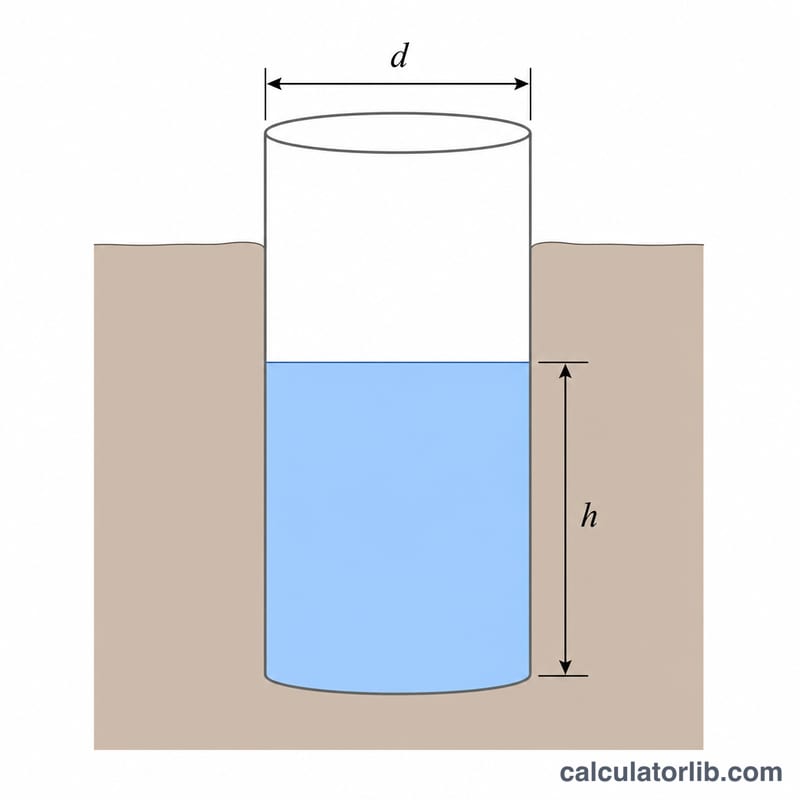
Enter the well's inside diameter in inches (a typical drilled residential well is 6 inches). Then enter the depth of water in feet — this is the height of the standing water column, not the total well depth. The calculator converts the diameter to feet, applies the cylinder volume formula, and converts the result to gallons.
The Formula Explained
The water in a well forms a vertical cylinder, so volume equals the cross-sectional area times the water depth:
$$V = \pi \times \left(\frac{d}{2}\right)^{2} \times h$$
Here \(d\) is the diameter and \(h\) is the water depth. To get gallons, the cubic-foot result is multiplied by \(7.4805\) (the number of US gallons in one cubic foot).
Worked Example
For a 6-inch (0.5 ft) diameter well with 100 ft of water: radius = 0.25 ft, area = \(\pi \times 0.25^{2} = 0.19635 \text{ ft}^{2}\), volume = \(0.19635 \times 100 = 19.635 \text{ ft}^{3}\). Converting:
$$19.635 \times 7.4805 \approx 146.88 \text{ gallons}$$
FAQ
Is this total well depth or water depth? Use the depth of standing water only. The total drilled depth may be greater than the water column.
What diameter should I use? Use the inside (casing) diameter. Common drilled wells are 4–6 inches; dug wells can be 24–36 inches or more.
Why gallons per foot matters? A 6-inch well holds about 1.47 gallons per foot of water — handy for quick mental estimates.