

What is the Shannon Channel Capacity Calculator?
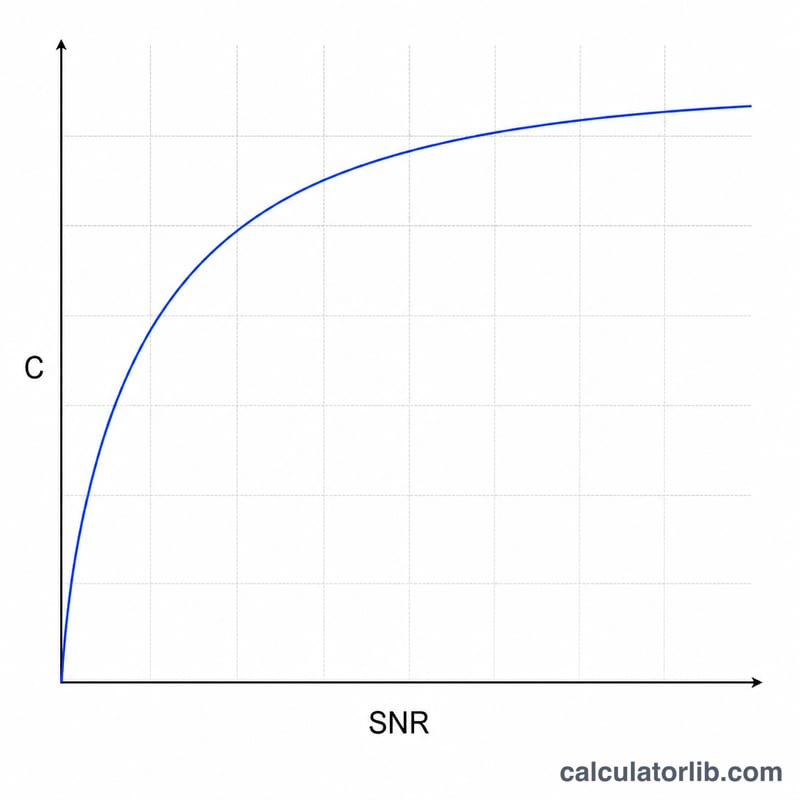
This tool computes the theoretical maximum data rate that can be transmitted error-free over a communication channel using the Shannon-Hartley theorem. The result, called the channel capacity \(C\), is expressed in bits per second (bps) and depends on the channel's bandwidth and the signal-to-noise ratio (SNR). It is a universal result from information theory and applies to any noisy analog channel — telephone lines, Wi-Fi, fiber, cellular and more.

How to use it
Enter the channel bandwidth \(B\) in hertz (Hz) and the signal-to-noise ratio in decibels (dB). The calculator converts the dB value to a linear ratio, applies the Shannon formula, and reports the capacity in bps, kbps and Mbps, plus the spectral efficiency in bits/s/Hz.
The formula explained
The capacity is $$C = \text{B} \cdot \log_{2}\!\left(1 + 10^{\frac{\text{SNR (dB)}}{10}}\right)$$ where \(B\) is bandwidth in Hz and \(S/N\) is the linear signal-to-noise power ratio. Because SNR is usually quoted in decibels, we first convert it: \(S/N = 10^{(\text{SNR}_{dB} / 10)}\). The log base 2 turns the power ratio into bits. Note this is an upper bound — real systems with coding and modulation overhead achieve somewhat less.
Worked example
A classic telephone line has \(B = 3000\) Hz and an SNR of 30 dB. First, 30 dB → \(10^{(30/10)} = 10^3 = 1000\) (linear). Then $$C = 3000 \cdot \log_{2}(1 + 1000) = 3000 \cdot \log_{2}(1001) \approx 3000 \cdot 9.9672 \approx 29{,}902 \text{ bps}$$ or about 29.9 kbps. This is why old dial-up modems topped out near 33–56 kbps.
FAQ
Is this an achievable speed? No — it is the theoretical maximum. Practical links reach a fraction of it depending on coding, modulation and implementation losses.
Why convert dB to linear? The Shannon formula uses a linear power ratio \(S/N\), while engineers usually specify SNR in decibels, so conversion is required first.
What is spectral efficiency? It is capacity divided by bandwidth (bits/s/Hz) and tells you how many bits each hertz of bandwidth carries.