
What Is the mAh to Wh Calculator?
Battery capacity is often printed in milliamp-hours (mAh), but airlines, shipping rules, and energy comparisons use watt-hours (Wh). This calculator converts mAh to Wh using the battery's nominal voltage, giving you the true energy capacity of any cell or pack. It works for phone batteries, power banks, laptop packs, drone LiPos, and rechargeable AA/AAA cells.
How to Use It
Enter the battery's capacity in mAh (for example 3000) and its nominal voltage in volts (3.7 V for most single-cell lithium-ion batteries). Press calculate to see the energy in watt-hours and kilowatt-hours. For multi-cell packs, use the pack's total nominal voltage (e.g. a 3S LiPo is about 11.1 V).
The Formula Explained
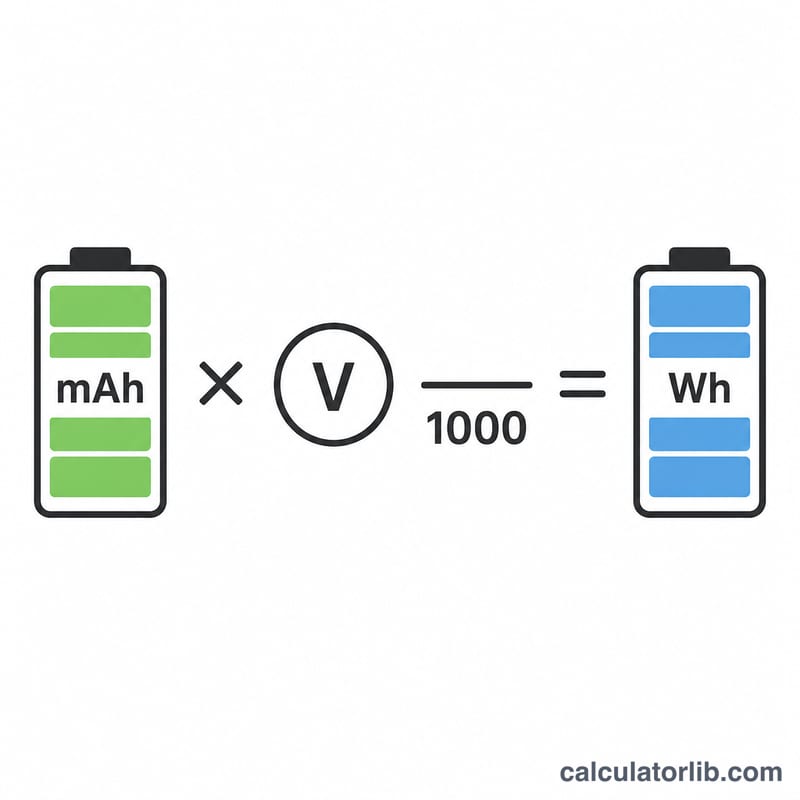
The conversion is $$\text{Wh} = \dfrac{\text{mAh} \times \text{V}}{1000}$$. Multiplying mAh by voltage gives milliwatt-hours (mWh); dividing by 1000 converts to watt-hours. The division by 1000 simply rescales milli- units to base units, the same way 1000 milliamps equal one amp.
Worked Example
A typical power bank rated 10,000 mAh at 3.7 V holds: $$10{,}000 \times 3.7 \div 1000 = \textbf{37 Wh}$$ That is below the 100 Wh airline carry-on limit, so it can travel in cabin baggage. In kilowatt-hours that is \(0.037\) kWh.
Common Nominal Voltages by Battery Chemistry
To convert milliamp-hours (mAh) to watt-hours (Wh) you need the battery's nominal voltage. Manufacturers print the nominal (average) voltage rather than the fully charged or fully discharged voltage, and this is the value used in the formula \(\text{Wh} = \frac{\text{mAh} \times V}{1000}\). The table below lists widely-published nominal voltages by chemistry and for common lithium-polymer (LiPo) cell counts.
| Battery type | Nominal voltage | Notes |
|---|---|---|
| Lithium-ion (Li-ion) | 3.7 V | Per cell; some cells rated 3.6 V or 3.85 V |
| Lithium iron phosphate (LiFePO4) | 3.2 V | Per cell; flatter discharge curve |
| Nickel-metal hydride (NiMH) | 1.2 V | Per cell (AA, AAA rechargeables) |
| Nickel-cadmium (NiCd) | 1.2 V | Per cell |
| Alkaline (non-rechargeable) | 1.5 V | Per cell (AA, AAA, C, D, 9V uses six cells) |
| Lead-acid | 2.0 V / cell | 12 V pack = six cells |
| 2S LiPo | 7.4 V | 2 × 3.7 V in series |
| 3S LiPo | 11.1 V | 3 × 3.7 V in series |
| 4S LiPo | 14.8 V | 4 × 3.7 V in series |
| 6S LiPo | 22.2 V | 6 × 3.7 V in series |
mAh to Wh for Common Batteries
The examples below apply \(\text{Wh} = \frac{\text{mAh} \times V}{1000}\) to everyday batteries. The final column flags whether the pack falls under the 100 Wh threshold that most airlines allow in carry-on baggage without special approval.
| Battery | Capacity (mAh) | Voltage (V) | Watt-hours (Wh) | Under 100 Wh airline limit? |
|---|---|---|---|---|
| Smartphone | 5000 | 3.7 | 18.5 | Yes |
| Power bank | 10000 | 3.7 | 37.0 | Yes |
| Large power bank | 20000 | 3.7 | 74.0 | Yes |
| Laptop battery | 5000 | 11.1 | 55.5 | Yes |
| AA NiMH cell | 2000 | 1.2 | 2.4 | Yes |
| 3S drone LiPo | 5000 | 11.1 | 55.5 | Yes |
Note that the printed mAh rating on a power bank usually refers to the internal 3.7 V cells. When the same energy is delivered at the 5 V USB output, the usable mAh appears lower because energy (Wh), not charge (mAh), is conserved.
Interpreting Your Wh Result
Watt-hours measure total energy stored, making Wh the most useful figure for comparing batteries of different voltages and for checking transport regulations. The mAh value alone is misleading across chemistries because a 5000 mAh cell at 3.7 V stores far less energy than a 5000 mAh pack at 11.1 V.
Air travel limits (IATA / FAA). Lithium battery rules are based on watt-hours, not mAh:
- Up to 100 Wh — permitted in carry-on baggage without airline approval (covers most phones, power banks and laptops).
- 100–160 Wh — allowed only with airline approval, and passengers are generally limited to a maximum of two spare batteries.
- Over 160 Wh — prohibited as passenger carry-on; must ship as regulated cargo.
Spare lithium batteries and power banks must travel in carry-on baggage, not checked luggage, because of fire-containment rules.
Estimating runtime. Dividing watt-hours by the average power draw of a device gives an approximate run time in hours: \(\text{hours} \approx \frac{\text{Wh}}{\text{load (W)}}\). For example, an 18.5 Wh phone battery powering a 3 W load lasts roughly \(18.5 \div 3 \approx 6.2\) hours before efficiency losses. For a more detailed estimate that accounts for conversion losses, feed the capacity into a dedicated battery life calculator. This is general reference information; always confirm current battery transport rules with your specific airline before flying.
FAQ
Why does voltage matter? mAh alone only measures charge, not energy. Two batteries with the same mAh but different voltages store different amounts of energy, so voltage is required to find Wh.
What voltage should I use? Use the nominal voltage. Single-cell Li-ion is 3.7 V, LiFePO4 is about 3.2 V, and NiMH cells are 1.2 V each.
Is this useful for flying? Yes. Airlines limit lithium batteries to 100 Wh without approval, so converting your mAh rating to Wh tells you if your power bank is allowed.