
What this calculator does
Air purifiers are rated by CADR (Clean Air Delivery Rate), measured in cubic feet per minute (CFM). CADR tells you how much filtered air a unit produces, but shoppers really want to know one thing: how big a room will it actually clean? This tool converts a CADR rating into the maximum floor area the purifier can keep clean at your chosen air-change rate.
How to use it
Enter the device's CADR (use the smoke or dust number if you want a conservative figure), your ceiling height, and a target number of air changes per hour (ACH). Most experts recommend at least 4–5 ACH for allergy, smoke, or wildfire smoke control. The AHAM "2/3 rule" assumes roughly 4.8 ACH at an 8 ft ceiling.
The formula explained
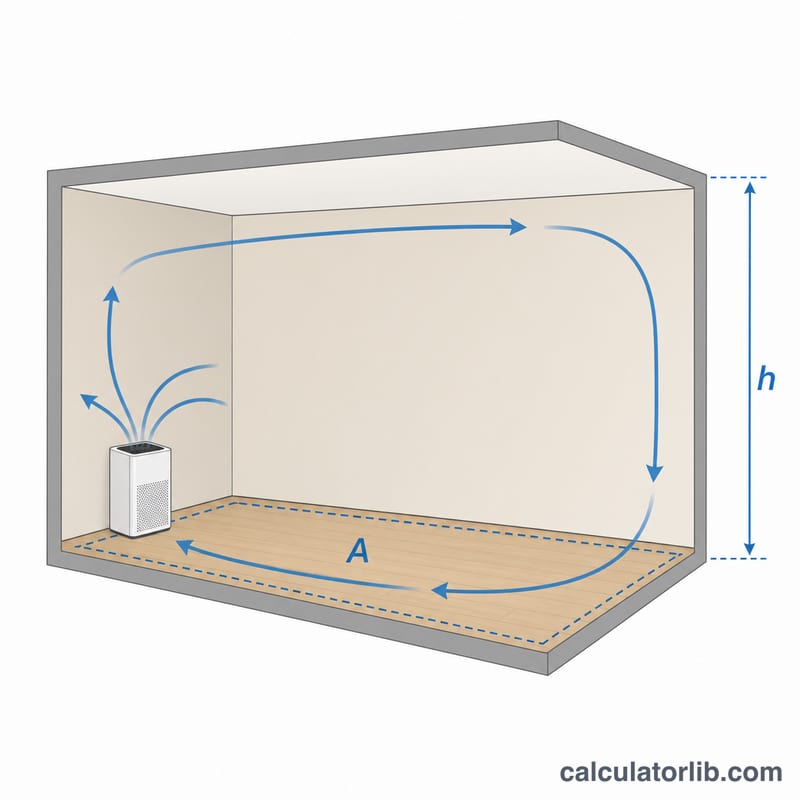
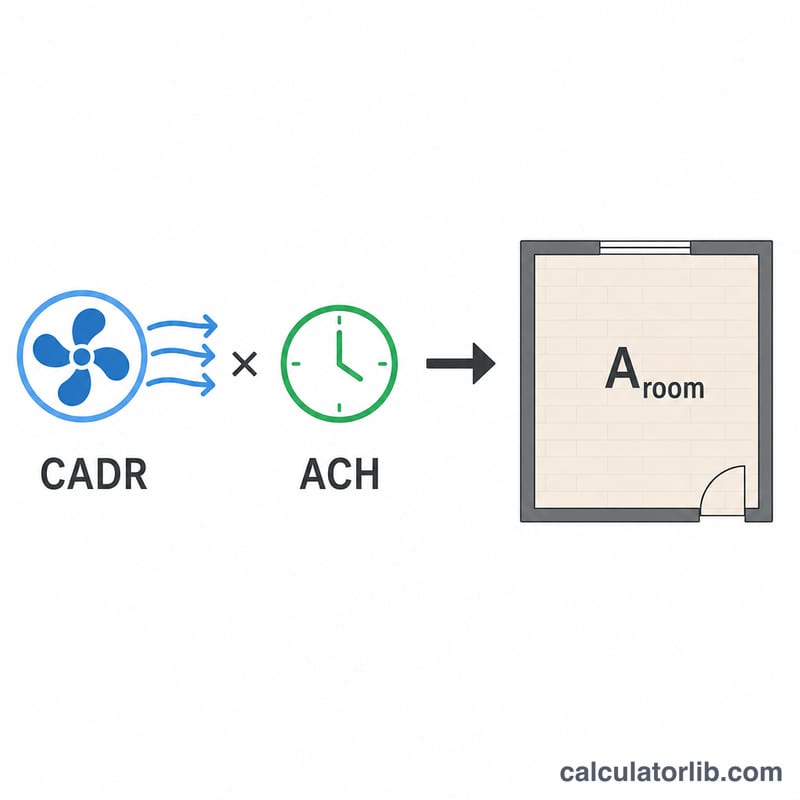
An ACH is one complete replacement of the room's air volume in an hour. CADR is in cubic feet per minute, so we multiply by 60 to get cubic feet per hour. Dividing by your target ACH gives the room volume the purifier can turn over that many times. Dividing by ceiling height converts volume to floor area:
$$\text{Area} = \dfrac{\text{CADR} \times 60}{\text{ACH} \times \text{ceiling height}}$$
With ACH = 4.8 and an 8 ft ceiling, the divisor becomes \(8 \times 4.8 \div 60 = 0.64\), very close to AHAM's famous 0.66 factor.
Worked example
A purifier with a CADR of 250 CFM, an 8 ft ceiling, and a 4.8 ACH target: volume = $$250 \times 60 \div 4.8 = 3{,}125 \text{ ft}^3.$$ Floor area = $$3{,}125 \div 8 \approx 391 \text{ sq ft}.$$ Want a higher 6 ACH? Re-run it and the supported area drops to about 313 sq ft.
Recommended ACH by Room Use
Air changes per hour (ACH) describes how many times the entire air volume of a room is filtered each hour. The required ACH depends on how clean you need the air to be and how aggressive the contaminant source is. Higher ACH means faster, more thorough cleaning — but it also means you need a more powerful purifier (higher CADR) for the same floor area.
| Room use / scenario | Recommended ACH | Notes |
|---|---|---|
| General air quality / odor control | 2–3 ACH | Adequate for routine maintenance in homes without specific sensitivities. |
| Allergies & asthma | 4–5 ACH | Recommended by allergy and clean-air guidance for removing pollen, dander and dust efficiently. |
| Wildfire smoke / heavy smoke | 6–8+ ACH | EPA and public-health guidance for cleaner-air rooms during smoke events; higher is better. |
The Association of Home Appliance Manufacturers (AHAM) bases its suggested room-size ratings on 4.8 ACH. This is why AHAM's "2/3 rule" (CADR should be at least two-thirds of the room's floor area in square feet) and the recommended coverage area on a purifier's box both assume roughly five air changes per hour at an 8-foot ceiling. If you want more than 4.8 ACH — for example during a wildfire — choose a purifier rated for a room larger than yours, or run a higher-CADR unit.
This is general information, not professional medical advice. People with significant respiratory conditions should follow guidance from their healthcare provider.
Key Terms Explained
- CADR (Clean Air Delivery Rate)
- The volume of filtered, contaminant-free air a purifier delivers, measured in cubic feet per minute (CFM). A CADR of 250 means the unit produces 250 cubic feet of clean air every minute. Higher CADR = faster cleaning of a given room.
- CFM (Cubic Feet per Minute)
- The unit of airflow used for CADR. One CFM is one cubic foot of air moved per minute. Multiplying CFM by 60 converts the rate to cubic feet per hour, which is the first step in finding air changes per hour.
- ACH (Air Changes per Hour)
- How many times the entire air volume of a room is replaced (filtered) in one hour. Calculated as clean airflow per hour divided by room volume. Typical targets range from 2 (basic) to 6–8 (smoke).
- AHAM (Association of Home Appliance Manufacturers)
- The industry body that runs the voluntary CADR certification program (AHAM Verifide). Its suggested coverage-area ratings assume 4.8 ACH at an 8-foot ceiling.
- 2/3 Rule
- AHAM's quick sizing guideline: a purifier's smoke CADR should be at least two-thirds of the room's floor area in square feet. For a 200 sq ft room, look for a CADR of roughly 133 or higher.
- Smoke, Dust & Pollen CADR
- AHAM reports three separate CADR numbers for different particle sizes: smoke (smallest particles, ~0.09–1 micron), dust (~0.5–3 micron) and pollen (largest, ~5–11 micron). Smoke CADR is usually the lowest and is the most conservative figure for sizing.
- Floor Area vs. Room Volume
- Floor area (length × width, in square feet) is what purifier ratings advertise. Room volume (floor area × ceiling height, in cubic feet) is what actually determines air changes. Tall ceilings increase volume and lower ACH even when floor area is unchanged — which is why this calculator asks for ceiling height.
FAQ
Which CADR number should I use? CADR is reported for smoke, dust, and pollen. Use the lowest (usually smoke) for the toughest particles.
Is 4.8 ACH enough? It's the AHAM standard for general use. For asthma, allergies, or wildfire smoke aim for 4–6+ ACH and size up.
Does ceiling height matter? Yes — taller ceilings mean more air volume, so a given CADR covers less floor area.