
What this calculator does
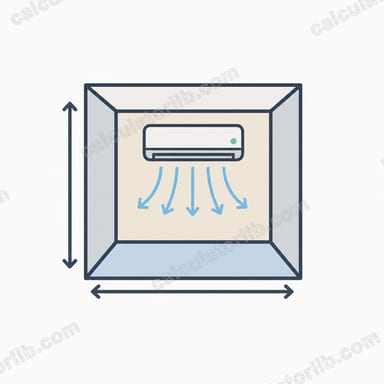
The HVAC BTU Calculator estimates the cooling capacity, measured in BTU per hour, that an air conditioner needs to comfortably cool a single room. It uses the widely used rule of thumb of 20 BTU per square foot of floor area, then refines that figure for the number of people in the room, how much direct sun it gets, and whether it is a heat-heavy kitchen. Sizing matters: an undersized unit runs constantly and never reaches the target temperature, while an oversized unit short-cycles, wastes energy, and leaves the air feeling damp.
How to use it
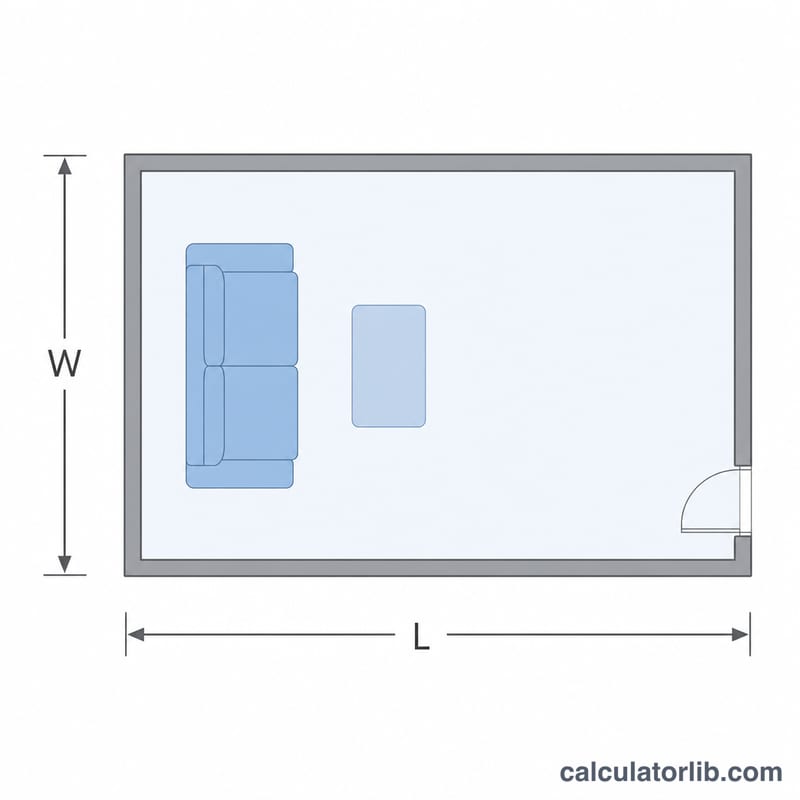
Measure the room and enter its length and width in feet. Enter how many people are normally in the room at the same time. Choose the sun exposure — pick "Very Sunny" for rooms with large south- or west-facing windows, or "Heavily Shaded" for rooms that stay cool. Tick the kitchen box if appliances add significant heat. The result is the recommended BTU/hr; round up to the nearest available unit size.
The formula explained
First the area is found as length \(\times\) width. That area is multiplied by 20 to get the base load. The rule already assumes two occupants, so 600 BTU is added for each additional person. A 10% increase or decrease is then applied for sun exposure, and finally 4,000 BTU is added for kitchens to cover stove and oven heat.
$$\text{BTU} = (S + O)\,(1 + f) + K$$ $$\text{where}\quad \left\{ \begin{aligned} S &= \text{Length} \times \text{Width} \times 20 \\ O &= 600 \times \max(0,\ \text{Occupants} - 2) \\ f &= 0 \quad (\text{Normal Sun}) \\ K &= 0 \end{aligned} \right.$$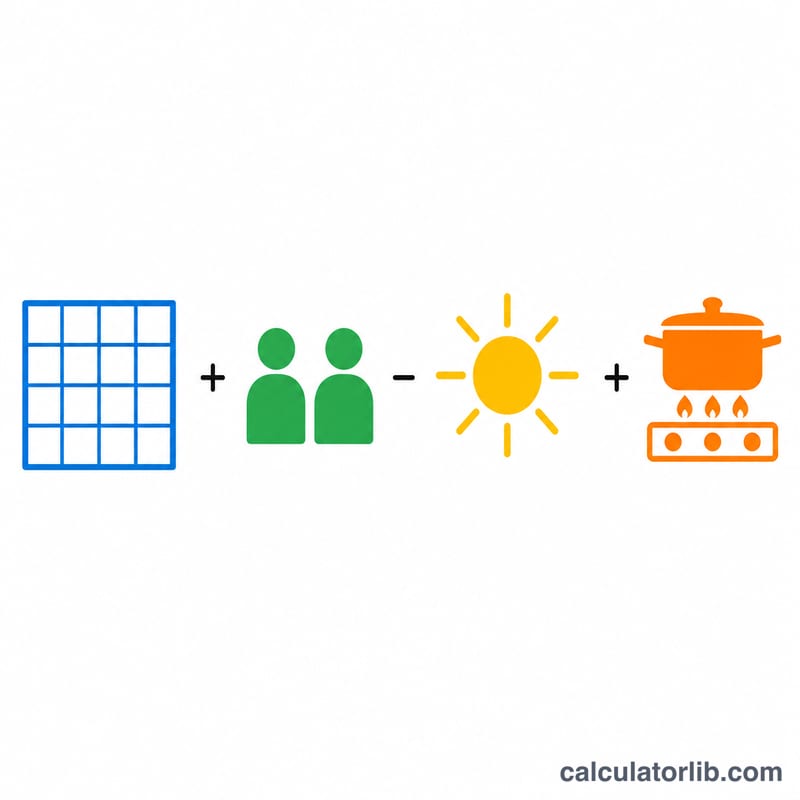
Worked example
A 15 ft \(\times\) 12 ft living room is 180 ft². Base load $$= 180 \times 20 = 3{,}600 \text{ BTU}.$$ With two occupants there is no occupancy addition. Normal sun adds nothing, and it is not a kitchen, so the recommended capacity is 3,600 BTU/hr — a small window or portable unit.
FAQ
What size AC do I buy? Choose the nearest unit at or just above the calculated BTU. Common sizes are 5,000, 8,000, 10,000 and 12,000 BTU.
Is 20 BTU per square foot accurate? It is a reliable rule of thumb for typical 8 ft ceilings and average insulation. Very high ceilings or poor insulation need a professional load calculation (Manual J).
Why add BTU for a kitchen? Ovens and stoves generate substantial heat, so kitchens need roughly 4,000 BTU more than an equivalent ordinary room.