What This Calculator Does
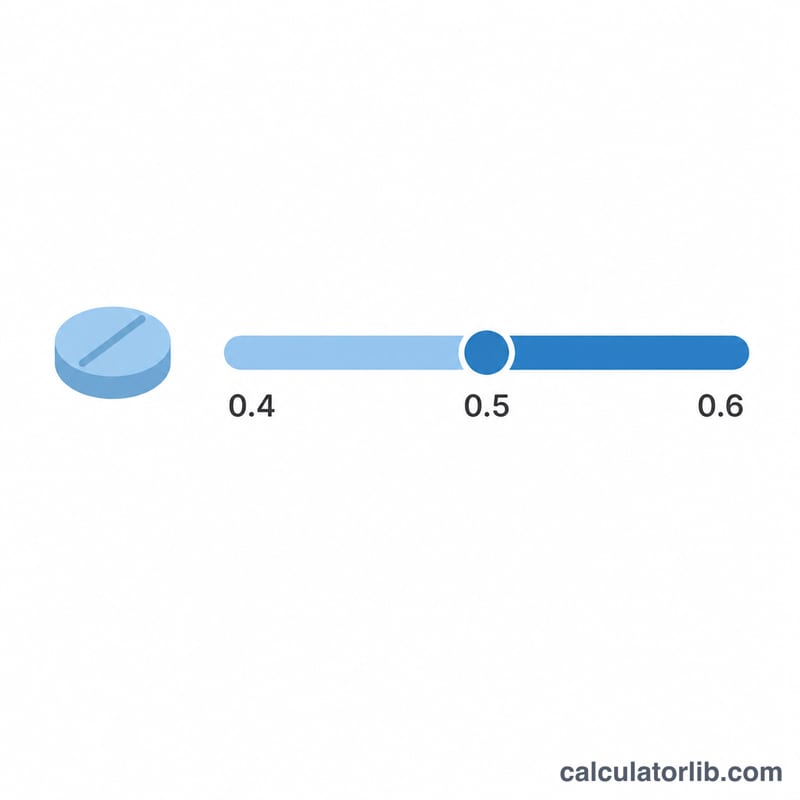
This tool estimates the per-administration dose of Apoquel (oclacitinib) for a dog based on its body weight. Apoquel is a prescription veterinary medication used to control itching (pruritus) and inflammation associated with allergic and atopic dermatitis. The manufacturer's labeled dosing target is approximately 0.4 to 0.6 mg of oclacitinib per kilogram of body weight, given twice daily for up to 14 days, then reduced to once daily for long-term maintenance.
How to Use It
Enter your dog's weight and choose kilograms or pounds. The calculator converts pounds to kilograms automatically (\(1\text{ lb} = 0.45359237\text{ kg}\)) and returns a target dose at the 0.5 mg/kg midpoint plus the low (0.4 mg/kg) and high (0.6 mg/kg) ends of the range. Compare these milligram values against the available tablet strengths — 3.6 mg, 5.4 mg, and 16 mg — with the guidance of your veterinarian.
The Formula Explained
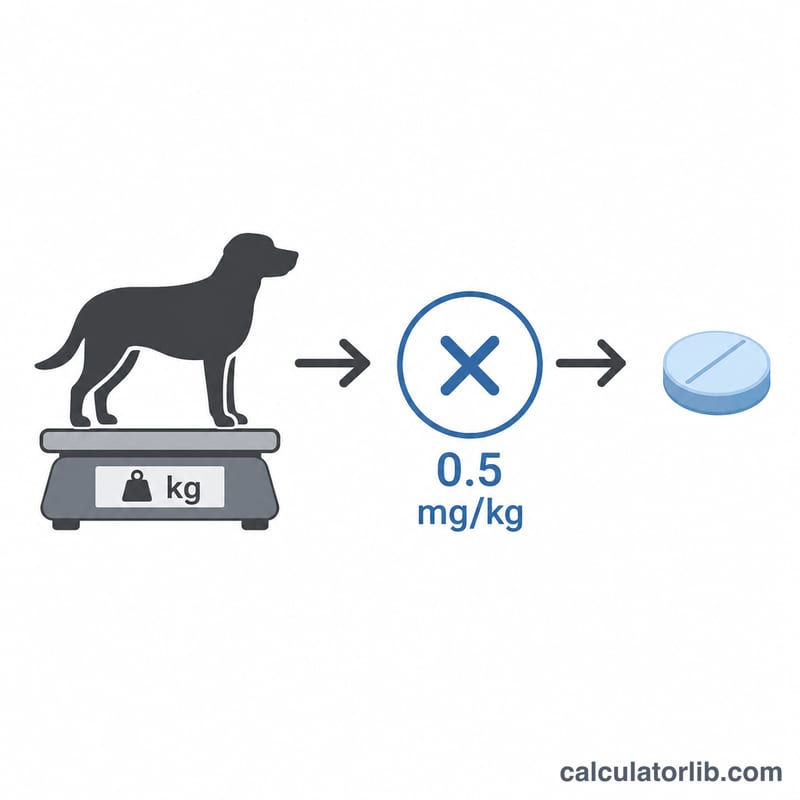
The dose is a simple linear function of weight:
$$\text{Dose} = \text{Weight (kg)} \times 0.4 \text{ to } 0.6 \;\text{mg}$$Using the midpoint rate of 0.5 mg/kg gives a convenient estimate, while the 0.4 and 0.6 multipliers bracket the acceptable label range that your vet rounds to the nearest practical tablet combination.
Worked Example
A dog weighs 22 lb. Converting: \(22 \times 0.45359237 \approx 9.98\text{ kg}\). Target dose \(\approx 9.98 \times 0.5 \approx 4.99\text{ mg}\), with a range of about 3.99 mg (low) to 5.99 mg (high). A vet would likely dispense a 5.4 mg tablet per dose.
Apoquel Tablet Strengths and Labeled Dosing by Weight
Apoquel (oclacitinib maleate) is supplied as film-coated tablets in three strengths: 3.6 mg, 5.4 mg and 16 mg. The chart below follows the structure of the US manufacturer's labeled dosing chart for dogs. The bands are designed to deliver roughly 0.4–0.6 mg/kg per administration using whole or half tablets. The minimum labeled body weight is 6.6 lb (3 kg).
| Body weight (lb) | Body weight (kg) | 3.6 mg tablets | 5.4 mg tablets | 16 mg tablets |
|---|---|---|---|---|
| 6.6–9.9 | 3.0–4.4 | 0.5 | – | – |
| 10.0–14.9 | 4.5–5.9 | – | 0.5 | – |
| 15.0–19.9 | 6.0–8.9 | 1 | – | – |
| 20.0–29.9 | 9.0–13.4 | – | 1 | – |
| 30.0–44.9 | 13.5–19.9 | – | – | 0.5 |
| 45.0–59.9 | 20.0–26.9 | – | 2 | – |
| 60.0–89.9 | 27.0–39.9 | – | – | 1 |
| 90.0–129.9 | 40.0–54.9 | – | – | 1.5 |
| 130.0–175.9 | 55.0–80.0 | – | – | 2 |
Important: because tablets come in fixed strengths, the mg/kg actually delivered varies within each band and can sit slightly outside or at the edge of 0.4–0.6 mg/kg. This table is a summary for education. Always confirm exact figures against the current product label for your country and the instructions of the prescribing veterinarian. Labeling and approved strengths can differ between countries.
Dose Comparison Across Dog Sizes
The table multiplies body weight by 0.4, 0.5 and 0.6 mg/kg to show the target mg range per administration, then lists a tablet combination (per the label bands above) whose total falls in or at the edge of that range. This is an educational illustration, not a prescription.
| Weight | Low (0.4 mg/kg) | Midpoint (0.5 mg/kg) | High (0.6 mg/kg) | Example tablet combination (total mg, mg/kg) |
|---|---|---|---|---|
| 5 kg | 2.0 mg | 2.5 mg | 3.0 mg | ½ × 5.4 mg = 2.7 mg (0.54 mg/kg) |
| 10 kg | 4.0 mg | 5.0 mg | 6.0 mg | 1 × 5.4 mg = 5.4 mg (0.54 mg/kg) |
| 20 kg | 8.0 mg | 10.0 mg | 12.0 mg | 2 × 5.4 mg = 10.8 mg (0.54 mg/kg) |
| 30 kg | 12.0 mg | 15.0 mg | 18.0 mg | 1 × 16 mg = 16 mg (0.53 mg/kg) |
| 40 kg | 16.0 mg | 20.0 mg | 24.0 mg | 1½ × 16 mg = 24 mg (0.60 mg/kg) |
Example arithmetic for 20 kg: \(20 \times 0.4 = 8.0\) mg and \(20 \times 0.6 = 12.0\) mg, so the target range is 8.0–12.0 mg. Two 5.4 mg tablets give 10.8 mg, which lies inside it.
Interpreting Your Result
- The output is a dose in mg per administration, not a tablet count. It equals body weight in kg multiplied by 0.4 to 0.6 mg/kg. If you enter pounds, the weight is first converted to kilograms (1 lb ≈ 0.4536 kg).
- 0.4–0.6 mg/kg is the labeled target range (US label). Because tablets come only in 3.6 mg, 5.4 mg and 16 mg strengths, the dose actually given is the closest practical combination of whole or half tablets, so it rarely matches the calculated figure exactly.
- Schedule on the US label: twice daily for up to 14 days, then once daily for maintenance. Tablets may be given with or without food. Check the label used in your country, as it may differ.
- Age and health limits: the US label restricts use to dogs at least 12 months old. It lists contraindications, including dogs with serious infections. The label also warns that the drug may increase susceptibility to infection, may worsen parasitic skin conditions such as demodicosis and may worsen existing neoplastic conditions. Safety has not been evaluated in breeding, pregnant or lactating dogs.
- The veterinarian determines the final dose. This tool gives an educational estimate only. It cannot account for your dog's medical history, other medications or lab results.
This is general information, not veterinary advice. Do not start, change or stop any medication without consulting your veterinarian.
FAQ
How often is Apoquel given? Typically twice daily for up to 14 days, then once daily for ongoing maintenance.
Can I dose my dog without a vet? No. Apoquel is prescription-only. This calculator is for educational estimation; your veterinarian determines the exact dose, tablet strength, and suitability.
What if my dog is between tablet sizes? Vets combine tablet strengths or split scored tablets to reach a dose within the 0.4–0.6 mg/kg range — never adjust on your own.