What This Calculator Does
The Fish Tank Heater Wattage Calculator estimates how powerful an aquarium heater you need to comfortably warm your tank to tropical temperatures. It uses the familiar "watts per gallon" rule of thumb but adjusts the value based on how far above room temperature you need to heat the water — the bigger the gap, the more wattage required.
How to Use It
Enter your tank volume in gallons and the temperature rise you need above the room. For example, if your room sits at 70 °F and your fish need 78 °F, the rise is 8 °F. The calculator picks a suitable watts-per-gallon figure and multiplies it by your tank size, then shows the common 3–5 W/gal range for comparison.
The Formula Explained
The core formula is Watts = Gallons × Watts-per-gallon. We scale watts-per-gallon with the heating demand: about 2.5 W/gal for a tiny rise (≤5 °F), 3.5 for a moderate rise (≤10 °F), 4 for ≤15 °F, 4.5 for ≤20 °F, and 5 W/gal for very cold rooms. Larger tanks lose heat more slowly per gallon, so for big aquariums you can lean toward the lower end of the range.
$$\text{Watts} = \text{Volume (gal)} \times W_{pg}, \quad W_{pg} = \begin{cases} 2.5 & \text{Rise} \le 5 \\ 3.5 & 5 < \text{Rise} \le 10 \\ 4.0 & 10 < \text{Rise} \le 15 \\ 4.5 & 15 < \text{Rise} \le 20 \\ 5.0 & \text{Rise} > 20 \end{cases}$$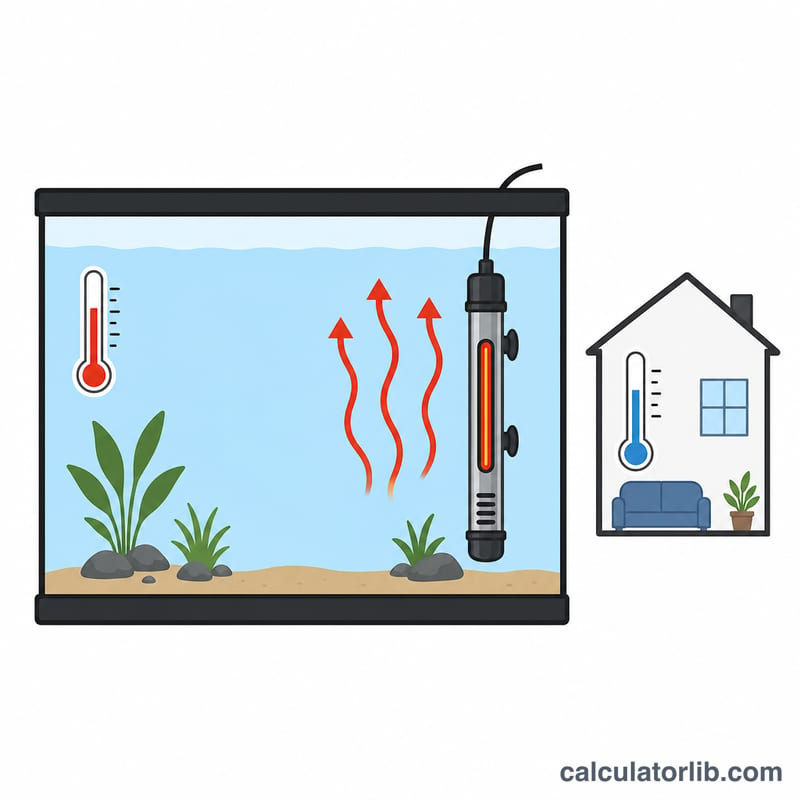
Worked Example
Suppose you have a 20-gallon tank and need an 8 °F rise. That falls in the ≤10 °F band, so we use 3.5 W/gal: \(20 \times 3.5 = 70\) 70 watts. The 3–5 W/gal range gives 60–100 W, so a standard 75 W or 100 W heater would work well.
$$20 \times 3.5 = 70 \text{ watts}$$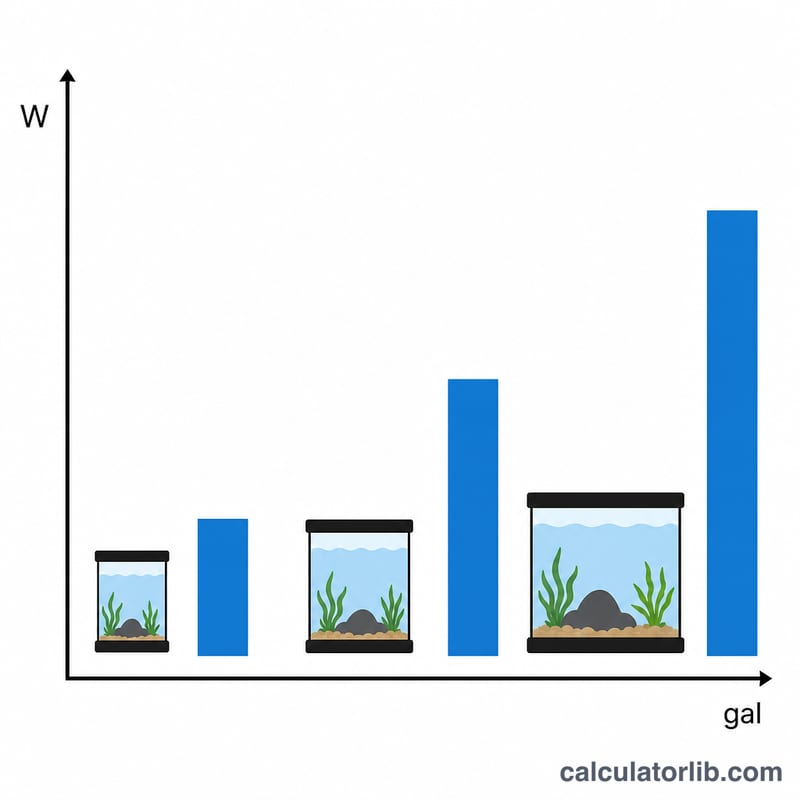
Heater Wattage by Tank Size and Temperature Rise
This calculator multiplies tank volume in US gallons by a watts-per-gallon factor that depends on the temperature rise in °F. The rise is your target water temperature minus the coldest room temperature you expect. The factors are 2.5 W/gal for a rise up to 5 °F, 3.5 for over 5 up to 10, 4.0 for over 10 up to 15, 4.5 for over 15 up to 20, and 5.0 above 20. This is a rule-of-thumb sizing method, not an exact heat-loss calculation. Each cell shows calculated watts, then the next standard heater size at or above that figure (25, 50, 75, 100, 150, 200 or 300 W).
| Tank (gal) | Rise 5 °F (2.5 W/gal) | Rise 10 °F (3.5 W/gal) | Rise 15 °F (4.0 W/gal) | Rise 20 °F (4.5 W/gal) |
|---|---|---|---|---|
| 5 | 12.5 W → 25 W | 17.5 W → 25 W | 20 W → 25 W | 22.5 W → 25 W |
| 10 | 25 W → 25 W | 35 W → 50 W | 40 W → 50 W | 45 W → 50 W |
| 20 | 50 W → 50 W | 70 W → 75 W | 80 W → 100 W | 90 W → 100 W |
| 29 | 72.5 W → 75 W | 101.5 W → 150 W | 116 W → 150 W | 130.5 W → 150 W |
| 40 | 100 W → 100 W | 140 W → 150 W | 160 W → 200 W | 180 W → 200 W |
| 55 | 137.5 W → 150 W | 192.5 W → 200 W | 220 W → 300 W | 247.5 W → 300 W |
| 75 | 187.5 W → 200 W | 262.5 W → 300 W | 300 W → 300 W | 337.5 W → two 200 W heaters |
Worked example: a 55-gallon tank in a room that drops to 63 °F, with a target of 78 °F, has a rise of 78 − 63 = 15 °F. That falls in the 4.0 W/gal band, so \(55 \times 4.0 = \)220 W. The next standard size up is 300 W, or two 150 W heaters.
Choosing and Installing Your Heater
- Round up to the next standard size. Heaters come in fixed wattages, and a slightly larger unit is usually better than one that runs constantly at its limit. Always check the manufacturer's stated tank-size range.
- Use two heaters on larger tanks. On tanks over about 40 gallons, consider two heaters of roughly half the total wattage each. If one fails, the other still limits the temperature drop. If one sticks on, the tank is less likely to overheat quickly.
- Place heaters near water flow. Put them near a filter outlet or powerhead so warmed water circulates evenly and the thermostat reads the true tank temperature.
- Use a thermostat or controller. A heater with a built-in thermostat is the minimum. An external controller adds a second layer of control. Verify the actual temperature with a separate aquarium thermometer.
- Adjust for your conditions. A lid, a hood, good insulation and a draft-free spot reduce heat loss. An open-top tank, a window or vent draft, or a cold room increases it. Measure the coldest room temperature, not the average.
- Submerge it as directed. Fully submersible heaters must be underwater as the manufacturer specifies. Some models must stay fully covered, and others have a minimum water level mark. Running a heater in air can damage it or crack the glass.
- Let it acclimate before plugging in. Place the heater in the water for about 15–30 minutes before switching it on. This lets the glass reach water temperature and avoids thermal shock and cracking.
- Maintain it. Unplug the heater before water changes or maintenance. Inspect the cord and housing regularly, and replace old or damaged units.
This is general guidance. Always follow the instructions and safety warnings supplied with your specific heater.
FAQ
Should I round up to the next heater size? Yes — heaters come in fixed sizes (25, 50, 75, 100, 150, 200, 300 W). Round up to the nearest available size.
Is two smaller heaters better than one big one? For tanks over ~40 gallons, two heaters give more even heating and a safety backup if one fails.
Does room temperature matter? Absolutely. A heater fights the gap between room and target temperature, so a colder room needs more wattage for the same tank.