
What This Calculator Does
The Solar Battery Storage Size Calculator estimates the nominal battery capacity (in kilowatt-hours) you need for an off-grid or backup solar system. It accounts for how much energy you use each day, how many days you want to run without sunshine (days of autonomy), how deeply you can safely discharge the battery, and the round-trip losses in your system.
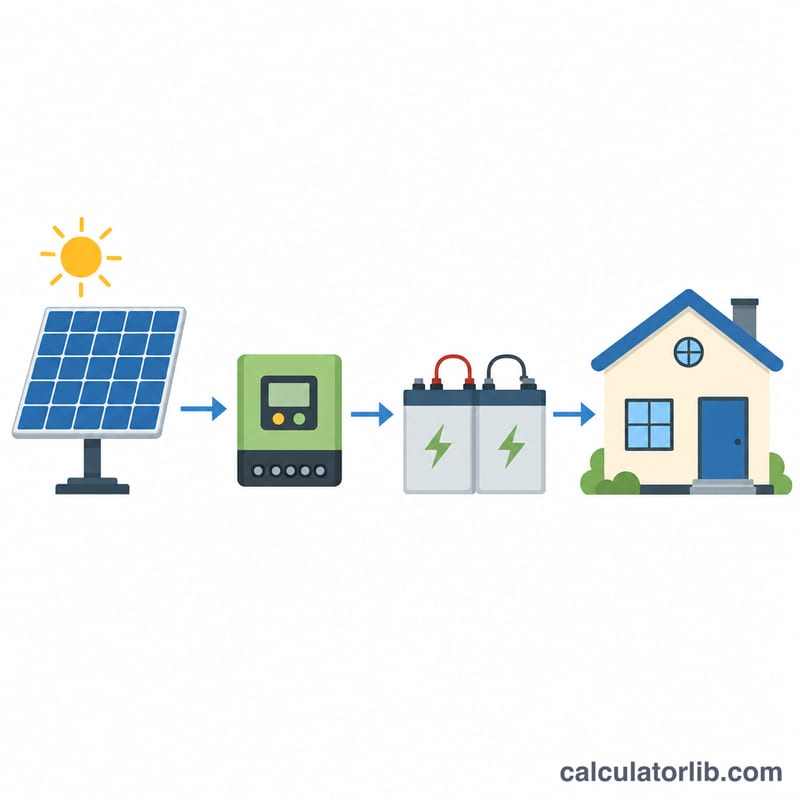
How to Use It
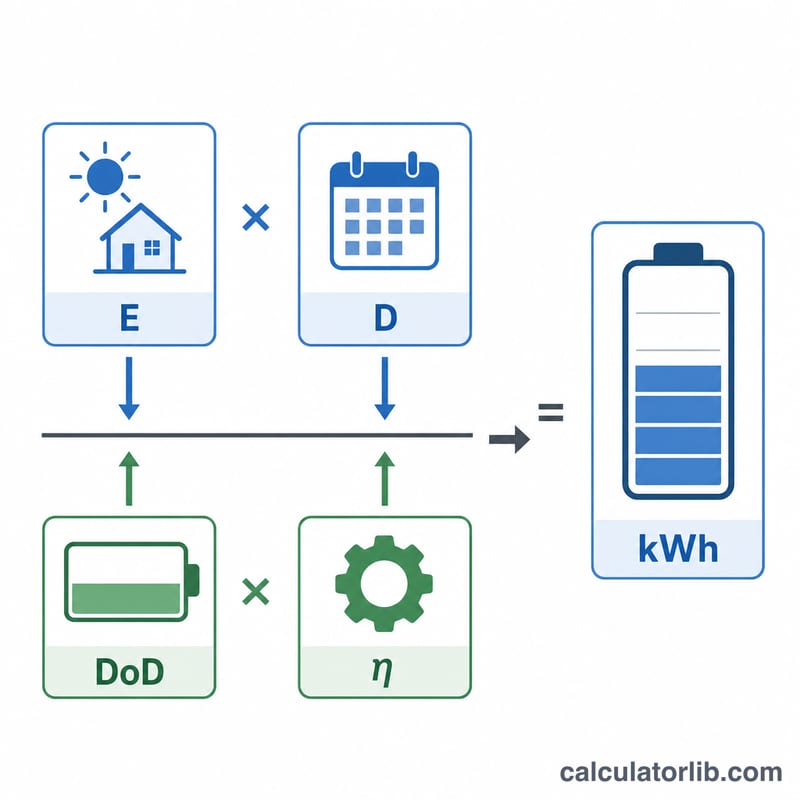
Enter your average daily energy consumption in kWh, the number of days of backup you want, the recommended depth of discharge (DoD) for your battery chemistry, and an overall system efficiency. Lithium batteries commonly allow 80–90% DoD, while lead-acid is typically limited to 50%. System efficiency of 85–95% covers inverter and wiring losses.
The Formula Explained
The calculation is: $$\text{kWh} = \frac{\text{Daily Load} \times \text{Days of Autonomy}}{\text{DoD} \times \text{Efficiency}}$$. The numerator is the total energy you must supply over the backup period. Dividing by DoD ensures you do not over-drain the battery, and dividing by efficiency adds a margin for energy lost during charge and discharge cycles.
Worked Example
Suppose you use 10 kWh per day and want 2 days of autonomy, with a battery rated for 80% DoD and a 90% efficient system. Total energy = \(10 \times 2 = 20\) kWh. Divide by (\(0.80 \times 0.90 = 0.72\)): $$20 \div 0.72 \approx 27.78 \text{ kWh}$$ of nominal storage.
FAQ
What is depth of discharge? DoD is the percentage of a battery's capacity you can safely use without shortening its life. Higher DoD means you need less total capacity.
Why divide by efficiency? Real systems lose energy to heat in the inverter, charge controller, and cables, so you must oversize the bank slightly to deliver the usable energy.
Does this include solar panel sizing? No. This tool sizes the battery only. Panel sizing depends on your local sun hours and recharge goals.