
What This Calculator Does
The Solar System Size Calculator estimates how many kilowatts (kW) of solar panels you need to cover your electricity consumption. It works by comparing your daily energy demand against how much energy a single kilowatt of solar capacity can realistically produce in your location, accounting for real-world losses.
How to Use It
Enter three values: your average monthly energy use in kWh (check a utility bill), your local peak sun hours per day (typically 3–6 in most regions), and a derate factor between 0 and 1 that captures losses from inverters, wiring, dust, temperature and panel orientation. A derate of 0.75–0.80 is common. The tool returns the recommended DC system size plus estimated daily and annual production.
The Formula Explained
The core equation is:
$$\text{System Size (kW)} = \frac{\text{Monthly kWh} / 30}{\text{Peak Sun Hours} \times \text{Derate}}$$
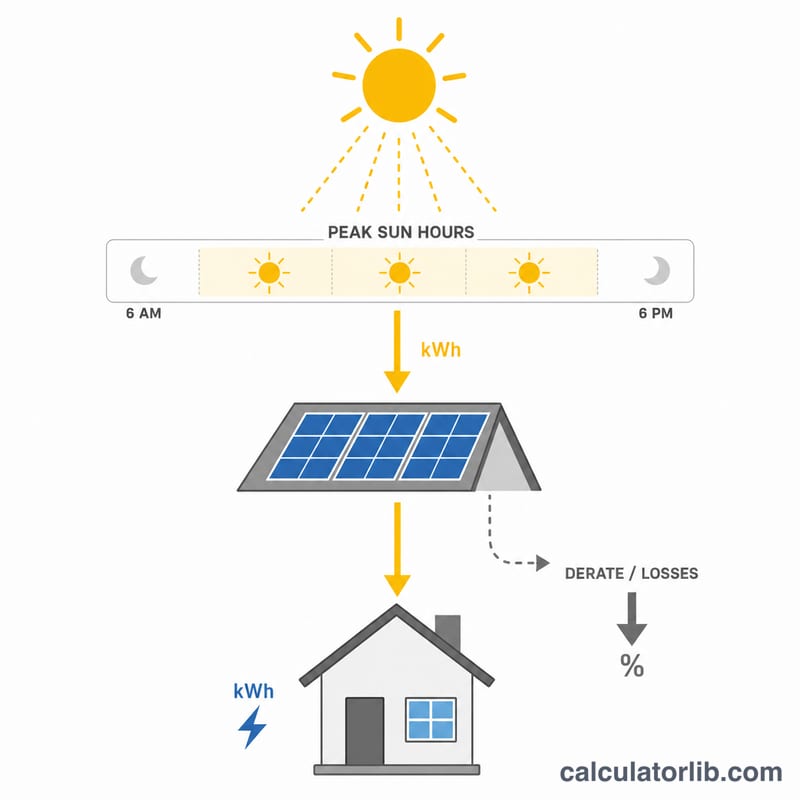
Dividing monthly use by 30 gives average daily demand. Multiplying sun hours by the derate factor gives the realistic daily energy yield per installed kW. Dividing demand by that yield gives the system size needed.
Worked Example
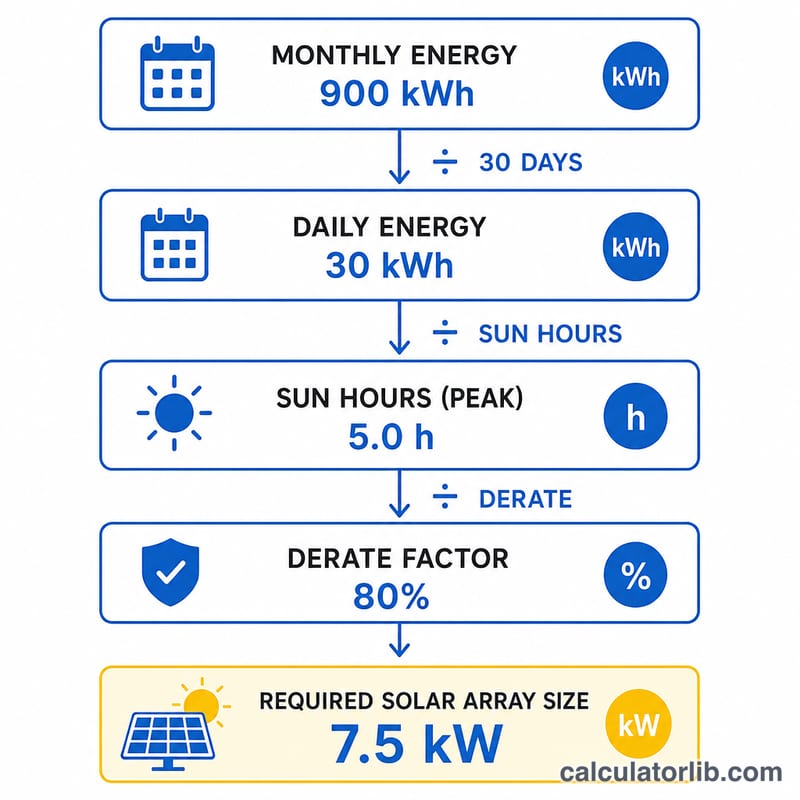
Suppose you use 900 kWh per month, get 5 peak sun hours per day, and use a derate of 0.8. Daily use is \(900 \div 30 = 30\) kWh. Yield per kW is \(5 \times 0.8 = 4\) kWh/day. System size = \(30 \div 4 = \mathbf{7.5}\) kW. That system would produce about \(7.5 \times 4 = 30\) kWh per day, or roughly 10,950 kWh per year.
FAQ
What are peak sun hours? Peak sun hours represent the equivalent number of hours per day at full 1,000 W/m² irradiance — it is not the same as daylight hours.
What derate factor should I use? Use 0.75–0.80 for a typical installation. Lower it for hot climates, shading, or poor orientation; raise it slightly for ideal conditions.
Is this a quote? No. This is a sizing estimate to guide planning. A licensed installer should perform a detailed assessment that includes roof space, local irradiance data and panel specifications.