What this PA-28 weight and balance calculator does
Before every flight a pilot must confirm the aircraft is under its maximum gross weight and that its center of gravity (CG) falls inside the approved envelope. This tool adds up the basic empty weight, front and rear occupants, usable fuel and baggage of a Piper PA-28, computes the total moment and CG, and compares them with typical PA-28-161 Warrior II limits: 2,440 lb maximum gross, forward limit 83.0 in at 1,950 lb or less rising to 87.0 in at gross, aft limit 93.0 in, and 200 lb of baggage. Other PA-28 models (Cherokee, Archer, Arrow) use different arms and limits, so always confirm with the POH and weight and balance record of your specific airplane. This calculator is for planning only.
How to use it
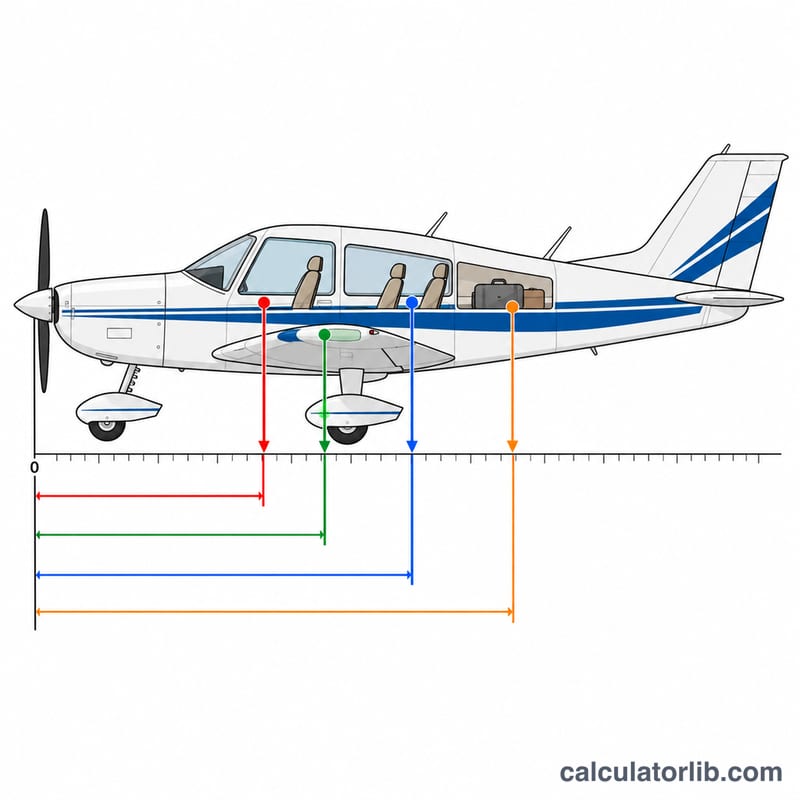
Enter the basic empty weight and its CG arm from the aircraft weight and balance record. Add front and rear occupant weights, usable fuel in US gallons (converted at 6 lb/gal) and baggage. Station arms default to common PA-28-161 values (front seats 80.5 in, rear seats 118.1 in, fuel 95.0 in, baggage 142.8 in) and can be edited.
The formula
Each item produces a moment equal to its weight times its arm. The CG is the total moment divided by the total weight:
$$\text{CG} = \frac{\sum W_i A_i}{\sum W_i}$$where \(W_i\) is the weight of each station in pounds and \(A_i\) its arm in inches aft of the datum. Above 1,950 lb the forward limit is interpolated linearly toward the gross weight limit.
Worked example
Empty 1,500 lb at 86.0 in, front 340 lb, rear 170 lb, 40 gal of fuel (240 lb) and 50 lb of baggage:
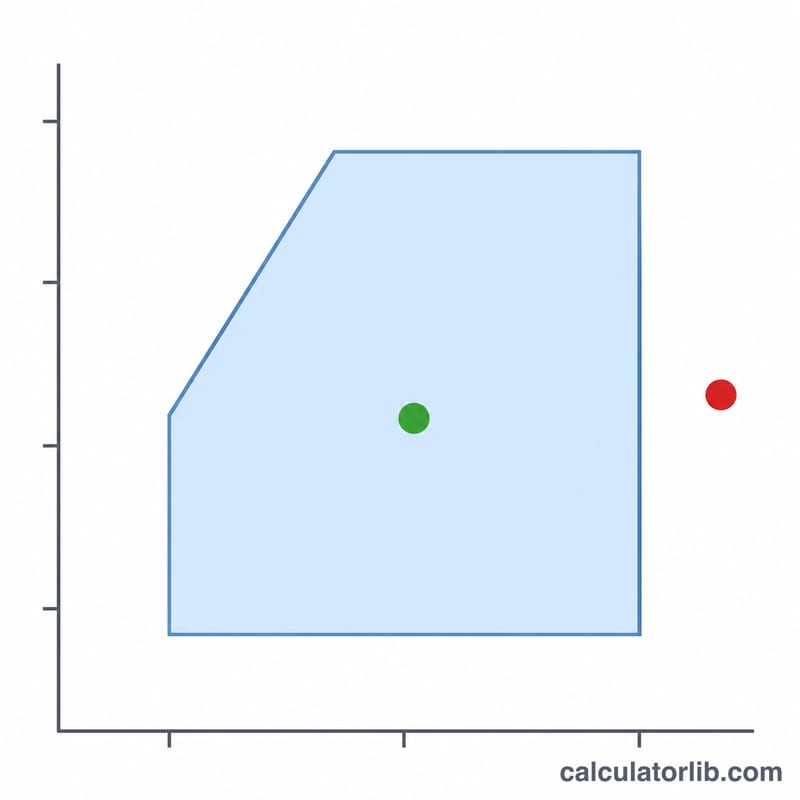
$$W = 1500 + 340 + 170 + 240 + 50 = 2300\,\text{lb}$$$$M = 129000 + 27370 + 20077 + 22800 + 7140 = 206387\,\text{lb-in}$$$$\text{CG} = \frac{206387}{2300} = 89.73\,\text{in}$$The forward limit at 2,300 lb is \(83 + 350 \times \tfrac{4}{490} = 85.86\) in, so a CG of 89.73 in is inside the 85.86 to 93.0 in range, and the airplane is 140 lb below gross.
How Loading Changes Weight and CG: PA-28-161 Scenarios
The table uses the calculator's default values. The basic empty weight is 1,500 lb at 86.0 in. The arms are 80.5 in for the front seats, 118.1 in for the rear seats, 95.0 in for fuel and 142.8 in for baggage. Fuel weighs 6 lb/gal and the maximum gross weight is 2,440 lb. Each occupant weighs 170 lb. "Full fuel" means 48 US gal usable, which is typical for a PA-28-161. Baggage is capped at the usual 200 lb. These are example values only. Your aircraft's own weight and balance record and Pilot's Operating Handbook (POH) may differ.
The empty aircraft's moment is \(1500 \times 86.0 = 129{,}000\) lb·in. The forward limit is 83.0 in up to 1,950 lb. Above that it is interpolated in a straight line to 87.0 in at 2,440 lb:
$$x_{\text{fwd}} = 83 + 4\cdot\frac{W - 1950}{2440 - 1950}$$The aft limit is 93.0 in at every weight.
| Scenario | Load (front / rear / fuel / baggage) | Total weight (lb) | Total moment (lb·in) | CG (in) | Forward limit (in) | Aft limit (in) | Status |
|---|---|---|---|---|---|---|---|
| 1. Solo pilot, full fuel | 170 / 0 / 48 gal / 0 | 1,958 | 170,045 | 86.85 | 83.07 | 93.0 | Within |
| 2. Example trip, takeoff | 340 / 150 / 40 gal / 30 | 2,260 | 201,169 | 89.01 | 85.53 | 93.0 | Within |
| 3. Same trip, landing (25 gal burned) | 340 / 150 / 15 gal / 30 | 2,110 | 186,919 | 88.59 | 84.31 | 93.0 | Within |
| 4. Four adults, full fuel, max baggage | 340 / 340 / 48 gal / 200 | 2,668 | 252,444 | 94.62 | 87.00 | 93.0 | Outside: 228 lb over gross and 1.62 in aft of the limit |
| 5. Front seats only, light fuel | 400 / 0 / 10 gal / 0 | 1,960 | 166,900 | 85.15 | 83.08 | 93.0 | Within (most forward CG in this table) |
How the rows were calculated
- Row 1: \(W = 1500 + 170 + 6\times48 = 1958\). \(M = 129{,}000 + 170\times80.5 + 288\times95.0 = 129{,}000 + 13{,}685 + 27{,}360 = 170{,}045\). \(\text{CG} = 170{,}045 / 1958 = 86.85\) in. Forward limit \(= 83 + 4\times8/490 = 83.07\) in.
- Row 2: \(W = 1500 + 340 + 150 + 240 + 30 = 2260\). \(M = 129{,}000 + 27{,}370 + 17{,}715 + 22{,}800 + 4{,}284 = 201{,}169\). \(\text{CG} = 201{,}169 / 2260 = 89.01\) in. Forward limit \(= 83 + 4\times310/490 = 85.53\) in.
- Row 3: burning 25 gal removes 150 lb and \(150\times95.0 = 14{,}250\) lb·in. That gives \(W = 2110\), \(M = 186{,}919\) and \(\text{CG} = 88.59\) in. Forward limit \(= 83 + 4\times160/490 = 84.31\) in.
- Row 4: \(W = 1500 + 340 + 340 + 288 + 200 = 2668\). \(M = 129{,}000 + 27{,}370 + 40{,}154 + 27{,}360 + 28{,}560 = 252{,}444\). \(\text{CG} = 94.62\) in. Because the weight is above maximum gross, the forward limit is capped at the 2,440 lb value of 87.0 in.
- Row 5: \(W = 1500 + 400 + 60 = 1960\). \(M = 129{,}000 + 32{,}200 + 5{,}700 = 166{,}900\). \(\text{CG} = 85.15\) in. Forward limit \(= 83 + 4\times10/490 = 83.08\) in.
What the scenarios show
- Burning fuel moves the CG forward in this aircraft, because the fuel arm (95.0 in) is aft of the loaded CG. In rows 2 and 3 the CG moves from 89.01 in to 88.59 in.
- Rear passengers and baggage have long arms, so they push the CG aft quickly. Row 4 is over both the gross weight limit and the aft limit.
- With an empty CG of 86.0 in, even heavy front-seat loads only reach about 85 in. The forward limit is reached more easily in aircraft whose empty CG is further forward.
Interpreting Your Weight and Balance Result
"Within the envelope" means only that the loading is inside the published limits. The total weight is at or below maximum gross, and the CG is between the forward and aft limits for that weight. It says nothing about runway length, density altitude, climb performance or fuel reserves. Those still have to be checked separately using the performance charts in the POH.
What each limit protects against
- CG forward of the limit: the tail has to push down harder to balance the aircraft. This raises stall speed and makes the elevator feel heavier. It also leaves less elevator authority to raise the nose during the landing flare, especially at low speed with full flaps.
- CG aft of the limit: longitudinal stability is reduced, so the aircraft may tend to pitch further once it is disturbed. Stall behaviour can become more abrupt, and recovery from a stall or spin may be difficult or impossible.
- Over maximum gross weight: takeoff roll gets longer and climb rate drops. Stall speed rises and landing distance increases. The structure is also operating outside the margins it was certified for, so turbulence or a hard landing can load it beyond what was tested.
Reading the margin to each limit
The margins are measured at the actual weight:
$$\text{Forward margin} = \text{CG} - x_{\text{fwd}}, \qquad \text{Aft margin} = 93.0 - \text{CG}$$Take the example trip at takeoff, with a CG of 89.01 in at 2,260 lb. The forward margin is \(89.01 - 85.53 = 3.48\) in and the aft margin is \(93.0 - 89.01 = 3.99\) in. A margin below about an inch leaves little room for error. Such errors include a passenger heavier than you estimated, extra baggage, or a fuel reading that is off. In that case, re-check the inputs or move the load. Weight margin is simply maximum gross minus total weight.
Check both takeoff and landing
The CG moves as fuel burns, so a loading that is legal at takeoff can drift outside the envelope by landing. Run the calculation at least twice: once with takeoff fuel and once with expected landing fuel, including reserves. With the default PA-28 arms, burning fuel moves the CG forward. If the CG is close to the forward limit, the landing condition is usually the critical one.
What governs
The POH or Airplane Flight Manual, and the current weight and balance record for your specific aircraft, are the authority. Use their empty weight, empty arm, station arms, fuel capacity and CG envelope, not the defaults here. Envelopes differ between PA-28 models and serial numbers, and also between normal and utility category operation. Some envelopes are not a single straight line.
This calculator is a planning aid only. In the United States, the pilot in command must become familiar with all available information concerning a flight under 14 CFR 91.103. Under 14 CFR 91.9, the aircraft must be operated within the limitations in its approved flight manual, markings and placards. Weight and balance limits are part of those limitations. Pilots outside the US have equivalent duties under their own aviation authority's rules. In every case, responsibility for the loading decision stays with the pilot in command, not with this tool.
FAQ
Why does fuel burn matter? Fuel sits near the middle of the envelope, so burning it changes weight more than CG, but always check both the takeoff and landing conditions.
Can I use this for an Archer or Arrow? Only if you enter that model arms and verify the limits; the built-in envelope matches the Warrior II.
What if I am out of limits? Move baggage, reduce fuel or reduce passenger load until both weight and CG are within the envelope.