
What Is Aircraft Weight and Balance?
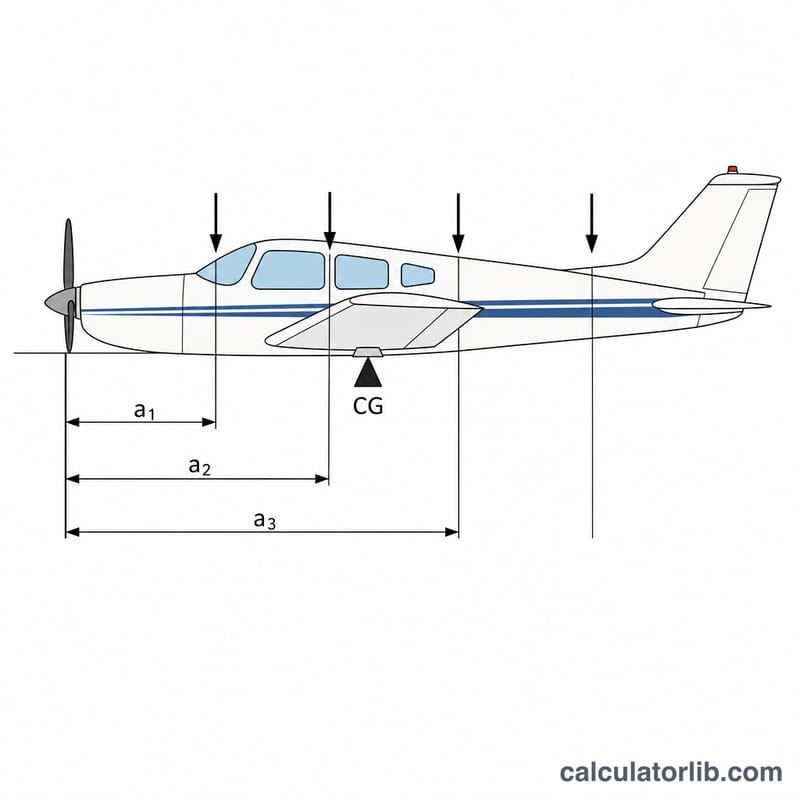
Weight and balance is a fundamental preflight calculation that ensures an aircraft is loaded within its certified weight limits and that its center of gravity (CG) falls inside the manufacturer approved range. An overloaded or improperly balanced aircraft can be unstable, hard to control, or unable to climb safely. This calculator sums the weight and moment contribution of each loading station to give you the total weight and the resulting CG location.
How to Use It
Enter the aircraft empty weight and its empty arm (from the type certificate or a current weighing). Then add the weight and arm for each station: pilot and front seats, rear seats, fuel, and baggage. Arms are distances in inches measured aft of the reference datum. The tool returns total weight, total moment, and the CG. Compare these against your aircraft Pilot Operating Handbook limits.
The Formula
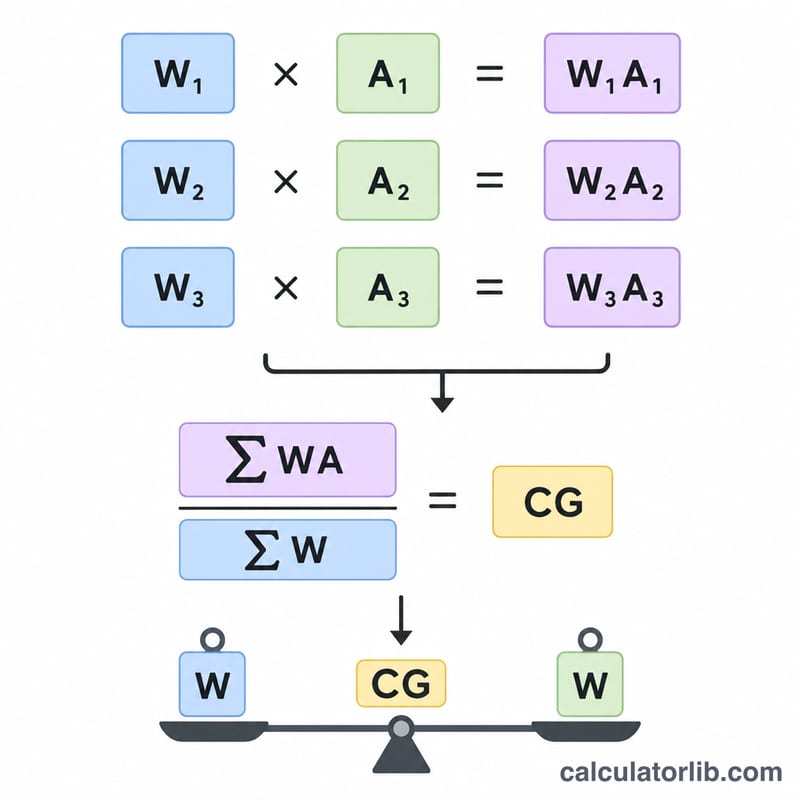
Each station contributes a moment equal to its weight times its arm. Adding all moments and dividing by total weight gives the CG:
$$\text{CG} = \frac{\sum (W_i \times A_i)}{\sum W_i}$$where \(W_i\) = weight of station \(i\) in pounds and \(A_i\) = arm of station \(i\) in inches.
Worked Example
Empty: 1500 lb at 39 in. Pilot/front: 340 lb at 37 in. Fuel: 228 lb at 48 in. Baggage: 50 lb at 95 in.
$$W = 1500 + 340 + 228 + 50 = 2118\,\text{lb}$$ $$M = 58500 + 12580 + 10944 + 4750 = 86774\,\text{lb-in}$$ $$\text{CG} = \frac{86774}{2118} \approx 40.97\,\text{in}$$Interpreting Your CG and Weight Result
The calculator returns three numbers: total weight, total moment, and center of gravity (CG). Each must be checked against the limits published in your aircraft's flight manual.
1. Check total weight against the weight limits
Compare the computed total weight against, in order:
- Maximum ramp (taxi) weight — the most you may weigh before engine start; includes fuel that will be burned during taxi.
- Maximum takeoff (gross) weight — the limit at the start of the takeoff roll.
- Maximum landing weight — for many light singles this equals gross weight, but transport and some twin aircraft have a lower landing limit, requiring fuel burn or fuel dump before landing.
- Maximum zero-fuel weight (if published) — the most the airframe may weigh with no usable fuel, protecting the wing structure.
If total weight exceeds any applicable limit, you must remove weight (fewer passengers, less baggage, or less fuel) before the result is legal and safe.
2. Verify CG is inside the envelope
Being under gross weight is not enough — the CG must also fall between the forward limit and the aft limit for that weight. Because these limits often change with weight, the cleanest check is to plot your total weight and total moment on the moment envelope (CG envelope) chart in the AFM: if the point lands inside the printed polygon, the loading is approved. The calculator's CG (in inches aft of datum) should be greater than or equal to the forward limit and less than or equal to the aft limit at your weight.
3. Understand forward-CG vs aft-CG behavior
- Forward CG (heavier nose) increases longitudinal stability and stall resistance, but raises stall speed, requires more elevator/trim force, lengthens takeoff and landing, and can make the nose hard to raise on rotation or flare. An excessively forward CG can prevent rotation entirely.
- Aft CG (heavier tail) reduces stick forces and slightly improves cruise efficiency, but degrades stability and stall/spin recovery. An aft CG beyond the limit can make the aircraft uncontrollable in pitch and resist spin recovery.
4. Re-check CG after fuel burn
Weight and CG change continuously as fuel burns off. Because the fuel arm is usually different from the empty-aircraft CG, the CG shifts during flight. A loading that is legal at takeoff can move outside the envelope by landing — most commonly the CG drifts aft as fuel burns when the tanks are forward of the CG, or forward when tanks are aft. Compute both a takeoff (full fuel) and a landing (minimum/reserve fuel) case and confirm both points lie inside the envelope.
Key Terms and Variables
- Datum
- An imaginary reference plane from which all horizontal distances (arms) are measured. It is chosen by the manufacturer and may be the propeller spinner, firewall, wing leading edge, or a point ahead of the nose. Units: defines the zero point for inches.
- Arm (A)
- The horizontal distance from the datum to the center of gravity of an item, in inches. Arms aft of the datum are positive; arms forward are negative.
- Moment (M)
- The product of an item's weight and its arm, \(M = W \times A\). Units: inch-pounds (in·lb). Large numbers are sometimes divided by 100 or 1,000 ("moment/1000") on AFM charts.
- Station
- A location along the aircraft identified by its arm (its distance in inches from the datum). "Station 95" means a point 95 inches aft of the datum.
- Empty weight
- The weight of the airframe, engine(s), fixed equipment, unusable fuel, and (for standard/basic empty weight) full operating fluids such as oil. Units: pounds.
- Useful load
- Maximum gross weight minus empty weight — the total weight available for pilot, passengers, usable fuel, and baggage. Units: pounds.
- Gross weight (MTOW)
- The maximum certificated weight of the loaded aircraft. The computed total weight must not exceed it. Units: pounds.
- Center of gravity (CG)
- The point at which the aircraft would balance; the total moment divided by the total weight, \(\text{CG} = M_{\text{total}} / W_{\text{total}}\). Units: inches aft of datum.
- MAC (Mean Aerodynamic Chord)
- A reference wing chord length used to express CG as a percentage: \(\%\text{MAC} = \frac{\text{CG} - \text{LEMAC}}{\text{MAC}} \times 100\), where LEMAC is the leading edge of the MAC. Common on larger and transport aircraft. Units: inches (and resulting %).
- Moment envelope (CG envelope)
- A chart in the AFM plotting allowable combinations of weight (vertical axis) and moment or CG (horizontal axis). A loading is approved only if its plotted point falls inside the envelope. Units: pounds vs. in·lb (or CG in inches).
FAQ
What is the datum? The datum is an arbitrary reference plane chosen by the manufacturer; all arms are measured from it.
Why does CG matter? A CG too far forward or aft changes pitch authority and stability, affecting safety and stall behavior.
Does fuel burn move the CG? Yes. As fuel is consumed, both weight and moment change, so CG shifts during flight depending on the fuel tank arm.