
What this calculator does
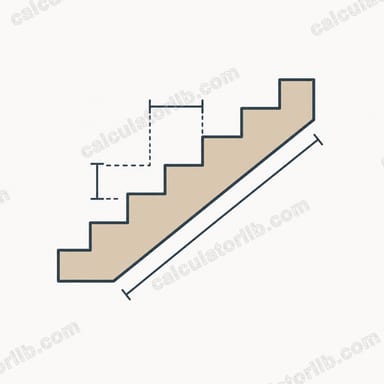
The Deck Stair Stringer Calculator turns your deck height into a complete stair layout. Enter the total vertical rise from the ground to the deck surface, a comfortable target riser height, and your tread depth (run). It returns the number of risers, the exact riser height, the number of treads, the total horizontal run, the diagonal stringer cut length, and the stair angle so you can cut your stringers accurately.
How to use it
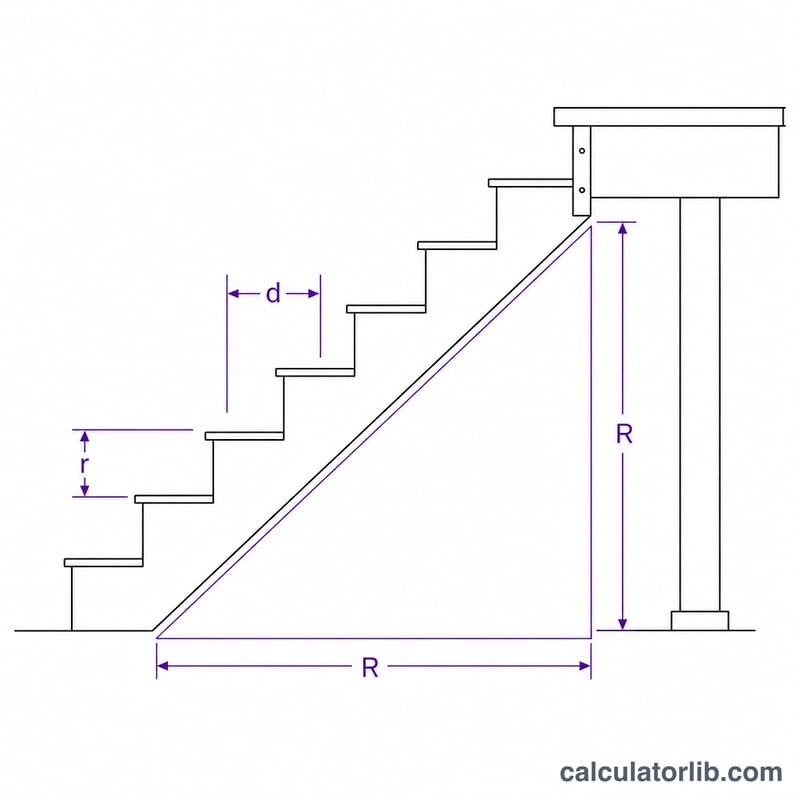
Measure the total rise as the vertical distance from the finished landing surface up to the top of the deck. Pick a target riser height — most building codes cap risers around 7.75 in, and 7–7.5 in is comfortable. Set the tread depth (commonly 10–11 in). The tool divides the rise by the target and rounds to a whole number of risers so every step is identical.
The formula
First the riser count, where \(R\) = total rise and \(h_t\) = target riser height:
$$n_r = \operatorname{round}\!\left(\frac{R}{h_t}\right)$$Actual riser height is \(R / n_r\). A stair always has one fewer tread than risers, so \(n_t = n_r - 1\) and the total run is \(n_t \times d\) where \(d\) = tread depth. The stringer cut length is the hypotenuse:
$$L = \sqrt{R^2 + (n_t \times d)^2}$$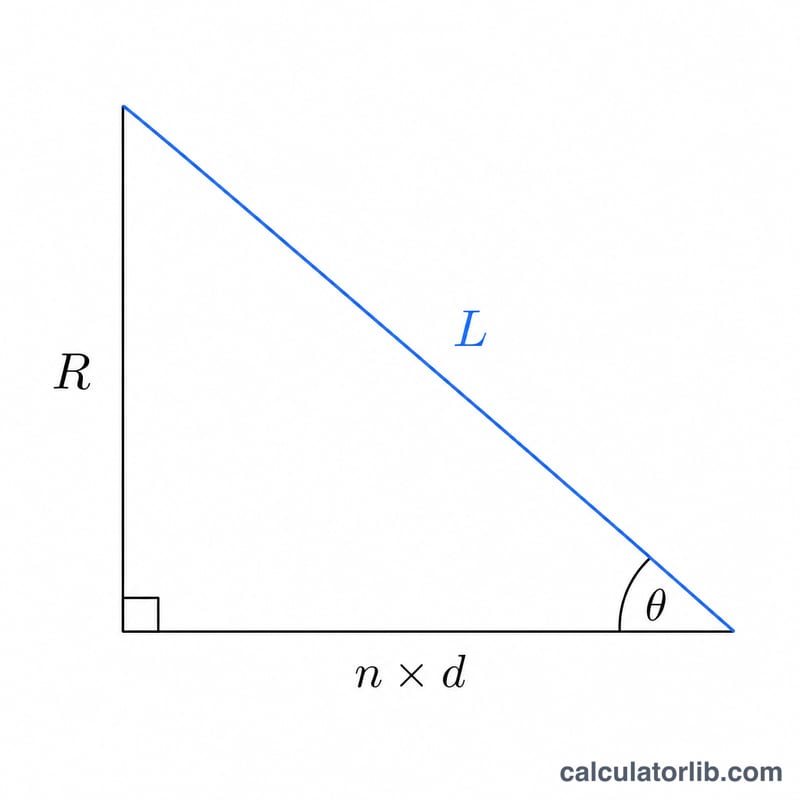
Worked example
Total rise \(R = 48\) in, target riser \(h_t = 7.5\) in, tread depth \(d = 10\) in.
$$n_r = \operatorname{round}\!\left(\tfrac{48}{7.5}\right) = \operatorname{round}(6.4) = 6$$Actual riser \(= 48/6 = 8\) in, treads \(n_t = 5\), total run \(= 5 \times 10 = 50\) in.
$$L = \sqrt{48^2 + 50^2} = \sqrt{2304 + 2500} = \sqrt{4804} \approx 69.31\,\text{in}$$Stair angle \(= \arctan(48/50) \approx 43.8^\circ\).
FAQ
Why one fewer tread than risers? The top tread is the deck surface itself, so a flight with 6 risers has 5 treads.
What riser height should I use? Keep it consistent and within local code — typically a maximum near 7.75 in. Uneven risers are a trip hazard.
Is the stringer length the board length I buy? The result is the diagonal cut span; buy stringer stock longer to allow for end cuts, the bottom plate notch and overhang.