
What Is a Stair Stringer?
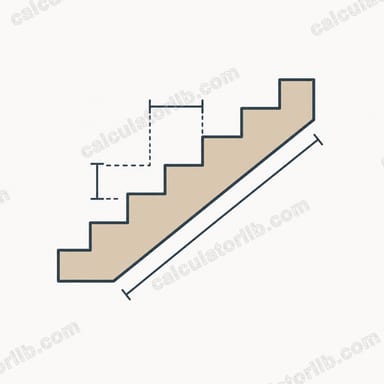
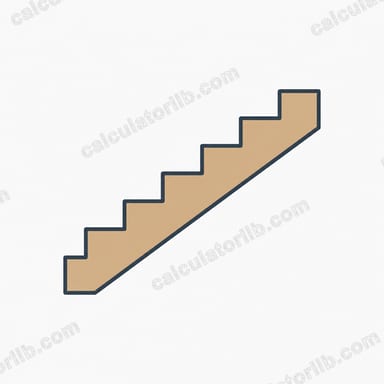
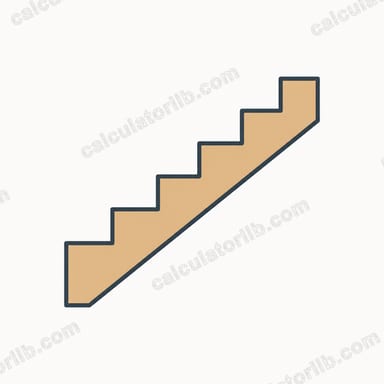
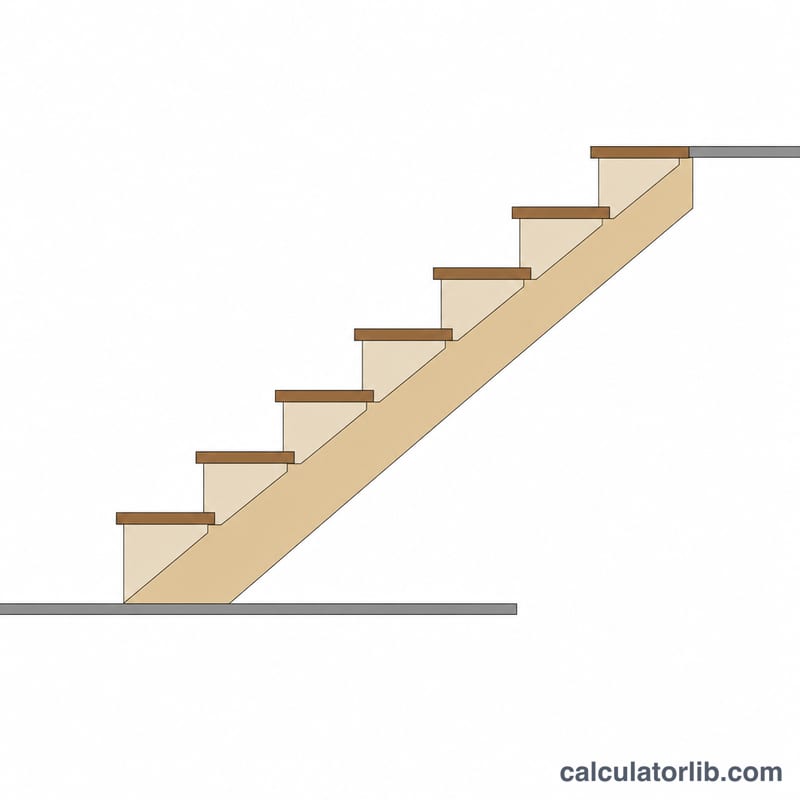
A stair stringer is the inclined structural board that supports the treads and risers of a staircase. The stringer length is the straight diagonal distance along the slope of the stairs, which you need to know before cutting your lumber. This calculator finds the minimum board length required so your stringer spans the full rise and run of the staircase.
How to Use This Calculator
Enter the number of risers and the height of each riser (in inches), then the number of treads and the depth of each tread. The calculator multiplies these to find the total rise and total run, then applies the Pythagorean theorem to return the diagonal stringer length. It also reports the stair angle so you can check it falls within a comfortable 30°–37° range.
The Formula Explained
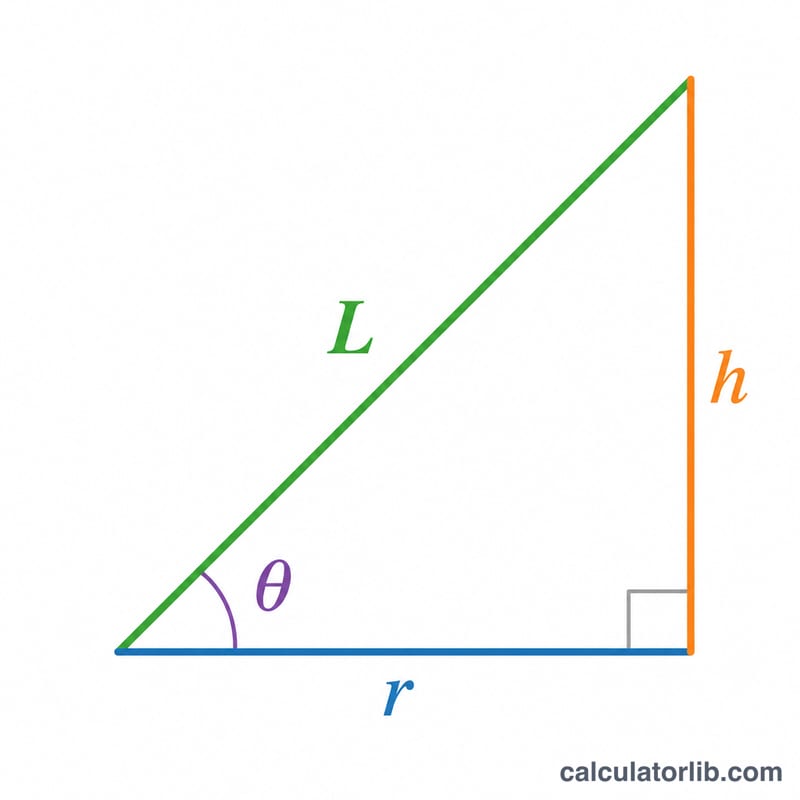
The total rise is the riser count times riser height, and the total run is the tread count times tread depth. The stringer forms the hypotenuse of a right triangle whose legs are the rise and run:
$$L = \sqrt{\left(\text{Risers} \times \text{Riser Height}\right)^{2} + \left(\text{Treads} \times \text{Tread Depth}\right)^{2}}$$
Note that a typical stair has one more riser than treads, because the top landing acts as the final step.
Worked Example
Suppose you have 14 risers at 7.5 in each and 13 treads at 10 in each. Total rise = \(14 \times 7.5 = 105\) in. Total run = \(13 \times 10 = 130\) in. Stringer length = $$\sqrt{105^{2} + 130^{2}} = \sqrt{11025 + 16900} = \sqrt{27925} \approx 167.11 \text{ in.}$$ The stair angle is \(\arctan(105 / 130) \approx 38.9\degree\).
FAQ
Should I buy a longer board than the calculated length? Yes — always add extra length for the cuts at the top and bottom plus a margin for error.
Why is the angle important? Building codes typically favour stairs between 30° and 37° for comfort and safety; steeper stairs feel like a ladder.
Does this account for the tread nosing? No. This computes the raw structural diagonal from rise and run; nosing overhang does not change the stringer length.