
What is the Pea Gravel Calculator?
Pea gravel is a small, rounded aggregate popular for paths, patios, driveways, drainage beds and landscaping fill. This calculator estimates how much pea gravel you need for a rectangular area, giving the answer in both cubic yards (how gravel is often sold in bulk) and tons (how trucks usually charge). Just enter the dimensions of the area and a density figure, and the tool does the rest.
How to use it
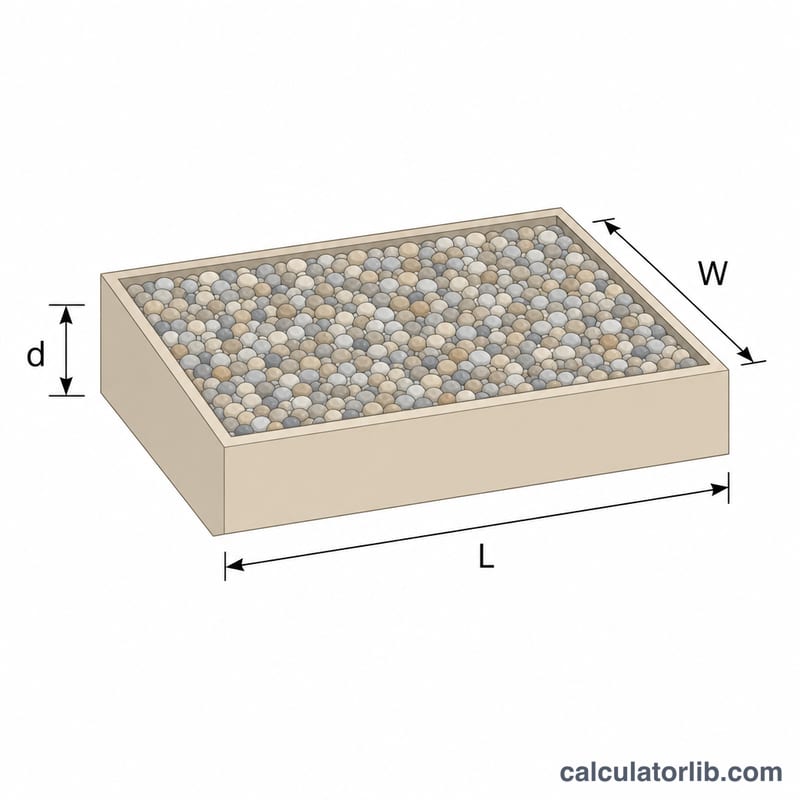
Measure the length and width of the area in feet and decide how deep you want the gravel layer in inches (2–3 inches is common for walkways, up to 4 inches for driveways). Enter the density in tons per cubic yard — loose dry pea gravel is roughly 1.4 tons per cubic yard, though this varies by moisture and supplier. The calculator returns the volume in cubic yards and cubic feet, the coverage area, and the estimated weight in tons.
The formula explained
First the depth in inches is converted to feet by dividing by 12. The cubic feet of material equals length × width × depth (all in feet). Since there are 27 cubic feet in a cubic yard, dividing by 27 gives cubic yards. Multiplying cubic yards by the density gives the weight in tons.
$$\text{Tons} = \frac{\text{Length} \times \text{Width} \times (\text{Depth}/12)}{27} \times \text{Density}$$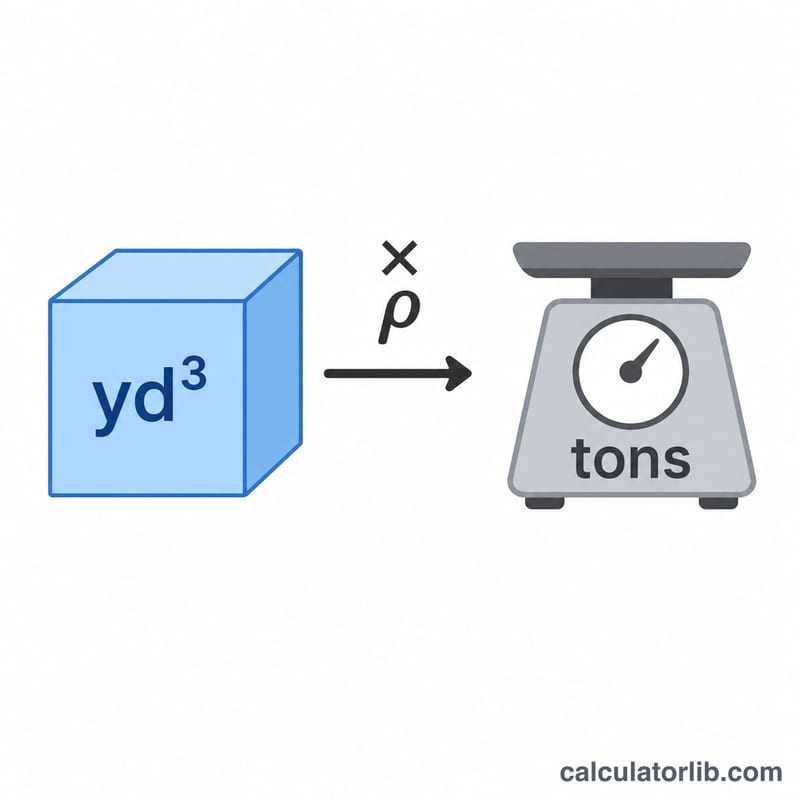
Worked example
For a patio 20 ft long and 10 ft wide filled 2 inches deep: depth = \(2/12 = 0.1667\) ft. Cubic feet = \(20 \times 10 \times 0.1667 = 33.33\) ft³. Cubic yards = \(33.33 / 27 = 1.235\) yd³. At 1.4 tons per yard, that is \(1.235 \times 1.4 \approx 1.73\) tons.
FAQ
How deep should pea gravel be? About 2 inches for walkways and decorative beds, and 3–4 inches for driveways or high-traffic areas. For loose surfaces, add a compacted base layer underneath.
What density should I use? Dry loose pea gravel averages around 1.4 tons per cubic yard (about 2,800 lb). Wet or compacted gravel weighs more; check with your supplier for an exact figure.
Should I order extra? Yes — adding about 5–10% accounts for settling, compaction and uneven ground.