What is the Gravel Coverage Area Calculator?
This calculator estimates how much gravel you need to cover a given area at a chosen depth. It returns the volume in cubic feet and cubic yards, and the weight in tons, so you can order the right amount of material for driveways, paths, patios, drainage beds, and landscaping projects.
How to use it
Enter the area you want to cover in square feet, the desired depth of gravel in inches, and the density of your gravel in tons per cubic yard. Most crushed stone and gravel weighs between 1.3 and 1.5 tons per cubic yard; check with your supplier for an exact figure. Press calculate to see the volume and tonnage required.
The formula explained
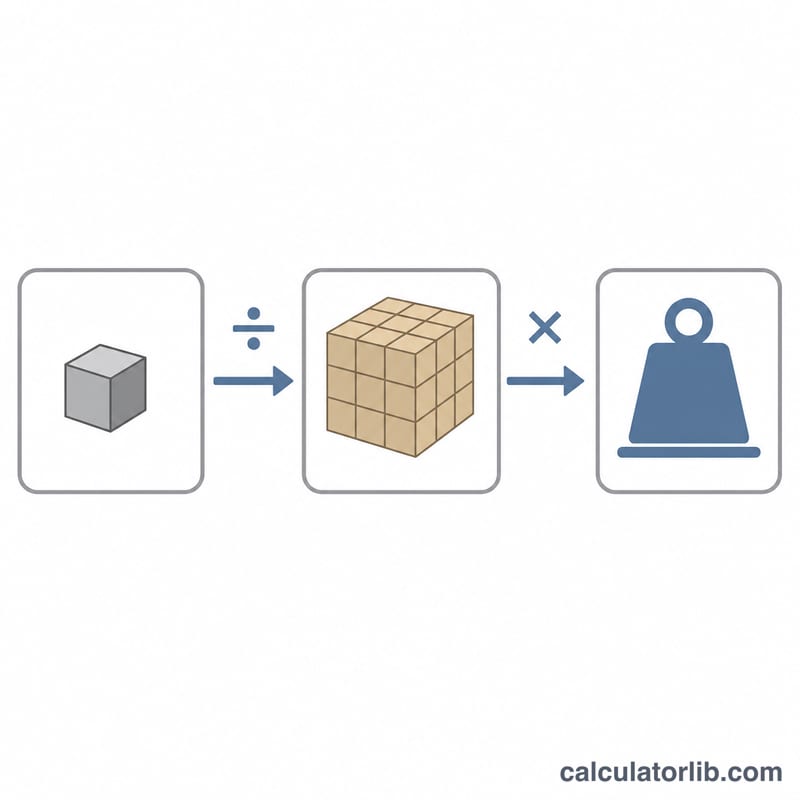
First the depth is converted from inches to feet by dividing by 12. Volume in cubic feet equals area times depth in feet. Since gravel is sold by the cubic yard, divide cubic feet by 27 (there are 27 cubic feet in a cubic yard). Finally, multiply the cubic yards by the density to get the weight in tons.
$$\text{Tons} = \frac{\text{Area (sq ft)} \times \dfrac{\text{Depth (in)}}{12}}{27} \times \text{Density (t/yd}^3\text{)}$$where
$$\left\{ \begin{aligned} V_{ft^3} &= \text{Area} \times \dfrac{\text{Depth}}{12} \\ V_{yd^3} &= \dfrac{V_{ft^3}}{27} \end{aligned} \right.$$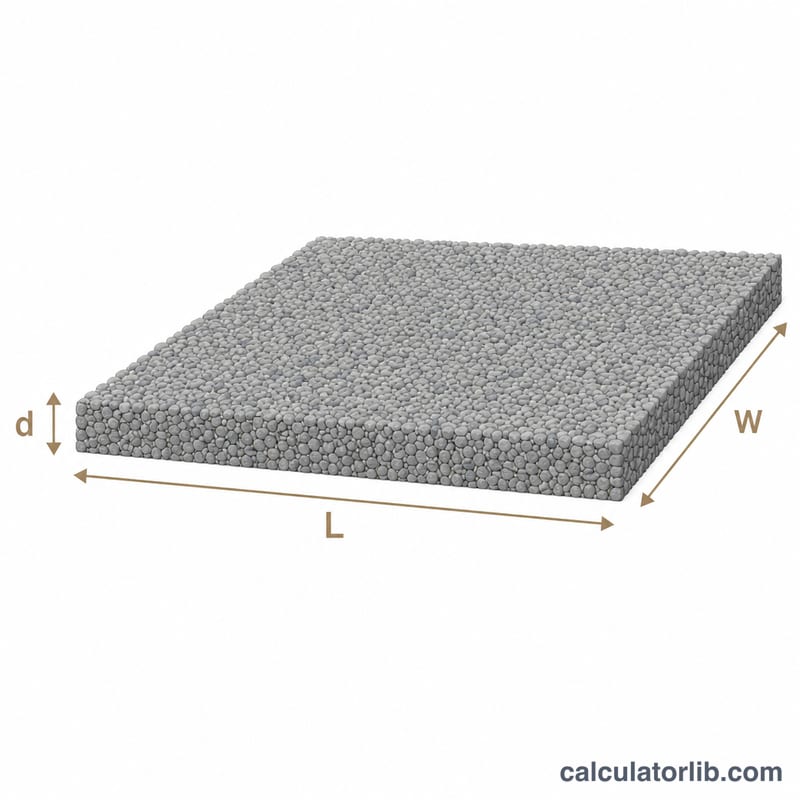
Worked example
Suppose you cover 200 sq ft at 2 inches deep with gravel weighing 1.4 t/yd³. Depth in feet = \(2/12 = 0.1667\) ft. Volume = \(200 \times 0.1667 = 33.33\) ft³. In cubic yards = \(33.33 / 27 = 1.235\) yd³. Tons = \(1.235 \times 1.4 = 1.728\) tons.
Gravel Density by Material Type
Use these approximate bulk densities as the Density (t/yd³) input. Tons here are US short tons (2,000 lb). Real values vary by supplier, rock type, particle size, and moisture. Wet or damp material can weigh noticeably more than dry, so ask your supplier for the figure for your load.
| Material | Approx. density (tons per yd³) | Approx. density (lb per ft³) |
|---|---|---|
| Pea gravel | 1.4 – 1.5 | 104 – 111 |
| Crushed stone (#57) | 1.35 – 1.5 | 100 – 111 |
| Road base / crusher run | 1.4 – 1.7 | 104 – 126 |
| River rock | 1.3 – 1.5 | 96 – 111 |
| Decomposed granite | 1.3 – 1.5 | 96 – 111 |
| Sand | 1.2 – 1.5 (dry to wet) | 89 – 111 |
| Topsoil | 0.9 – 1.2 | 67 – 89 |
Conversion used: \(\text{lb/ft}^3 = \dfrac{\text{tons/yd}^3 \times 2000}{27}\). If you have no supplier figure, 1.4 tons per cubic yard is a common planning value for general gravel.
Recommended Gravel Depths by Project
These are typical, general depths in inches. Actual needs depend on soil, load, and drainage.
| Project | Typical depth (in) |
|---|---|
| Walkways and paths | 2 – 3 |
| Patios (base layer) | 4 |
| Driveways (base plus top layer) | 4 – 6 |
| Drainage trenches / French drains | 6 – 12+ |
| Decorative landscaping beds (mulch-like cover) | 2 – 3 |
Note: Confirm depth, stone size, and compaction requirements with your local building codes or your gravel supplier. Many people also order about 5–10% extra to allow for compaction and uneven ground.
Gravel Quick Conversions
| Conversion | Value |
|---|---|
| 1 cubic yard | 27 cubic feet = 0.7646 m³ |
| 1 ton (US short) | 2,000 lb |
| 1 metric tonne | 1.1023 short tons |
Area covered by 1 cubic yard
| Depth | Coverage (approx. sq ft) |
|---|---|
| 1 in | 324 |
| 2 in | 162 |
| 3 in | 108 |
| 4 in | 81 |
| 6 in | 54 |
Coverage formula: \(\text{Area} = \dfrac{27}{\text{depth in feet}}\). For 4 in, \(\dfrac{27}{4/12} = \dfrac{27}{0.3333} = 81\) sq ft.
Example: 81 sq ft at 4 in deep is \(81 \times \tfrac{4}{12} = 27\) ft³, which is 1 yd³. At 1.4 tons per yd³ that is 1.4 tons.
FAQ
What density should I use? A typical value for pea gravel or crushed stone is about 1.4 tons per cubic yard. Wet or compacted gravel weighs more.
Should I order extra? Yes — add roughly 5–10% to account for compaction and uneven ground.
Can I use this for sand or topsoil? Yes, just enter the correct density for that material.