
What this calculator does
The Epoxy Resin Coverage Calculator tells you how much liquid epoxy you need to pour a coating of a given thickness over a flat surface. It works from the simplest geometric idea: the volume of a coating equals its surface area multiplied by its depth. Enter the dimensions of your piece and the target thickness and it returns the total mixed resin you should prepare, in fluid ounces and gallons.
How to use it
Measure the surface you plan to coat and enter its length and width in inches. Choose your coating thickness — a thin "seal coat" is typically 1/32" (0.03"), while a self-leveling "flood coat" on a tabletop is usually 1/8" (0.125"). Add a waste percentage to cover what stays in the mixing cup, drips off the edges, and minor measuring error; 10% is a common default. The result is the combined volume of resin plus hardener you should mix.
The formula explained
Volume (in³) = Length × Width × Thickness. Because resin is sold by liquid volume, we convert cubic inches to fluid ounces using 1 fl oz = 1.8046875 in³, and to gallons using 1 gallon = 231 in³. The waste factor multiplies the raw volume by (1 + waste ÷ 100).
$$V = L \times W \times T \times \left(1 + \frac{w}{100}\right)$$where:
$$\left\{ \begin{aligned} L &= \text{Length (in)} \\ W &= \text{Width (in)} \\ T &= \text{Thickness (in)} \\ w &= \text{Waste (\%)} \end{aligned} \right.$$$$\text{Ounces} = \frac{\text{Length} \times \text{Width} \times \text{Thickness} \times \left(1 + \frac{\text{Waste}}{100}\right)}{1.8046875}$$$$\text{Gallons} = \frac{\text{Length} \times \text{Width} \times \text{Thickness} \times \left(1 + \frac{\text{Waste}}{100}\right)}{231}$$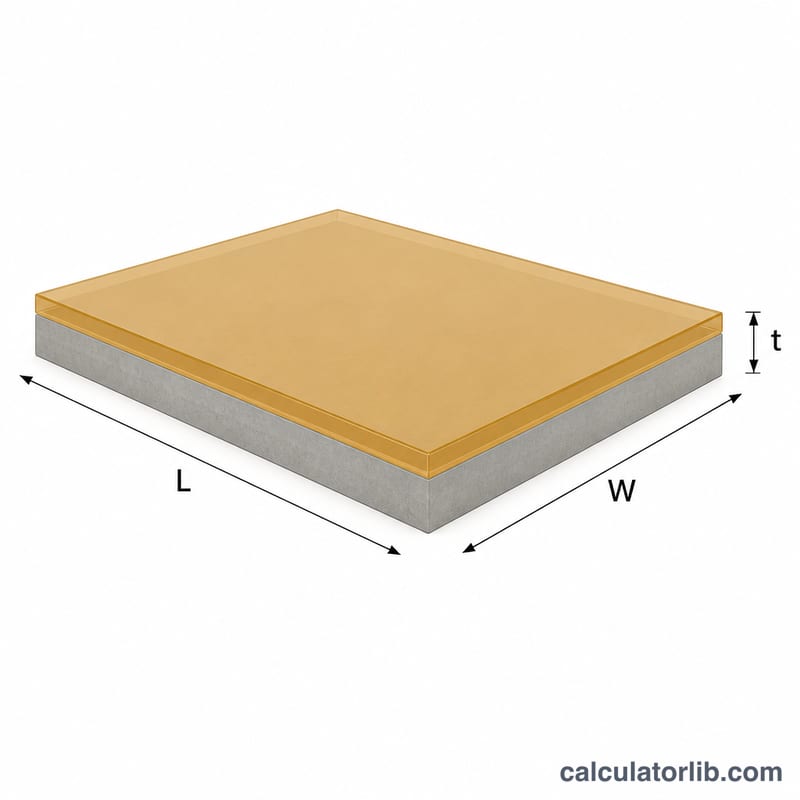
Worked example
For a 24 × 24 inch tabletop with a 1/8" (0.125") flood coat and 10% overage: area = 576 in², raw volume = 576 × 0.125 = 72 in³. With 10% overage that is 79.2 in³, which is 79.2 ÷ 1.8046875 ≈ 43.9 fluid ounces, or about 0.343 gallons of mixed epoxy.
$$\text{area} = 576 \text{ in}^2$$$$\text{raw volume} = 576 \times 0.125 = 72 \text{ in}^3$$$$72 \times 1.10 = 79.2 \text{ in}^3$$$$\frac{79.2}{1.8046875} \approx 43.9 \text{ fluid ounces}$$$$\approx 0.343 \text{ gallons}$$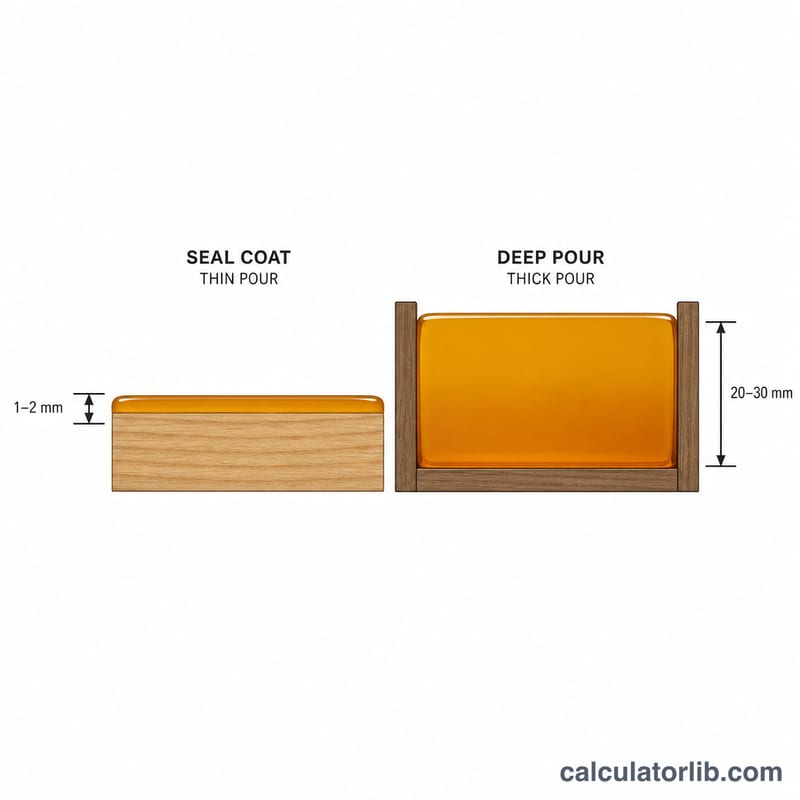
FAQ
Does this include hardener? Yes — the result is the total mixed volume. Split it by your product's mix ratio (e.g. 1:1 by volume means half resin, half hardener).
What thickness should I use? Seal coats are about 0.03", flood/casting coats 0.125" or more per pour. Many resins limit a single pour depth, so deep casts may need multiple layers.
What about edges and drips? Resin self-levels and runs off edges, so always add overage — 10–15% is sensible for open pours.