
What is the Gleason Score?
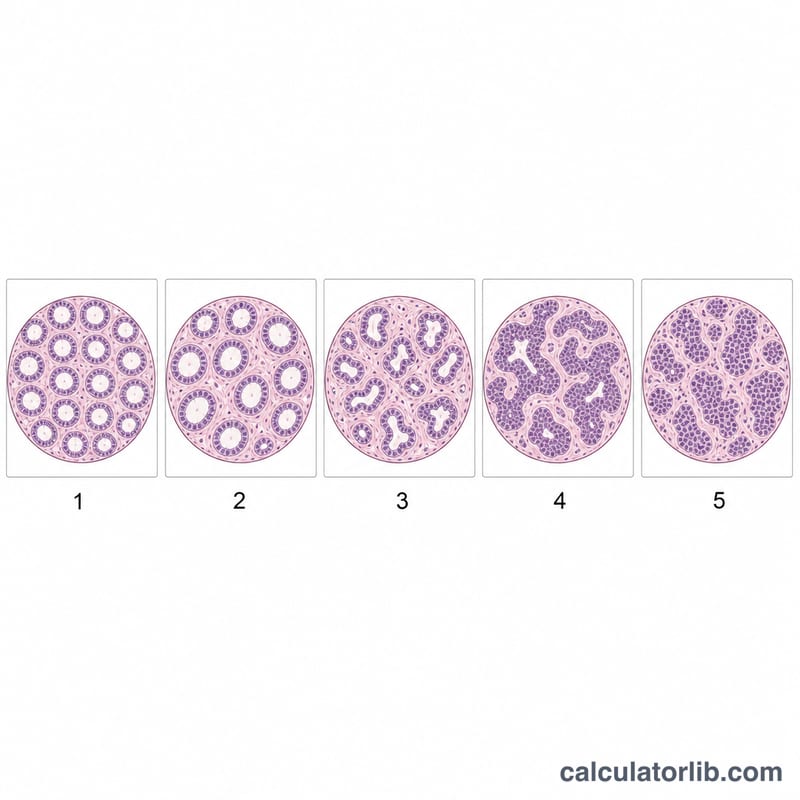
The Gleason score is a grading system used by pathologists to describe how aggressive prostate cancer cells appear under the microscope. It is reported as two numbers — the primary pattern (the most common cell pattern in the tissue) plus the secondary pattern (the next most common) — each rated from 1 (looks most like normal tissue) to 5 (most abnormal and aggressive). This calculator adds the two together and converts the result to the modern ISUP/WHO Grade Group. It is intended for educational reference and does not replace a pathologist's report or medical advice.
How to use it
Select the primary pattern reported by your pathologist (most prevalent), then the secondary pattern. The calculator instantly shows the total Gleason score (range 2–10, though most clinical scores are 6–10) and the corresponding Grade Group from 1 to 5.
The formula explained
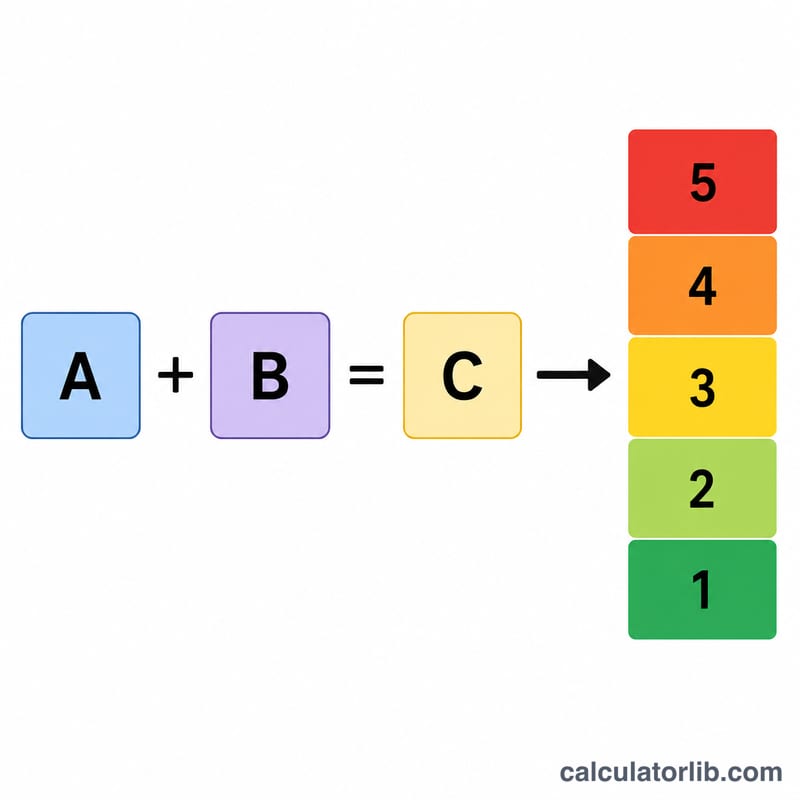
The score is simply Primary + Secondary.
$$\text{Gleason Score} = \text{Primary} + \text{Secondary}$$The Grade Group simplifies these into five clinically meaningful tiers:
$$\text{Grade Group} = \begin{cases} 1 & S \le 6 \\ 2 & S = 7,\ \text{Primary} = 3 \\ 3 & S = 7,\ \text{Primary} = 4 \\ 4 & S = 8 \\ 5 & S \ge 9 \end{cases} \quad S = \text{Primary} + \text{Secondary}$$GG1 = score 6 or less; GG2 = \(3+4=7\); GG3 = \(4+3=7\); GG4 = 8; GG5 = 9 or 10. Note that \(3+4\) and \(4+3\) both total 7 but fall into different Grade Groups because the dominant pattern matters.
Worked example
Suppose a biopsy shows a primary pattern of 4 and a secondary pattern of 3. The Gleason score is
$$4 + 3 = 7$$Because the primary pattern is 4 (not 3), this is Grade Group 3 — a more concerning 7 than a \(3+4 = 7\), which would be Grade Group 2.
FAQ
Why are 3+4 and 4+3 different? Both equal 7, but the first number is the dominant pattern. More high-grade (pattern 4) tissue generally means a worse prognosis, so \(4+3\) is Grade Group 3 while \(3+4\) is Grade Group 2.
What is a "good" score? Lower is less aggressive. Grade Group 1 (Gleason 6) is the lowest-risk diagnosable cancer; Grade Group 5 (Gleason 9–10) is the most aggressive.
Is this a diagnosis? No. Only a qualified pathologist and clinician can interpret your full pathology and clinical picture.