What the Tennis Rating (UTR-Style) Calculator does
This calculator estimates a single-match tennis rating on the same 1.0-16.5 scale made familiar by the Universal Tennis Rating (UTR). Instead of looking only at who won, it rewards how many games you took from a rated opponent, so a close loss to a strong player and a lopsided win over a weaker one both land where they belong. The output is a performance rating: roughly where your play in that one match sits on the UTR scale.
How to use it
Enter your opponent's UTR rating (a number from 1.0 to 16.5), the total number of games you won across the match, and the number of games your opponent won. Then calculate. The main figure is your estimated match rating; the table also shows how far above or below your opponent you played and the share of games you won.
The formula explained
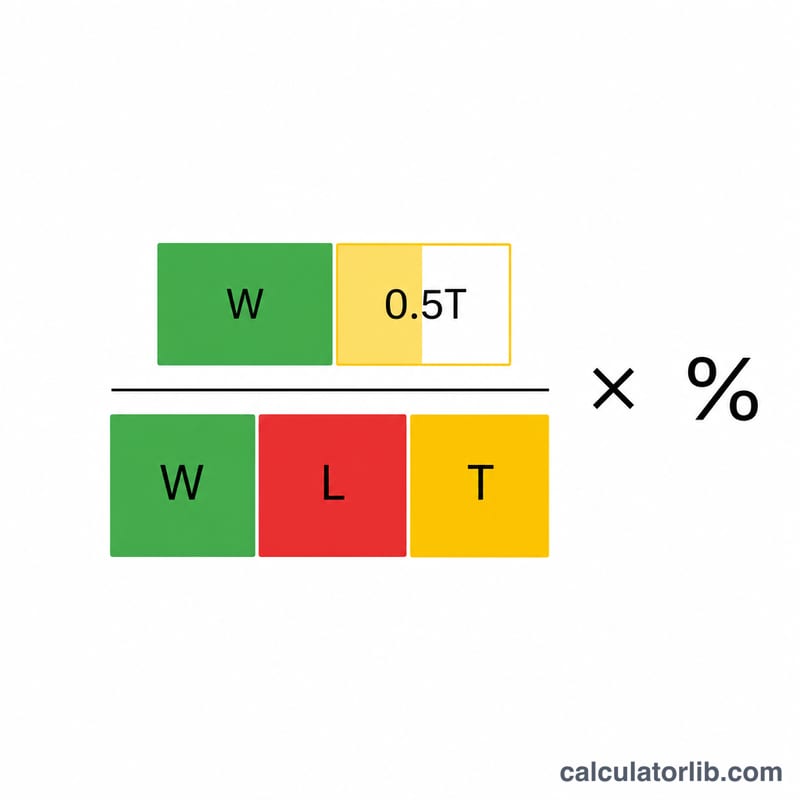
First we measure the share of games you won, P:
$$P = \frac{w}{w + L}$$Here w is the games you won and L is the games your opponent won. We then turn that share into a rating offset from your opponent and add it to their rating R_o:
$$R = R_o + S \cdot \log_{10}\left(\frac{P}{1 - P}\right)$$This is the standard Elo-style performance-rating inversion: an even 50% game share (P = 0.5) returns your opponent's exact rating, and winning a larger share pushes you above it. The scale constant S = 3.32 is a transparent calibration chosen so that winning about twice as many games as you lose places you roughly 1.0 point above your opponent. The estimate is clamped to the valid 1.0-16.5 UTR range. UTR's official algorithm is proprietary and blends many recent matches with reliability and recency weighting; this tool is a transparent, opponent-adjusted approximation for a single result.
Worked example
Suppose you play an opponent rated 8.0 and win 12 games while losing 6. Your game share is P = 12 / 18 = 0.667, so P / (1 - P) = 2. The base-10 log of 2 is about 0.301, and 3.32 times 0.301 is about 1.00. Your match rating is R = 8.0 + 1.00 = 9.0 - one full point above your opponent, reflecting a clear but not lopsided win.
Match Rating Across Example Scores
This simplified, UTR-style estimate turns the share of games you won in one match into a performance rating relative to your opponent. With game share \(P = \frac{w}{w+L}\), the rating is:
$$R = R_o + 3.32 \cdot \log_{10}\left(\frac{P}{1-P}\right)$$
Because \(\frac{P}{1-P} = \frac{w}{L}\), this is the same as \(R = R_o + 3.32\cdot\log_{10}(w/L)\). The result is clamped to the range 1.0–16.5. The table below uses a fixed opponent rating \(R_o = 8.0\).
| Games won (w) | Games lost (L) | Game share P | Calculation | Rating R |
|---|---|---|---|---|
| 6 | 0 | 1.000 | w/L is undefined (infinite), so the rating is clamped | 16.5 (clamped at maximum) |
| 6 | 1 | 0.857 | 8.0 + 3.32·log10(6) = 8.0 + 2.58 | 10.58 |
| 12 | 6 | 0.667 | 8.0 + 3.32·log10(2) = 8.0 + 1.00 | 9.00 |
| 12 | 9 | 0.571 | 8.0 + 3.32·log10(1.333) = 8.0 + 0.41 | 8.41 |
| 9 | 9 | 0.500 | 8.0 + 3.32·log10(1) = 8.0 + 0 | 8.00 |
| 6 | 12 | 0.333 | 8.0 + 3.32·log10(0.5) = 8.0 − 1.00 | 7.00 |
| 0 | 6 | 0.000 | w/L = 0, so the logarithm is undefined (−∞) and the rating is clamped | 1.0 (clamped at minimum) |
Worked example (12-6): \(P = \frac{12}{12+6} = 0.667\), so \(\frac{P}{1-P} = \frac{0.667}{0.333} = 2\). Then \(R = 8.0 + 3.32 \times 0.30103 = 8.0 + 0.9994 \approx 9.00\).
Note how a shutout (6-0 or 0-6) pushes the rating to the edge of the scale, which is why such results are clamped rather than used as-is. Rounded values are shown to two decimals.
Interpreting Your Match Rating
The output is a single-match performance rating: the level you effectively played at in that match, judged against your opponent's rating.
- Above the opponent's rating: you won more than half of the games (P > 0.5), so the match suggests a level higher than your opponent's.
- Equal to the opponent's rating: you won exactly half the games (P = 0.5), so the match suggests an even level.
- Below the opponent's rating: you won fewer than half of the games (P < 0.5), so the match suggests a lower level.
Each doubling of the games ratio (w/L) shifts the rating by about 1.0 (3.32 × log102 ≈ 1.0).
Rough rating bands
| Approximate rating | Typical level of play |
|---|---|
| ~1–3 | Beginner |
| ~4–7 | Club / recreational player |
| ~8–12 | College / advanced player |
| ~13–16.5 | Professional |
These bands are approximate guides, not official cutoffs, and boundaries between levels overlap.
Why one match is noisy
A single match covers a small number of games, so conditions such as surface, weather, fatigue, a few key points or a lucky streak can swing the score. The official UTR system uses many matches, weighting each by factors such as how recent it is and how reliable the opponent's rating is, so random swings average out. This simplified calculator uses one match only, so treat its output as a rough estimate, not as an official rating.
Key Terms and Variables
- UTR (Universal Tennis Rating)
- A numerical tennis rating system on a scale from 1.0 to 16.5 that rates players by match results, regardless of age, gender or competition type. The official UTR algorithm is proprietary and more complex than the single-match formula used here.
- Opponent rating \(R_o\)
- The rating of the player you faced. It anchors the result: an even game split returns this value.
- Games won \(w\)
- The total number of games you won in the match.
- Games lost \(L\)
- The total number of games your opponent won in the match.
- Game share \(P\)
- The fraction of all games you won: \(P = \frac{w}{w+L}\). It ranges from 0 to 1.
- Performance rating \(R\)
- The estimated rating shown by this match: \(R = R_o + S\cdot\log_{10}\left(\frac{P}{1-P}\right)\).
- Scale constant \(S = 3.32\)
- The multiplier that converts the log of the games ratio into rating points. Since 3.32 ≈ 1/log102, doubling the games ratio adds about 1.0 to the rating.
- Clamping to 1.0–16.5
- Limiting the result to the scale's minimum and maximum. Shutouts (P = 0 or P = 1) make the logarithm undefined, and very lopsided scores can exceed the scale, so the rating is held at 1.0 or 16.5.
Frequently asked questions
Is this the official UTR number? No. UTR's real algorithm is proprietary and weighs up to your last 30 matches with reliability and recency factors. This calculator is a transparent single-match approximation on the same 1.0-16.5 scale, not an official rating.
Why does the score matter and not just who won? Because the share of games you win reflects how competitive the match was. Beating a player 6-0 6-0 signals a much larger skill gap than edging them 7-6 7-6, and the game-based formula captures that difference.
What happens if I won every single game? A clean sweep gives no information about how much better you are, so the math is capped to avoid an infinite offset and the estimate stays within the 1.0-16.5 range. Play closer matches against varied opponents for a more precise picture.