
What Is the Elo Rating System?
The Elo rating system, devised by physicist Arpad Elo, is a method for ranking players in two-player games such as chess, Go, and many esports. Each player has a numeric rating; after every game the ratings are updated based on the outcome and the difference between the players' ratings. Beating a stronger opponent earns more points than beating a weaker one.
How to Use This Calculator
Enter your current rating, your opponent's rating, the result of the game (win, draw, or loss), and the K-factor used by your federation or platform. The calculator returns your new rating, the net rating change, and the expected score — the probability-weighted result the formula predicted.
The Formula Explained
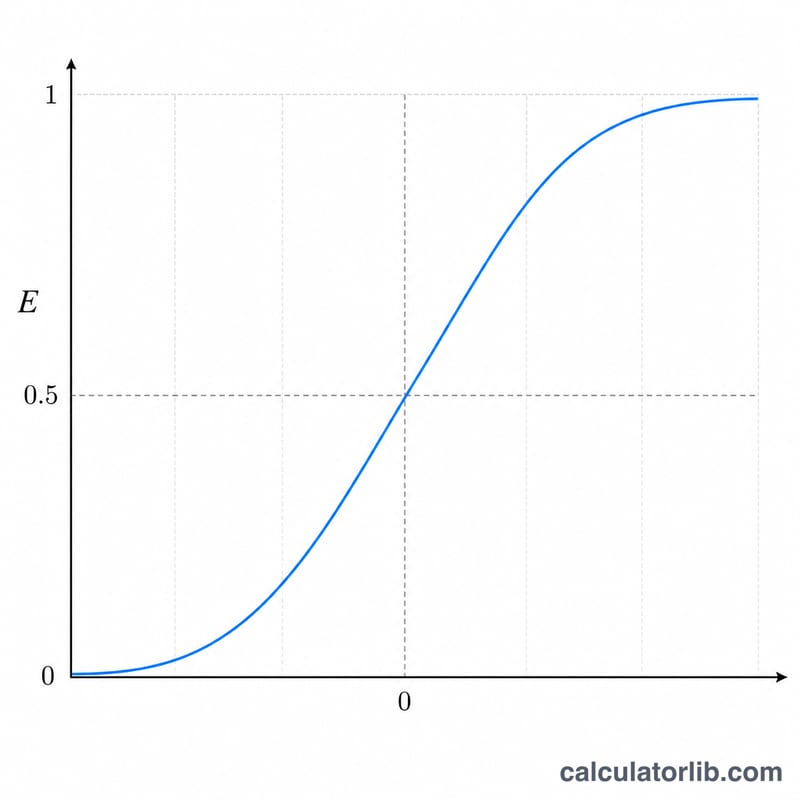
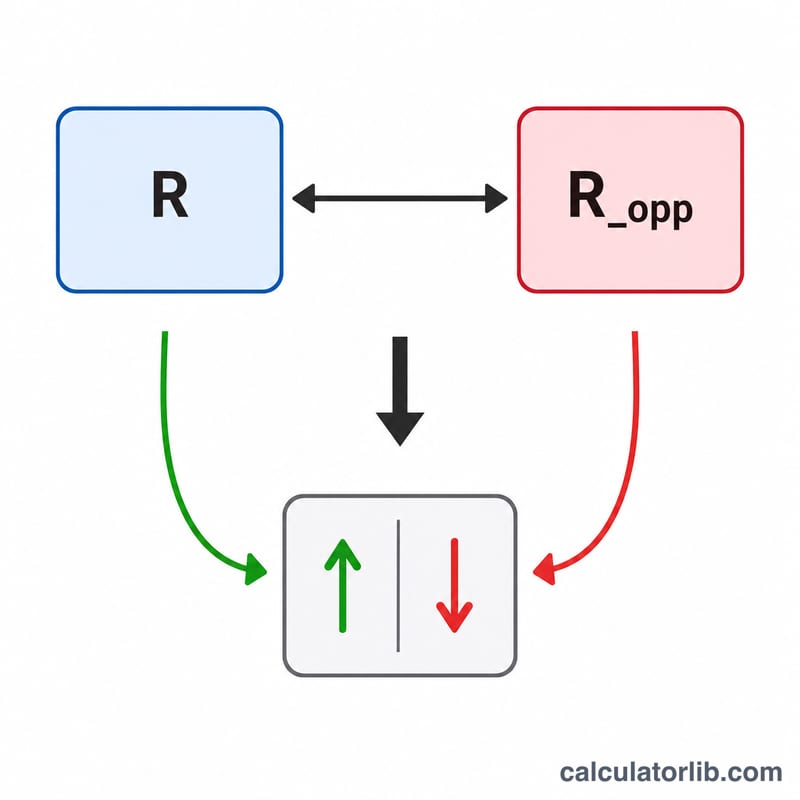
The expected score is \( E = \dfrac{1}{1 + 10^{(R_{opp} - R)/400}} \), a value between 0 and 1 representing the likelihood of winning. The new rating is \( R' = R + K\cdot(S - E) \), where S is the actual score (1 for a win, 0.5 for a draw, 0 for a loss). The K-factor controls volatility: higher K means bigger swings. Common values are 40 for new players, 20 for established players, and 10 for masters; many casual platforms use 32.
Worked Example
Suppose you are rated 1500 and beat an opponent rated 1600 with K = 32. The expected score is $$E = \frac{1}{1 + 10^{(1600 - 1500)/400}} = \frac{1}{1 + 10^{0.25}} \approx 0.3599.$$ Since you won, S = 1, so $$R' = 1500 + 32 \times (1 - 0.3599) \approx 1500 + 20.48 = 1520.48.$$ You gain about 20 points for the upset.
FAQ
What K-factor should I use? Use the value your rating provider applies. FIDE uses 40 for newcomers, 20 for most players, and 10 for those rated over 2400.
What does a draw do? A draw (S = 0.5) still changes ratings if the players differ in strength — the lower-rated player typically gains points.
Can ratings go down after a win? No. A win always gives points because \( S - E \) is positive when S = 1.