
What Is the Anaerobic Threshold?
The anaerobic threshold (AT), sometimes called the lactate threshold, is the exercise intensity at which lactate begins to accumulate in the blood faster than the body can clear it. Training near this point improves endurance and your ability to sustain hard efforts. This calculator gives a quick estimate of the heart rate at your anaerobic threshold based on your age and a chosen intensity percentage.
How to Use This Calculator
Enter your age in years and the threshold intensity percentage you want to target. The default of 85% reflects a common rule-of-thumb estimate of the anaerobic threshold for recreational athletes. The tool first computes your age-predicted maximum heart rate, then multiplies it by your chosen percentage to give the estimated AT heart rate in beats per minute.
The Formula Explained
First, maximum heart rate is estimated as \(\text{HR}_{max} = 220 - \text{age}\). Then the anaerobic threshold heart rate is
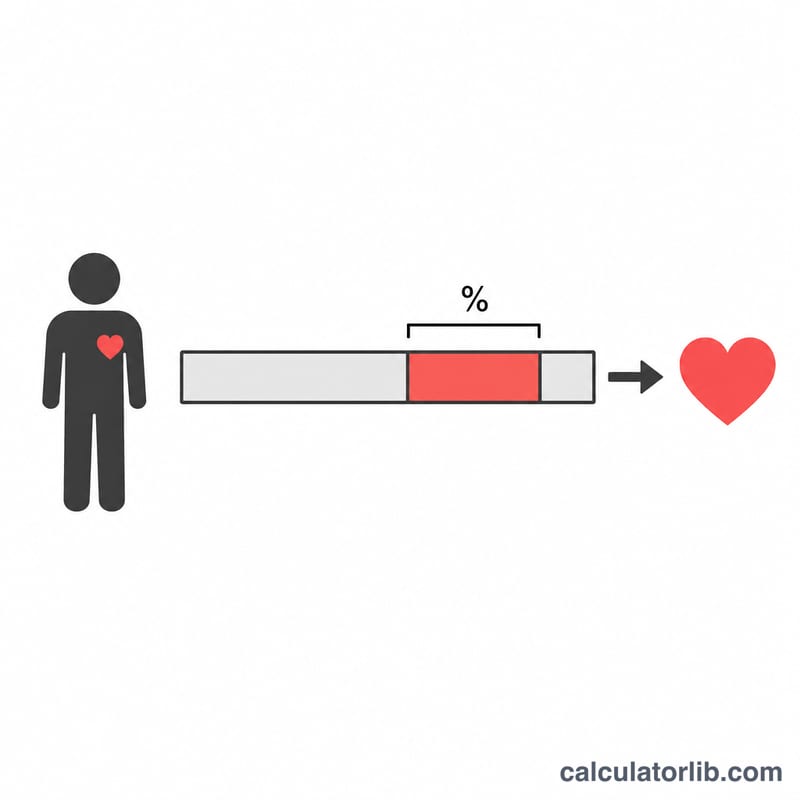
$$\text{AT}_{HR} = \frac{\%}{100} \times \text{HR}_{max}$$Using 85% as the default, \(\text{AT}_{HR} \approx 0.85 \times (220 - \text{age})\). Note that the "220 − age" formula is a population average — individual maximums can vary by ±10–12 bpm, so treat the result as a starting guideline rather than an exact value.
Worked Example
For a 30-year-old at 85% intensity: \(\text{HR}_{max} = 220 - 30 = 190\) bpm.
$$\text{AT}_{HR} = 0.85 \times 190 = 161.5 \text{ bpm}$$which rounds to about 162 bpm. Training sustained efforts near this heart rate helps push the threshold higher over time.
AT Heart Rate at Different Intensity Percentages
Anaerobic threshold is commonly targeted at roughly 80–90% of estimated maximum heart rate. Using the Fox formula \(\text{HR}_{max}=220-\text{age}\), the table below shows the estimated AT heart-rate band for several ages. Each row gives the bpm value at 80%, 85% and 90% of that age's estimated maximum.
| Age | Est. HRmax (bpm) | 80% (bpm) | 85% (bpm) | 90% (bpm) |
|---|---|---|---|---|
| 25 | 195 | 156 | 166 | 176 |
| 35 | 185 | 148 | 157 | 167 |
| 45 | 175 | 140 | 149 | 158 |
| 55 | 165 | 132 | 140 | 149 |
For a worked check at age 25 and 80%: \(\text{AT}_{HR}=\frac{80}{100}\times(220-25)=0.80\times195=156\ \text{bpm}\). The 80–90% span gives a practical AT band of about 156–176 bpm for this age. You can convert any single heart-rate value back into a percentage of maximum with a percent-of-max calculation, or map the full set of training zones with a heart-rate zone calculator.
Interpreting Your Result
The value this calculator returns is a population estimate, not a measured physiological constant. It is built on the age-based formula \(220-\text{age}\) for maximum heart rate and a fixed intensity percentage, so it inherits the uncertainty of both inputs.
Individual maximum heart rate varies by roughly \(\pm10\text{–}12\ \text{bpm}\) around the age-predicted figure, and the heart rate at which a person actually crosses anaerobic threshold depends on training status, genetics, the sport, temperature and hydration. As a result, your true AT can sit anywhere within a similar \(\pm10\text{–}12\ \text{bpm}\) range of the estimate. Treat the number as the center of a band rather than a precise line.
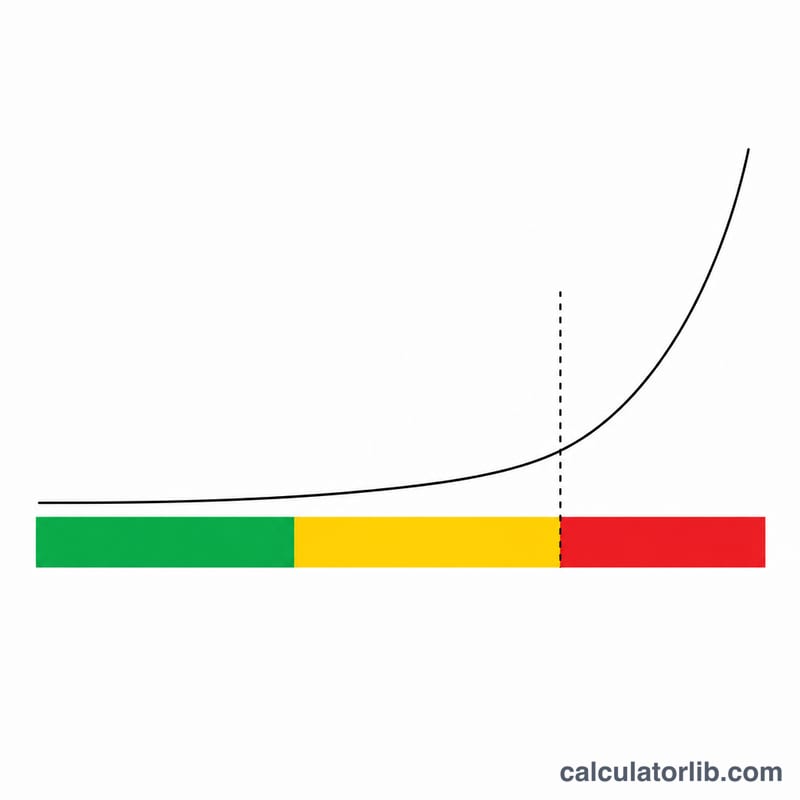
In practical training terms, the anaerobic (or lactate) threshold roughly marks the boundary between the tempo/threshold zone and harder, less sustainable efforts. Training at or just below AT — often described as "comfortably hard" pace that can be held for a sustained block — is used to improve the body's ability to clear lactate and to raise the pace sustainable for endurance events. Many five-zone models place AT near the top of Zone 3 or within Zone 4, which is why threshold sessions cluster around the 80–90% of maximum range.
Because formula-based estimates cannot account for individual physiology, field or laboratory lactate testing gives more accurate values. A graded lab test with blood-lactate sampling identifies the exact heart rate and workload where lactate begins to accumulate, while field tests (such as a sustained time-trial effort with a heart-rate monitor) approximate the same point under real conditions. These methods anchor your zones to measured data rather than an age average.
This is general educational information, not medical or professional training advice. Consult a qualified professional before beginning or changing high-intensity exercise, especially if you have any cardiovascular concern.
FAQ
How accurate is this estimate? It is a rough approximation. A lab lactate test or a field threshold test gives far more personalized numbers.
What intensity percentage should I use? Many sources place the anaerobic threshold between 80% and 90% of max heart rate; 85% is a reasonable midpoint default.
Should I train above or below this rate? Threshold ("tempo") workouts hold intensity right around AT, while easier base training stays well below it. Always progress gradually and consult a professional if you have health concerns.