
What is the Human Punch Force Calculator?
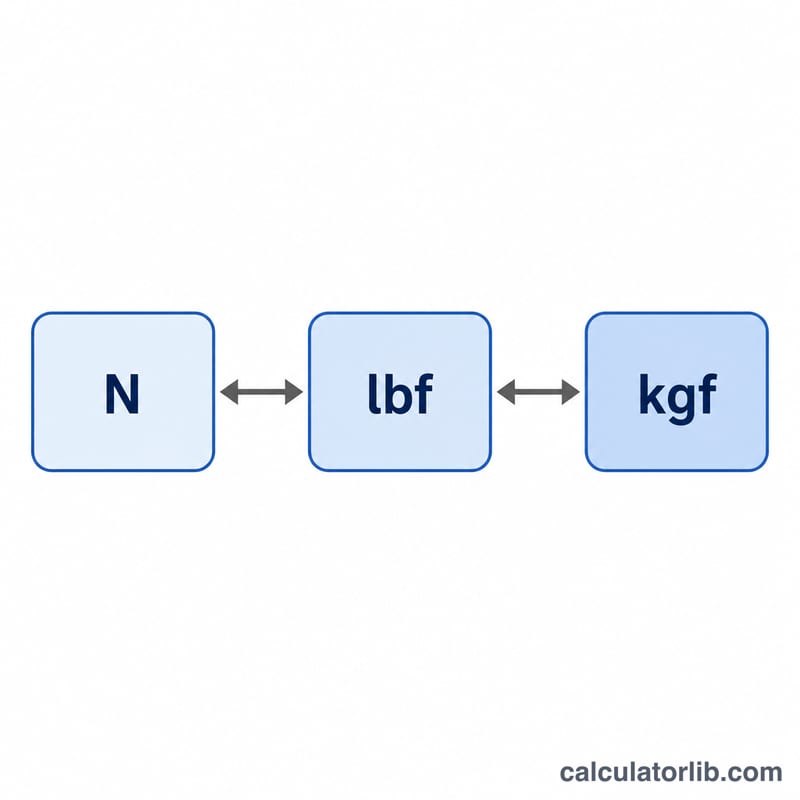
This calculator estimates the average force of a human punch using the impulse–momentum theorem. A punch delivers momentum (mass times velocity) to a target over a short contact time. The shorter the contact and the faster the fist, the larger the peak force. The result is given in newtons, pounds-force (lbf) and kilogram-force (kgf) so you can compare it to everyday references.
How to use it
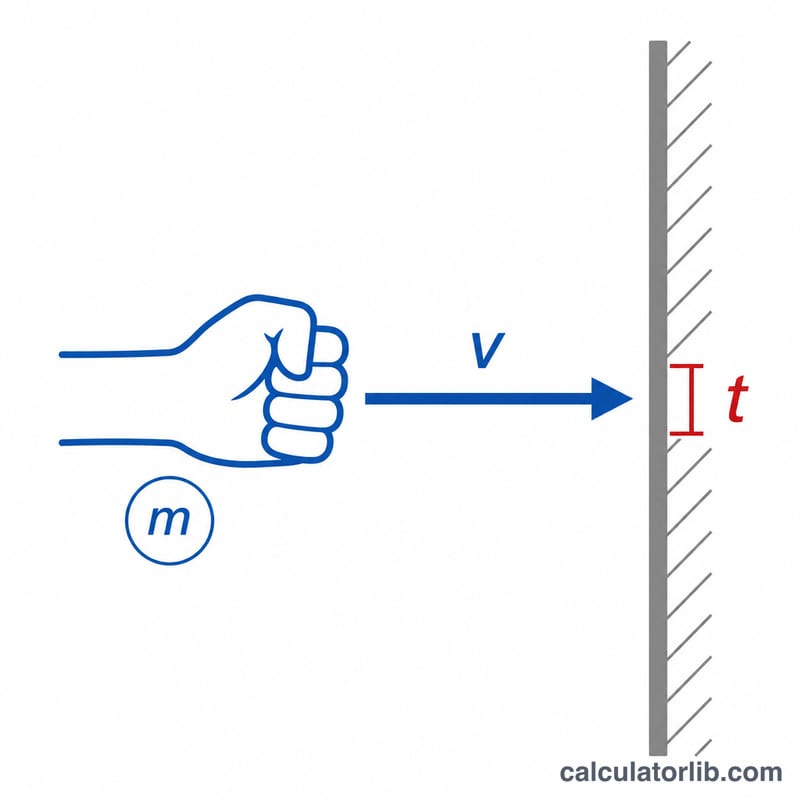
Enter three values: the effective fist/arm mass in kilograms (the portion of your body mass actually behind the strike, often roughly 0.7–1.5 kg for a fist, more if the shoulder and torso drive in), the impact velocity in metres per second (a trained boxer's fist can reach 8–11 m/s), and the contact time in seconds (typically 0.01–0.15 s). The calculator returns the average force of the impact.
The formula explained
The governing equation is $$F = \frac{\text{Mass (kg)} \times \text{Velocity (m/s)}}{\text{Contact Time (s)}}$$ Momentum \(p = m \times v\) is destroyed during the collision; impulse equals force times time (\(F \times t = m \times v\)), so rearranging gives the average force \(F = m \times v / t\). A smaller contact time produces a much larger force, which is why a snappy, rigid punch hits harder than a "pushy" one.
Worked example
Suppose the effective mass is 1 kg, the fist moves at 9 m/s, and contact lasts 0.1 s. Then $$F = \frac{1 \times 9}{0.1} = 90 \text{ newtons}$$ That converts to about 20.2 lbf and 9.2 kgf. Halving the contact time to 0.05 s would double the force to 180 N.
FAQ
Is this exact? No — it is an estimate of average force. Real impacts have a force that rises and falls, so peak force can be higher. Contact time is the hardest value to measure accurately.
What contact time should I use? For a stiff strike against a hard target use 0.01–0.05 s; against a softer target or pad use 0.1 s or more.
What is "effective mass"? It is the equivalent mass driving the fist, not your whole body weight. Good technique recruits more body mass, raising effective mass and force.