
What this calculator does
This tool estimates an approximate lifespan from a resting heart rate using the popular biological idea that mammals share a roughly fixed total number of heartbeats over a lifetime — commonly cited as about 2.0 to 2.3 billion beats (20 to 23 hundred-million, "x10^8"). The hypothesis, often attributed to Dr. Hiroshi Hayashi of Nagoya University, suggests that body size, heart rate, and lifespan are linked: small animals beat fast and live short, large animals beat slow and live long. It is a fascinating pattern, but it is not a medical prediction.
How to use it
Enter a resting heart rate in beats per minute (bpm) and the assumed total lifetime heartbeats in units of hundred-million (x10^8). The default total of 20 corresponds to 2,000,000,000 beats. The calculator returns the implied lifespan in minutes and years, plus a min-max band using the 20 and 23 endpoints of the accepted range.
The formula explained
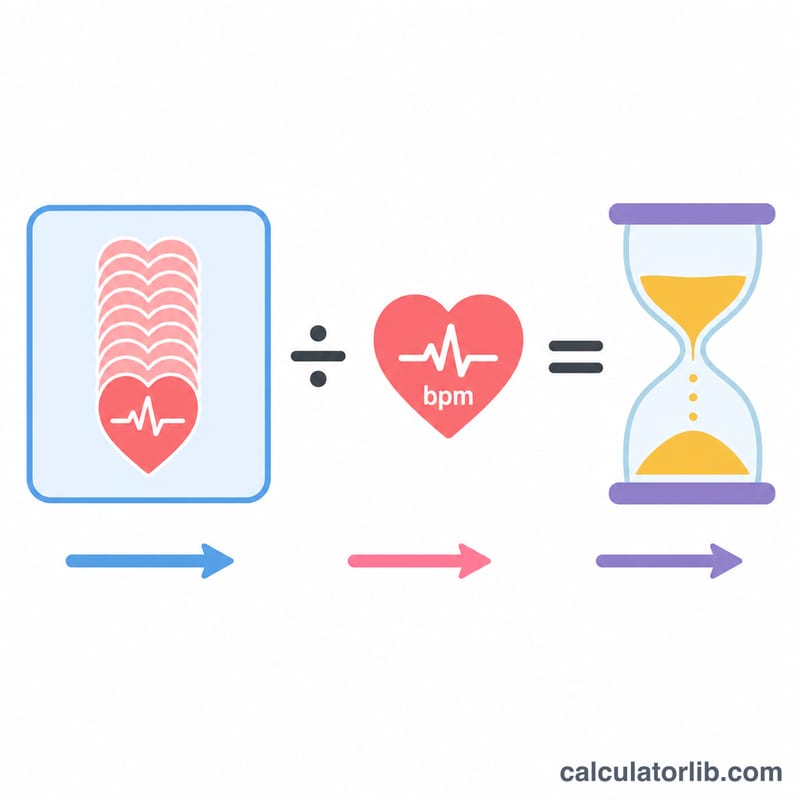
Lifespan in minutes equals total beats divided by heart rate: a faster heart "spends" the fixed beat budget sooner. We multiply your total (in x10^8) by 100,000,000 to get the raw beat count, divide by heart rate, then divide by 525,960 (= 60 x 24 x 365.25) to express the answer in years, accounting for leap years.
$$\text{Lifespan (years)} = \frac{\text{Total Beats} \times 10^{8}}{\text{Heart Rate (bpm)} \times 525960}$$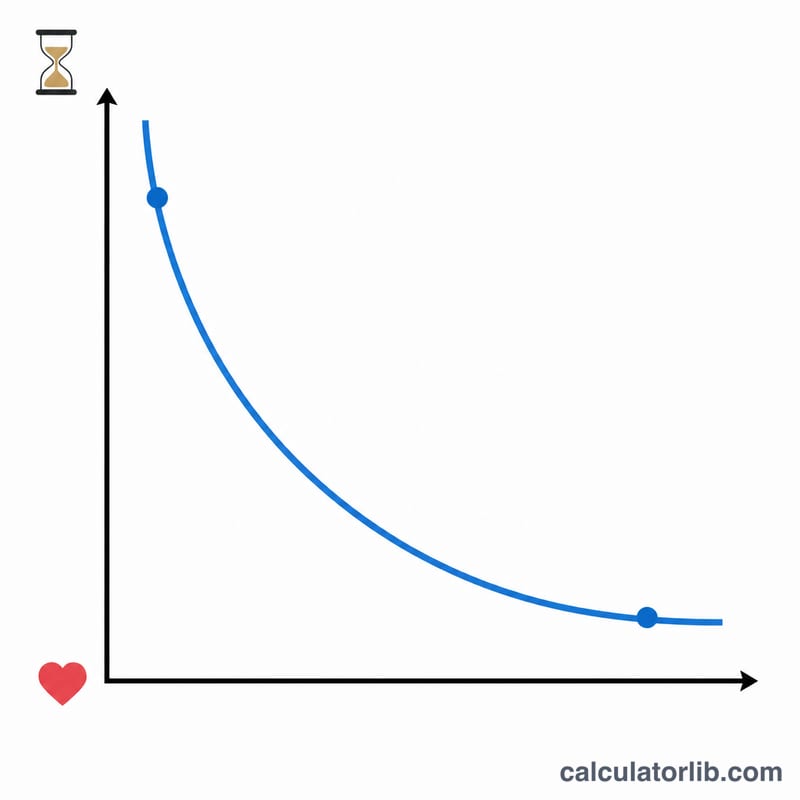
Worked example
Heart rate = 60 bpm, total = 20 (x10^8) = 2,000,000,000 beats. Lifespan(min) = \(2{,}000{,}000{,}000 / 60 = 33{,}333{,}333\) minutes. Lifespan(years) = \(33{,}333{,}333 / 525{,}960 = \) about 63.4 years. Using 23 instead of 20 gives about 72.9 years, so the band is roughly 63 to 73 years at 60 bpm.
FAQ
Is this medically accurate? No. It is a novelty and educational tool based on an unproven hypothesis. Real human life expectancy depends on genetics, lifestyle, and medicine.
Why does a lower heart rate give a longer lifespan? Because lifespan is inversely proportional to heart rate in this model — a slower heart uses the fixed beat budget more slowly.
What about a mouse or an elephant? A mouse (~600 bpm) yields ~6 years and an elephant (~40 bpm) ~95 years under the 2.0-billion-beat figure — the same order of magnitude biologists observe, illustrating the inverse relationship.