
What this calculator does
The Wind Turbine Power Output Calculator estimates the instantaneous power carried by the wind passing through a turbine rotor. It is power (energy per unit time), reported in watts (W), kilowatts (kW) and metric horsepower (PS) — not energy accumulated over a duration. The tool gives the theoretical available wind power; it deliberately does not apply any turbine efficiency or power coefficient, so the figure is an idealized upper bound.
How to use it
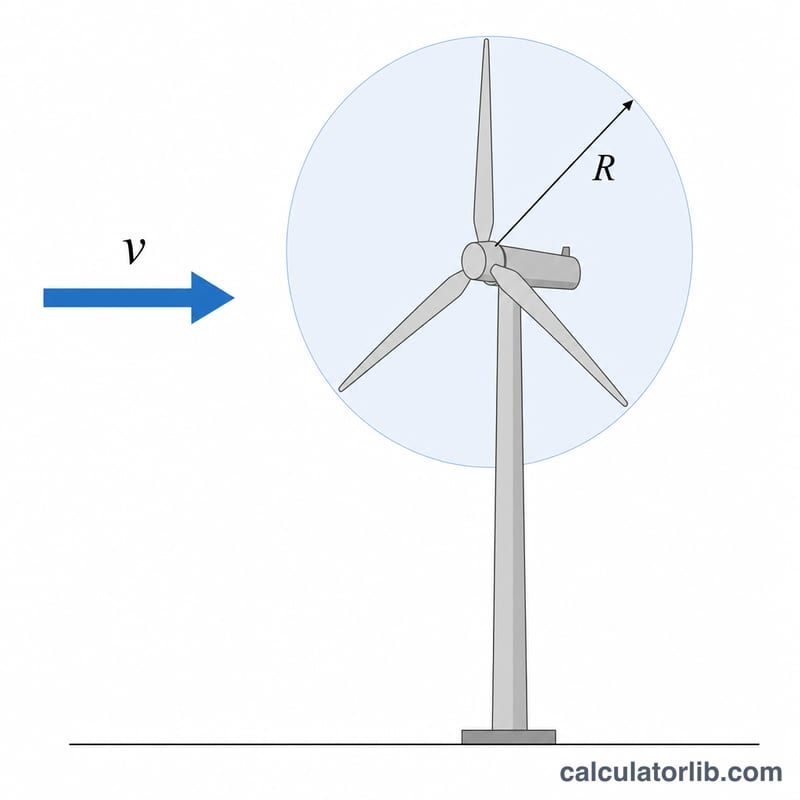
Enter three values: the rotor diameter R in meters (the full diameter of the circle swept by the blades), the air density d in kg/m³ (about 1.2 at sea level), and the wind speed v in m/s. All inputs are already in SI units, so no conversion is needed. Press calculate to see the available power in W, kW and PS.
The formula explained
The swept area is \( S = \pi R^{2}/4 \), using R as the diameter (radius \( r = R/2 \)). The kinetic power flux of moving air is \( E = \tfrac{1}{2} \cdot S \cdot d \cdot v^{3} \). Note that power scales with the cube of wind speed and the square of rotor diameter — doubling the wind speed multiplies power by eight, and doubling the rotor diameter multiplies power by four.
$$ P = \frac{1}{2} \cdot \frac{\pi\,\text{Rotor Diameter}^{2}}{4} \cdot \text{Air Density} \cdot \text{Wind Speed}^{3} $$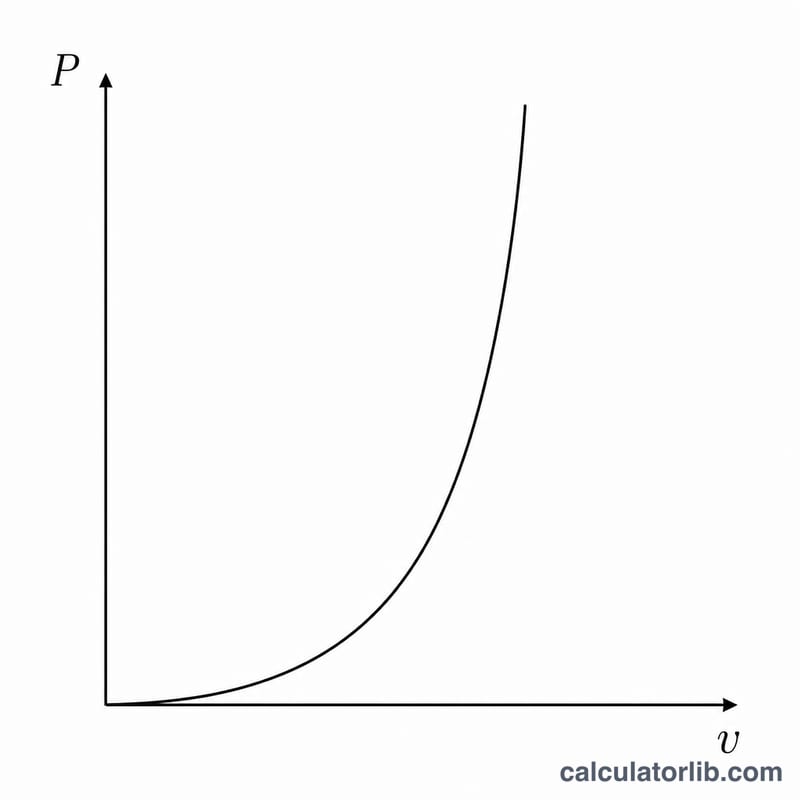
Worked example
With R = 8 m, d = 1.2 kg/m³, v = 5 m/s: \( S = \pi \times 8^{2} / 4 = 16\pi \approx 50.265 \ \text{m}^2 \). Then $$ E = 0.5 \times 50.265 \times 1.2 \times 5^{3} = 0.5 \times 50.265 \times 1.2 \times 125 \approx 3769.9 \ \text{W} \approx 3.77 \ \text{kW} \approx 5.13 \ \text{PS}. $$
FAQ
Is this the real electrical output of a turbine? No. It is the raw aerodynamic power in the wind. Real output = \( E \times C_p \) times mechanical/electrical efficiency. The Betz limit caps the extractable fraction at \( 16/27 \approx 0.593 \); typical turbines achieve \( C_p \approx 0.35\text{--}0.45 \).
Is R the radius or the diameter? R here is the full rotor diameter. The calculator derives the radius internally as \( R/2 \) via \( S = \pi R^{2}/4 \).
What air density should I use? About 1.2 kg/m³ at flat or sea level (1.225 at 15°C standard atmosphere). Density falls with altitude, temperature and humidity, which reduces available power.