
What Is the Air Conditioner Horsepower Calculator?
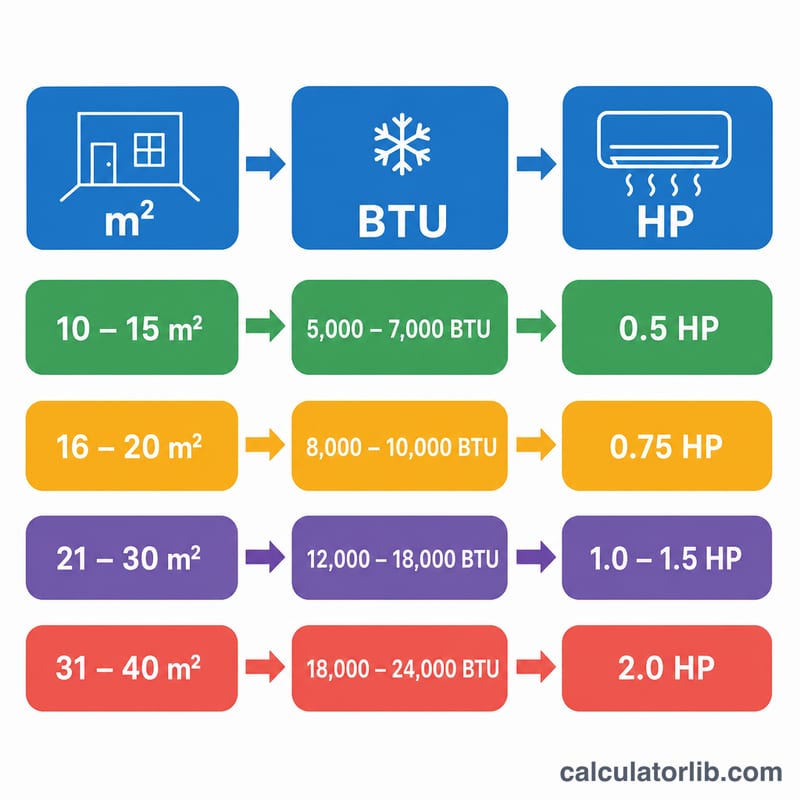
This tool estimates the air conditioner (AC) horsepower you need to comfortably cool a room. In the AC industry, "horsepower" (HP) is a common shorthand for cooling capacity, where roughly \(1\,\text{HP} = 9000\,\text{BTU/hr}\). Choosing the right size matters: an undersized unit runs constantly and never cools the room, while an oversized one wastes energy and cycles on and off too quickly.
How to Use It
Enter your room area and pick whether it is measured in square meters or square feet. The calculator converts to square meters, estimates the cooling load in BTU/hr, divides by 9000 to get the required horsepower, and rounds up to the nearest standard AC size (0.5, 0.75, 1.0, 1.5, 2.0, 2.5 HP).
The Formula Explained
The estimate uses a rule of thumb of about 550 BTU per square meter:
$$\text{HP} = \frac{\text{Area}_{m^2} \times 550}{9000}$$where \(\text{Area}_{m^2}\) = room floor area in square meters. If you enter square feet, the area is first converted using \(1\,\text{ft}^2 = 0.092903\,\text{m}^2\).
Worked Example
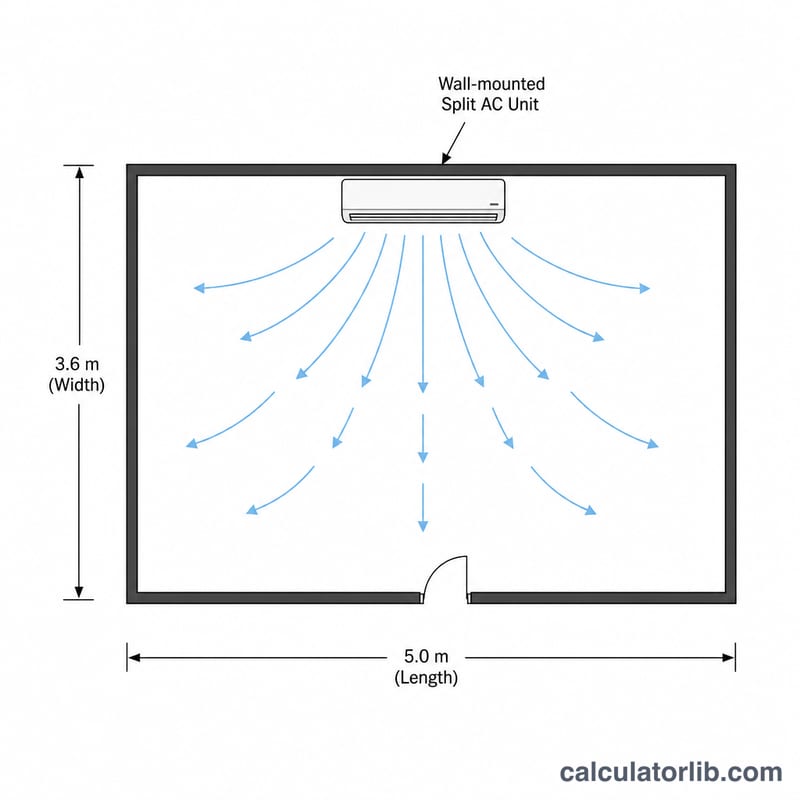
For a room of \(20\,\text{m}^2\):
$$\text{BTU} = 20 \times 550 = 11000\,\text{BTU/hr}$$$$\text{HP} = \frac{11000}{9000} \approx 1.22\,\text{HP}$$Rounding up to the nearest standard size gives a recommended 1.5 HP air conditioner.
Choosing and Installing the Right AC Size
The formula gives a baseline from floor area alone. Adjust upward when the real heat load is higher than average:
- Size up one step for rooms with strong afternoon sun or west-facing windows, high ceilings (above ~2.7 m / 9 ft), poor insulation, or large glass areas.
- Add capacity for heat sources: kitchens, server/equipment rooms, and rooms that regularly hold many people generate extra load. A rough rule is to add roughly 600 BTU/hr per additional regular occupant beyond two, and about 4,000 BTU/hr for a kitchen.
- Don't oversize. An AC that is too large cools the air quickly but switches off before removing humidity, then restarts — "short-cycling." This wastes energy, wears the compressor, and leaves the room cold and clammy. Bigger is not better.
- Check electrical requirements. Units around 1.5 HP and up may need a dedicated circuit; larger 2–2.5 HP units sometimes require 230 V service. Confirm voltage, breaker size, and outlet type before purchase.
- Confirm critical installs with a professional. For whole-home systems or unusual rooms, have an HVAC contractor perform a Manual J load calculation, which accounts for insulation, windows, orientation, infiltration, and local climate.
You can cross-check a floor-area estimate against a detailed room-by-room BTU calculation that factors in occupants, sun exposure, and kitchen load before settling on an HP size. This is general information for planning purposes, not professional engineering advice — verify critical sizing with a licensed HVAC contractor.
Definitions & Glossary
- BTU/hr (British Thermal Unit per hour)
- The standard unit of cooling capacity. One BTU is the energy needed to raise the temperature of one pound of water by 1 °F; BTU/hr is the rate at which an AC removes heat from a room.
- AC horsepower convention
- A marketing shorthand for cooling capacity, not mechanical engine power. One AC "horsepower" is conventionally treated as roughly 9,000 BTU/hr, so a 1.5 HP unit is about 12,000 BTU/hr.
- Cooling load
- The total amount of heat (in BTU/hr) that must be removed from a space to keep it at the target temperature. It depends on floor area, ceiling height, insulation, windows, sun exposure, occupants, and internal appliances.
- Square meter vs square foot
- Two units of area. 1 m² ≈ 10.764 ft²; 1 ft² ≈ 0.0929 m². Always convert to a single unit before applying a sizing formula.
- Standard AC size
- The discrete capacities AC units are actually sold in (e.g., 0.5, 0.75, 1.0, 1.5, 2.0, 2.5 HP). After calculating a required HP, you round up to the next available standard size.
- Manual J load calculation
- The ACCA (Air Conditioning Contractors of America) industry-standard procedure for computing a building's precise heating and cooling load, accounting for construction details, climate, and ventilation. It is the recommended basis for sizing permanent HVAC systems.
FAQ
Is this exact? No — it is a sizing estimate. Sunlight exposure, ceiling height, insulation, number of occupants, and heat-producing appliances all affect the true load. For a critical installation, a professional Manual J load calculation is recommended.
How many BTU is 1 HP? By convention, 1 air conditioner horsepower equals about 9000 BTU/hr.
Should I size up? If the room gets direct afternoon sun or is a kitchen, consider the next size up. The calculator already rounds up to a standard size to give a small safety margin.