What Is the Party Alcohol Calculator?
Planning drinks for a party is part math, part guesswork. This calculator removes the guesswork by estimating how many drinks your guests will consume and converting that into the number of beers, bottles of wine, and bottles of liquor to buy. It is a universal planning tool that works for any gathering, from a small dinner to a large celebration.
How to Use It
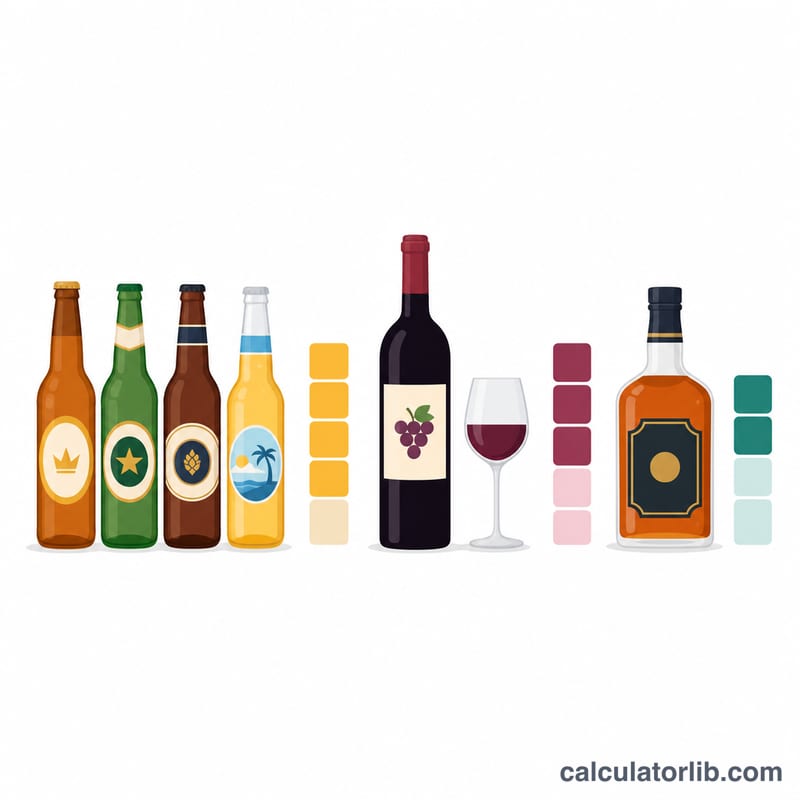
Enter the number of guests, how many hours the party will last, the percentage of guests who actually drink alcohol, and your crowd preferred drink type. The calculator returns a total drink count plus a suggested shopping breakdown by category.
The Formula Explained
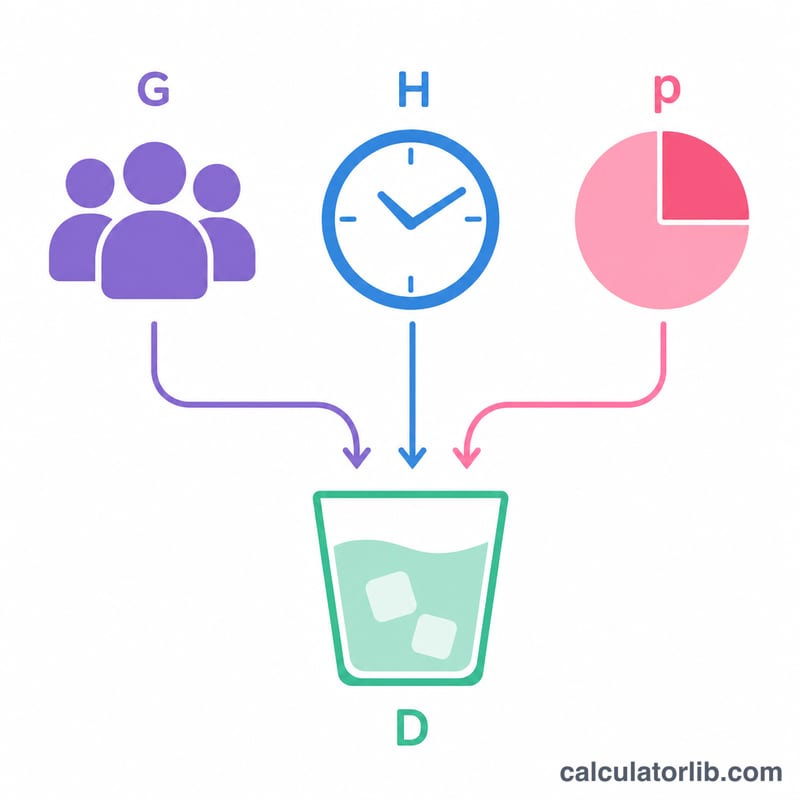
The core estimate uses a common hosting rule of thumb: each drinking guest consumes roughly one standard drink per hour.
$$D = G \times \frac{p}{100} \times H$$where \(D\) = total drinks, \(G\) = number of guests, \(p\) = percent of guests drinking, and \(H\) = party duration in hours. Drinks are then split by preference fraction \(f\) and converted to containers: one beer per drink, one wine bottle per 5 glasses, and one 750ml liquor bottle per 16 shots.
Worked Example
For 20 guests, 4 hours, 75% drinking, mixed preference:
$$D = 20 \times \frac{75}{100} \times 4 = 60 \text{ drinks}$$With a mixed split (50% beer, 30% wine, 20% liquor): \(60 \times 0.5 = 30\) beers, wine \(\lceil \tfrac{60 \times 0.3}{5} \rceil = \lceil 3.6 \rceil = 4\) bottles, liquor \(\lceil \tfrac{60 \times 0.2}{16} \rceil = \lceil 0.75 \rceil = 1\) bottle.
Drink Estimates for Common Party Sizes and Lengths
The table below uses the calculator's Mixed setting: 1 drink per drinking guest per hour, 75% of guests drinking, and a 50% beer / 30% wine / 20% liquor split. Wine is counted at 5 glasses per bottle and liquor at 16 drinks per bottle, and every bottle or beer count is rounded up.
Total drinks: \(D = \text{Guests} \times \frac{75}{100} \times \text{Hours}\)
| Scenario | Total drinks (D) | Beers (0.50 D) | Wine bottles (0.30 D ÷ 5) | Liquor bottles (0.20 D ÷ 16) |
|---|---|---|---|---|
| 10 guests, 3 hours | 22.5 | 12 | 2 | 1 |
| 20 guests, 4 hours | 60 | 30 | 4 | 1 |
| 50 guests, 5 hours | 187.5 | 94 | 12 | 3 |
| 100 guests, 6 hours | 450 | 225 | 27 | 6 |
Worked check: 50 guests, 5 hours
- Total drinks: \(D = 50 \times 0.75 \times 5 = 187.5\)
- Beers: \(\lceil 0.50 \times 187.5 \rceil = \lceil 93.75 \rceil = 94\)
- Wine bottles: \(\left\lceil \frac{0.30 \times 187.5}{5} \right\rceil = \lceil 11.25 \rceil = 12\)
- Liquor bottles: \(\left\lceil \frac{0.20 \times 187.5}{16} \right\rceil = \lceil 2.34 \rceil = 3\)
Rounding up each category separately means the bottle totals can slightly exceed the exact need. This is intentional, so you do not run short. Actual consumption varies with the crowd, the food served and the time of day. Please plan for non-alcoholic drinks and safe transport for guests.
FAQ
Is this an exact amount? No. It is a planning estimate. Buying slightly extra is wise, and many stores accept returns of unopened bottles.
What counts as one drink? A 12oz beer, a 5oz glass of wine, or a 1.5oz shot of liquor are each roughly one standard drink.
Should I add non-alcoholic options? Yes. Always provide water and soft drinks for non-drinkers and designated drivers.