
What This Blood Alcohol Calculator Does
This tool gives you a rough estimate of your Blood Alcohol Concentration (BAC) based on your gender, body weight, how much you've had to drink, and how long ago you started. BAC is the percentage of alcohol in your bloodstream — in most countries the legal driving limit sits between 0.05% and 0.08%. This is an educational estimate only and should never be used to decide whether you are safe to drive.
The Inputs You Provide
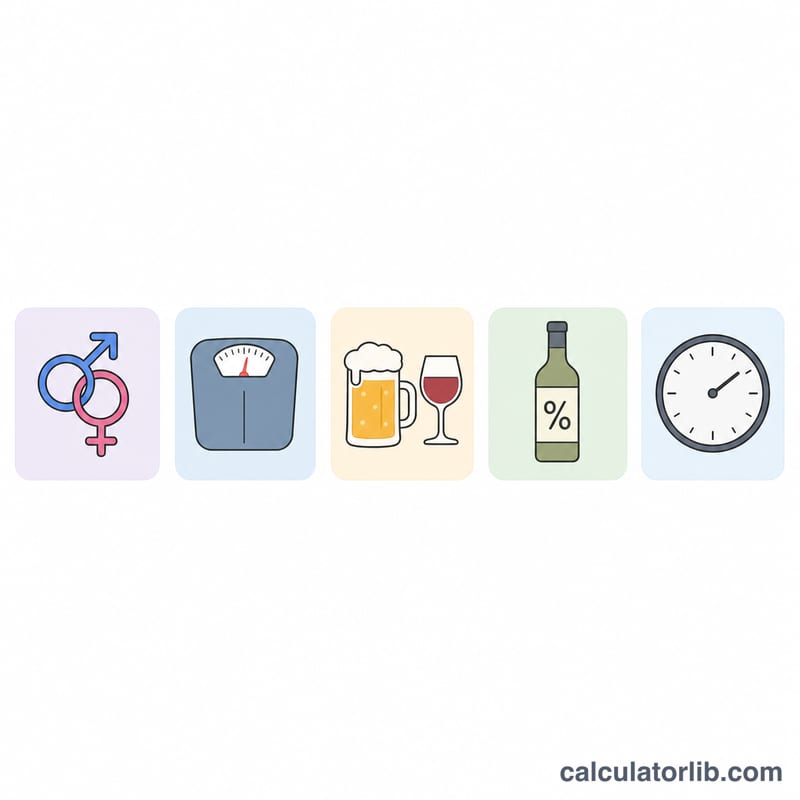
- Gender – determines the body-water ratio used (0.68 for males, 0.55 for females), because alcohol distributes through body water.
- Weight (kg) – your body mass; heavier people dilute alcohol over more water.
- Number of Drinks – how many standard drinks you've had.
- Alcohol Content (%) – the strength of the drink (e.g. 5% for beer, 12% for wine).
- Hours Since First Drink – used to subtract alcohol your body has already metabolised.
The Formula
The calculator works in two steps. First it finds the grams of pure alcohol consumed, assuming each drink is 30 ml of beverage:
$$\text{Alcohol consumed (g)} = \text{Drinks} \times \left(\frac{\text{Alcohol\%}}{100}\right) \times 0.789 \times 30$$
(0.789 is the density of ethanol.) It then divides by your body-water weight in grams and converts to a percentage to get peak BAC, before subtracting metabolism over time:
$$\text{Current BAC} = \text{Peak BAC} - (0.015 \times \text{Hours})$$, never going below 0. The 0.015 figure reflects the average rate the liver clears alcohol each hour.
Worked Example
A male weighing 80 kg has 3 drinks at 5% alcohol, 2 hours after his first drink:
- Alcohol consumed \(= 3 \times 0.05 \times 0.789 \times 30 = 3.55\text{ g}\)
- Body-water weight \(= 80 \times 0.68 = 54.4\text{ kg} = 54{,}400\text{ g}\)
- Peak BAC \(= \left(\dfrac{3.55}{54{,}400}\right) \times 100 \approx 0.0065\%\)
- Current BAC \(= 0.0065 - (0.015 \times 2) = 0\) (metabolised away)
This shows how quickly modest drinking can clear over a couple of hours.
Interpreting Your BAC Result
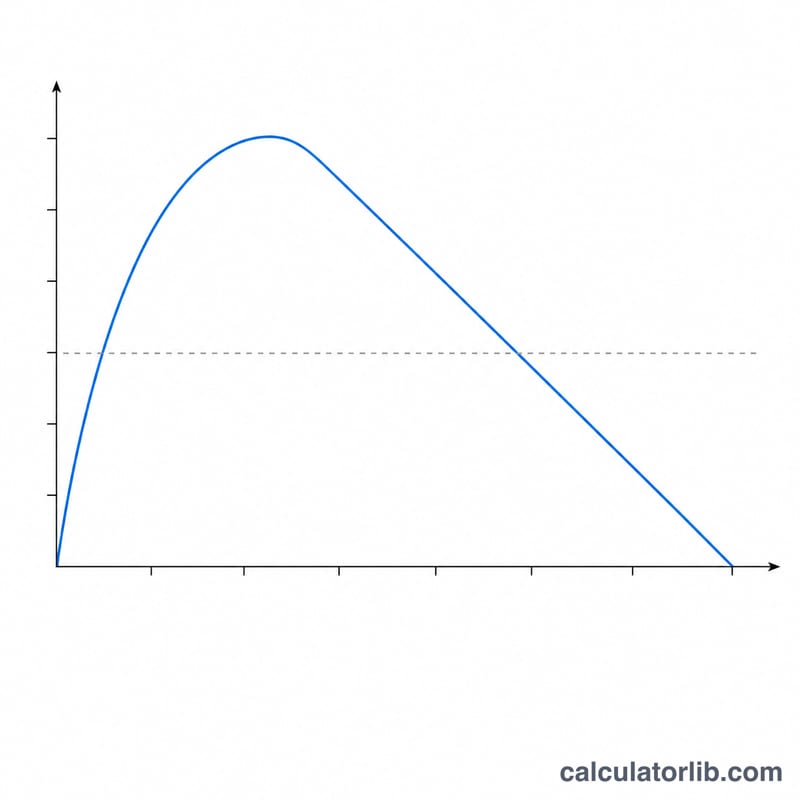
Blood alcohol concentration (BAC) is usually expressed as a percentage by volume of alcohol in the blood. The estimate this calculator returns is a starting point, not a measurement — actual BAC depends on individual metabolism, food intake, hydration, medications and how recently you drank. Use the result as a rough guide, never as a green light to drive.
- 0.00% — Sober. No measurable alcohol; no impairment attributable to alcohol.
- ~0.02–0.05% — Mild effects. Relaxation, slight mood elevation, minor loss of judgment and a measurable decline in the ability to track moving objects and divide attention.
- 0.05–0.08% — Common legal driving limits worldwide. Many countries set the driving limit at 0.05% (e.g. much of Europe and Australia), while others use 0.08%. Reduced coordination, slower reaction time and impaired judgment are typical.
- 0.08%+ — Legally impaired in many jurisdictions. 0.08% is the standard "per se" drunk-driving threshold across the United States and several other nations. Clear impairment of muscle control, reaction time, reasoning and self-control.
- 0.15% and above — Pronounced intoxication. Major impairment of balance and movement, possible nausea and vomiting; risk rises sharply with higher levels.
These ranges are general references. Legal limits vary by country and even by driver category (for example, lower limits for novice or commercial drivers), so always check the rules where you are.
BAC Levels and Documented Effects
| BAC (%) | Commonly documented effects | Typical legal status (driving) |
|---|---|---|
| 0.00 | No alcohol-related impairment | Legal everywhere |
| 0.02 | Some loss of judgment, relaxation, slight rise in body warmth; reduced ability to track a moving target and to multitask | Over the limit in zero/low-tolerance countries |
| 0.05 | Lowered alertness, reduced coordination and ability to track moving objects, harder to steer and respond to emergencies | At or over the limit in many countries (e.g. Europe, Australia) |
| 0.08 | Impaired muscle coordination, balance, speech, reaction time, judgment, self-control and reasoning; short-term memory affected | Legally impaired ("per se") in the US and many jurisdictions |
| 0.10 | Clear deterioration of reaction time and control; slurred speech and slowed thinking | Over the limit virtually everywhere |
| 0.15 | Far less muscle control than normal, vomiting may occur, major loss of balance | Greatly over the limit; often an aggravated offense |
| 0.30+ | Severe impairment, confusion or stupor, risk of loss of consciousness; potentially life-threatening | Medical emergency territory |
Values are general references drawn from commonly published BAC effect charts; individual responses vary considerably.
FAQ
Is this accurate enough to drive? No. Real BAC depends on food, hydration, medication and individual metabolism. Treat the result as a ballpark only.
Why do men and women get different results? Women typically have a lower body-water ratio (0.55 vs 0.68), so the same alcohol produces a higher concentration.
Why is my BAC sometimes zero? If enough hours have passed, the 0.015-per-hour metabolism subtracts your entire estimated BAC, and the result is capped at 0.