
What Is Impermanent Loss?
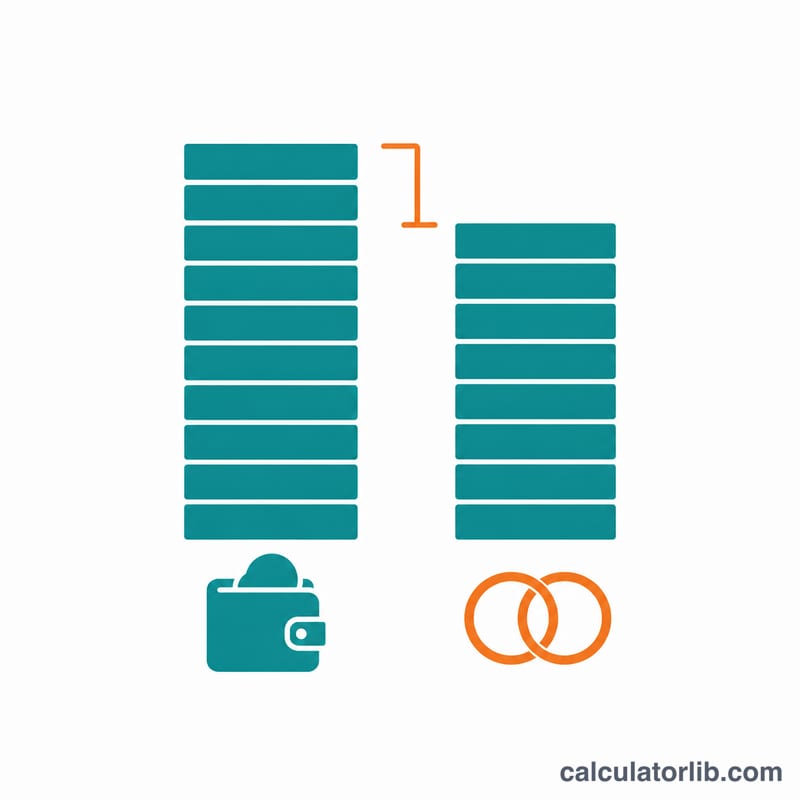
Impermanent loss is the difference in value between providing two assets to a 50/50 automated market maker (AMM) liquidity pool and simply holding those same assets in your wallet. When the relative price of the two tokens changes, the AMM rebalances your position, leaving you with more of the falling asset and less of the rising one. The gap versus just holding (HODL) is the impermanent loss. It becomes permanent only if you withdraw while prices remain diverged. This tool is general and applies to any constant-product AMM such as Uniswap, SushiSwap, or PancakeSwap.
How to Use the Calculator
Enter the price ratio \(r\), which is the new price of one asset divided by its old price, measured against the other token in the pair. If a token doubles relative to the other, enter \(2\); if it halves, enter \(0.5\). Optionally enter your position value at deposit to estimate the dollar loss.
The Formula Explained
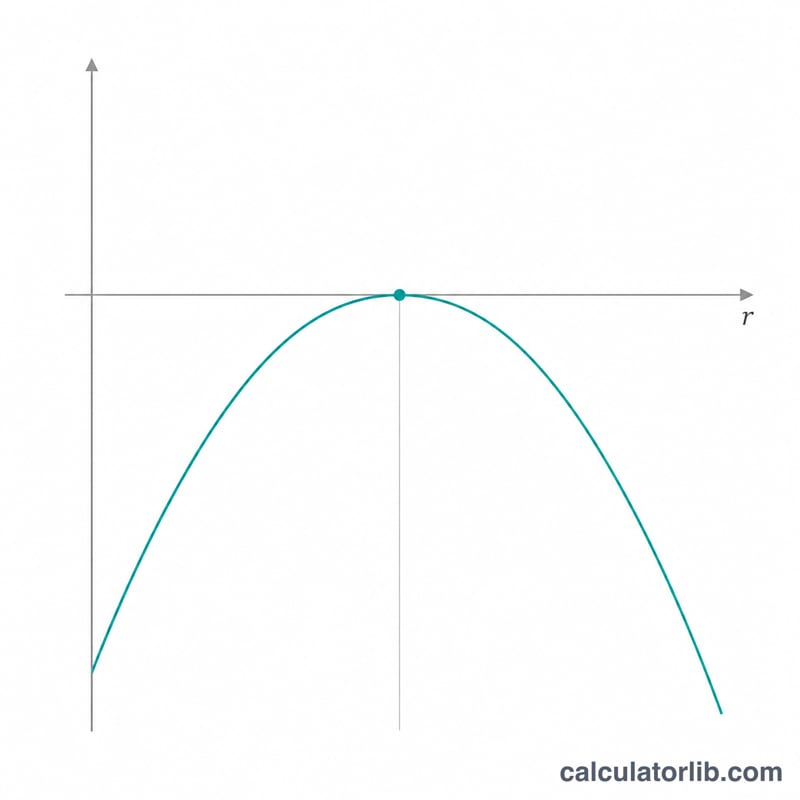
For a standard 50/50 constant-product pool the impermanent loss is:
$$\text{IL} = \frac{2\sqrt{r}}{1 + r} - 1$$where \(r\) = price ratio (new ÷ old). The result is always zero or negative. The dollar loss is \(L = |\text{IL}| \times V\), where \(V\) = position value at deposit.
Worked Example
Suppose one token doubles in price, so \(r = 2\), with a $1,000 position:
$$\text{IL} = \frac{2\sqrt{2}}{1 + 2} - 1 = \frac{2 \times 1.41421}{3} - 1 = 0.94281 - 1 = -0.05719$$That is about \(-5.72\%\), and the dollar loss is:
$$L = 0.05719 \times 1000 = \$57.19$$FAQ
Does impermanent loss include fees? No. Trading fees and rewards earned by the pool can offset or exceed the loss; this calculator shows only the price-divergence component.
When does it equal zero? When \(r = 1\), meaning the relative price has not changed since deposit.
Is the loss symmetric? Yes. A ratio of \(2\) and a ratio of \(0.5\) both yield the same percentage loss, because the formula depends on how far prices diverge, not the direction.