

What Is a Capital Loss Carryover?
This calculator applies to United States federal income tax (IRS rules). When your total capital losses exceed your capital gains for the year, the IRS lets you deduct a limited amount of that net loss against ordinary income. For most filers the limit is $3,000 per year ($1,500 if you are married filing separately). Any net loss beyond that limit is not lost — it is carried forward to future tax years until it is fully used. This tool estimates how much you can deduct now and how much carries over to next year.
How to Use It
Enter your total capital loss for the year, your total capital gain (which offsets losses first), and your filing status. The calculator subtracts gains from losses to find your net loss, applies the annual deduction limit, and shows the remaining carryover. Assumptions are based on current IRS rules; limits have been $3,000/$1,500 for many years but always confirm with the latest IRS guidance or a tax professional.
The Formula Explained
First, net loss = total capital loss − total capital gain (never below zero). Then the amount you can deduct this year is min(net loss, limit), where the limit is $3,000 (or $1,500 for married filing separately). Finally, carryover = net loss − deductible this year.
$$\text{Carryover} = \max\!\left(0,\; \text{Capital Loss} - \text{Capital Gain}\right) - \min(\text{Net Loss},\, 3000)$$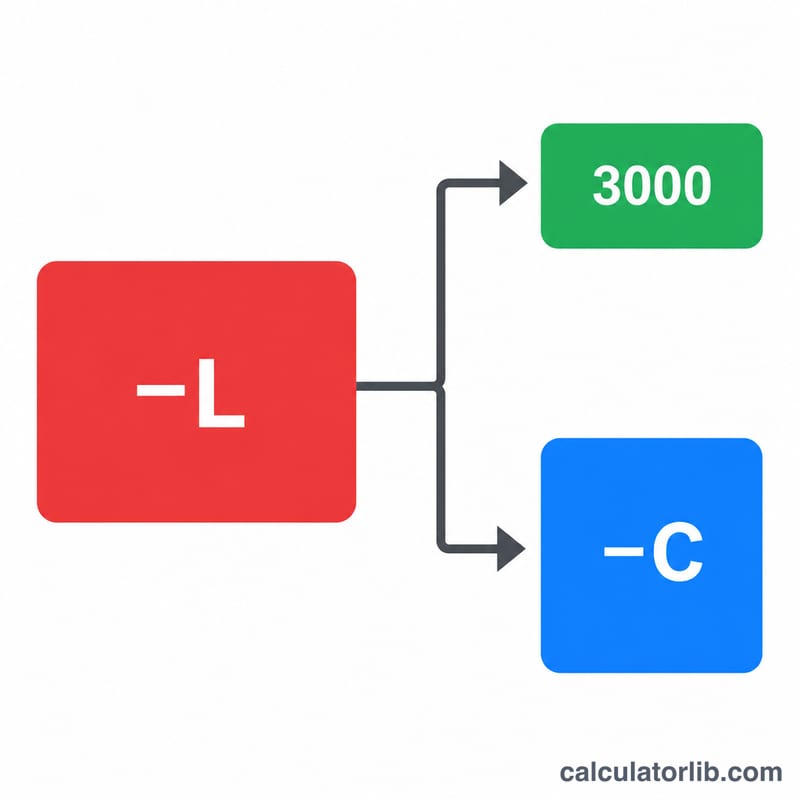
Worked Example
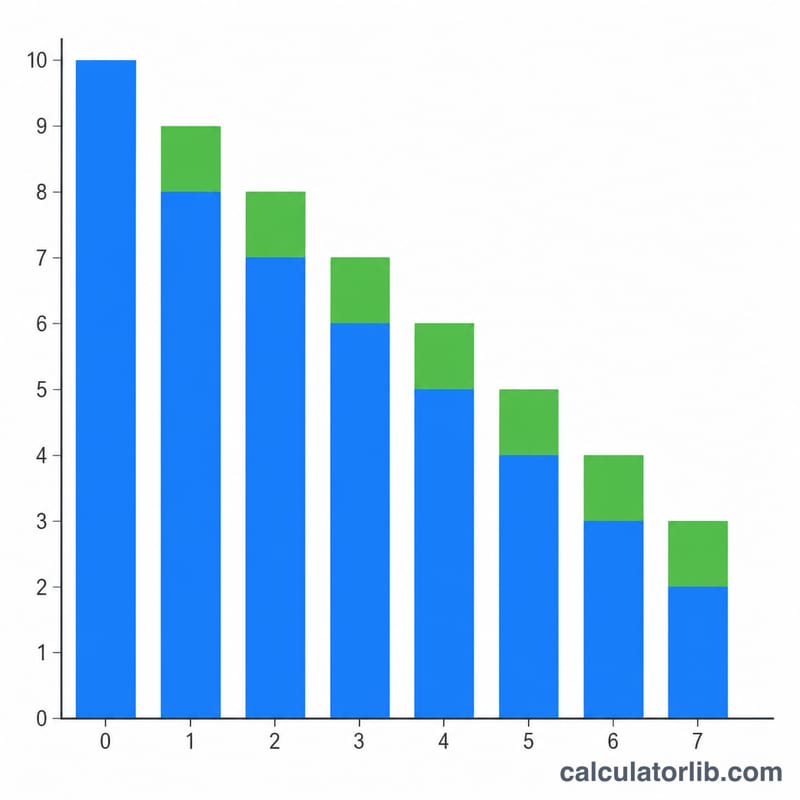
Suppose you had $10,000 in capital losses and $2,000 in capital gains, filing as single. Net loss = \(\$10{,}000 - \$2{,}000 = \$8{,}000\). You may deduct $3,000 this year, leaving a carryover of
$$\$8{,}000 - \$3{,}000 = \mathbf{\$5{,}000}$$to next year.
FAQ
How long can I carry losses forward? Indefinitely for federal taxes, until the loss is fully used up. Each year you can deduct up to the annual limit.
Do losses offset gains first? Yes. Capital losses offset capital gains dollar-for-dollar before the $3,000 ordinary-income deduction applies.
Is the limit different if married filing separately? Yes — it is $1,500 per spouse instead of $3,000. Select that filing status to apply the lower limit.