
What Is a Roth Conversion Tax Calculator?
This tool applies to the United States. A Roth conversion moves pre-tax money from a traditional 401(k) or traditional IRA into a Roth account. Because traditional contributions were never taxed, the converted amount is added to your taxable income for the year and taxed at your marginal tax rate. This calculator gives a quick estimate of that federal income tax so you can plan how much cash you need to cover the bill.
How to Use It
Enter the dollar amount you plan to convert and your marginal (top-bracket) tax rate as a percentage. The calculator returns the estimated conversion tax, plus the net amount that would actually land in your Roth account if you pay the tax out of the converted balance. Paying the tax from outside savings instead lets the full converted amount grow tax-free.
The Formula Explained
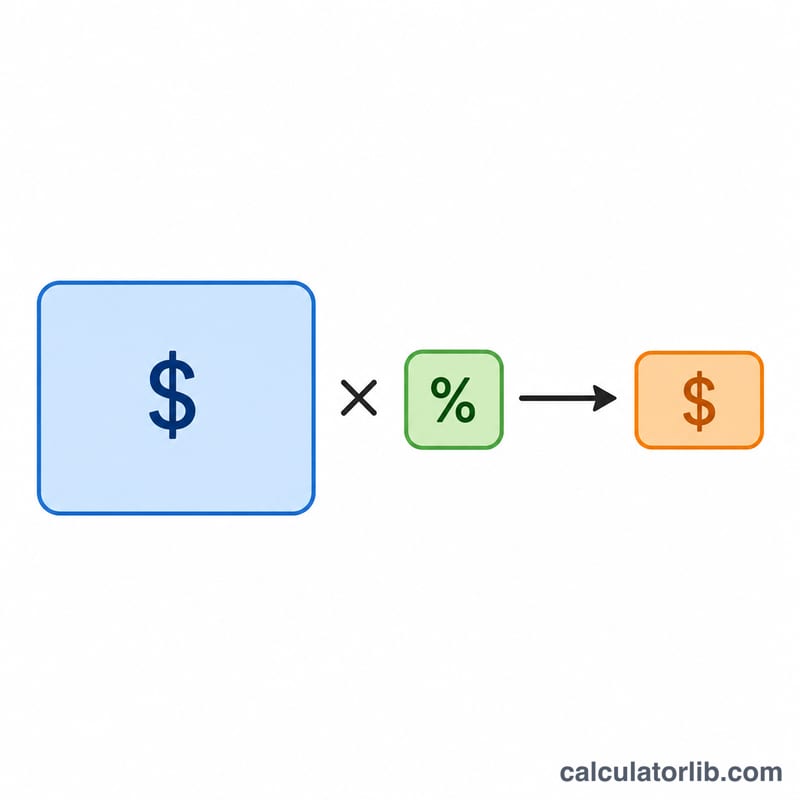
The math is simple: $$\text{conversionTax} = \text{amountConverted} \times \frac{\text{marginalTaxRate}}{100}$$. A conversion stacks on top of your other income, so a large conversion can push part of the money into a higher bracket — this estimator assumes a single flat marginal rate, which works well for modest conversions but understates tax for very large ones that cross brackets.
Worked Example
Suppose you convert $50,000 and your marginal tax rate is 24%. The tax is $$50{,}000 \times 0.24 = \$12{,}000$$. If you pay that tax from the conversion itself, $38,000 lands in your Roth. If you pay from outside cash, the full $50,000 stays invested and grows tax-free.
Interpreting Your Result
The figure this calculator returns is an estimate of the additional federal income tax created by your conversion. A traditional 401(k) or IRA holds pre-tax dollars, so converting to a Roth makes the converted amount taxable as ordinary income in the year of the conversion. That income is added on top of your other taxable income — wages, interest, capital gains and so on — not taxed in isolation.
The flat-rate assumption
The tool multiplies your converted amount by a single marginal rate:
$$\text{Conversion Tax} = \text{Amount Converted} \times \frac{\text{Marginal Tax Rate}}{100}$$
For example, converting $50,000 at a 22% marginal rate gives an estimated $11,000 in federal tax. This is accurate only when the entire conversion stays inside one bracket. A large conversion can push you into higher brackets: the first dollars may be taxed at 22% while the top dollars are taxed at 24% or 32%. In that situation a single marginal rate understates the true tax, and you should blend the rates across the bands the conversion fills. The brackets table above shows exactly where those thresholds sit.
What this estimate does not include
- State income tax. Most states also tax the conversion as ordinary income; this federal-only figure excludes that.
- IRMAA Medicare surcharges. For those on Medicare, conversion income raises modified adjusted gross income (MAGI) and can trigger higher Part B and Part D premiums about two years later.
- ACA premium subsidies. Higher MAGI can reduce or eliminate Affordable Care Act marketplace premium tax credits.
- Net investment income tax, AMT and credit phase-outs that key off your higher income.
Under age 59½
The conversion itself is not subject to the 10% early-withdrawal penalty, but the pro-rata rule applies when you hold both pre-tax and after-tax (basis) IRA dollars: each conversion is treated as a proportional mix, so you cannot convert only the non-taxable portion. Separately, if you use IRA money to pay the conversion tax before age 59½, that withdrawn amount can be hit with the 10% penalty. There is also a five-year rule for withdrawing converted principal. These are factual considerations, not advice specific to your situation.
This is general information, not professional tax advice. Conversion outcomes depend on your full return; consult a qualified tax professional before converting.
FAQ
Does this include state tax? No — it estimates federal tax only. Add your state's marginal rate to the input if you want a combined estimate.
Should I pay the tax from the converted money? Generally no. Paying with outside funds keeps more dollars compounding tax-free in the Roth, and avoids penalties if you're under 59½.
Is the rate my whole tax rate? Use your marginal rate (the rate on your next dollar of income), not your average effective rate, since the conversion adds income at the top of your stack.