
What Is the IRS Underpayment Penalty?
This calculator applies to United States federal income tax. The IRS may charge an underpayment penalty when you do not pay enough tax during the year through withholding or quarterly estimated payments. The penalty is effectively interest on the amount you underpaid, accrued for the number of days the payment was late. The IRS sets the applicable interest rate each calendar quarter, so always confirm the current rate before relying on an estimate.
How to Use It
Enter three values: the underpayment amount (the dollar shortfall of tax owed), the annual interest rate published by the IRS for the relevant quarter (for example, 8%), and the days late (how long the amount went unpaid). The tool returns the estimated penalty and the total you would owe including that interest.
The Formula Explained
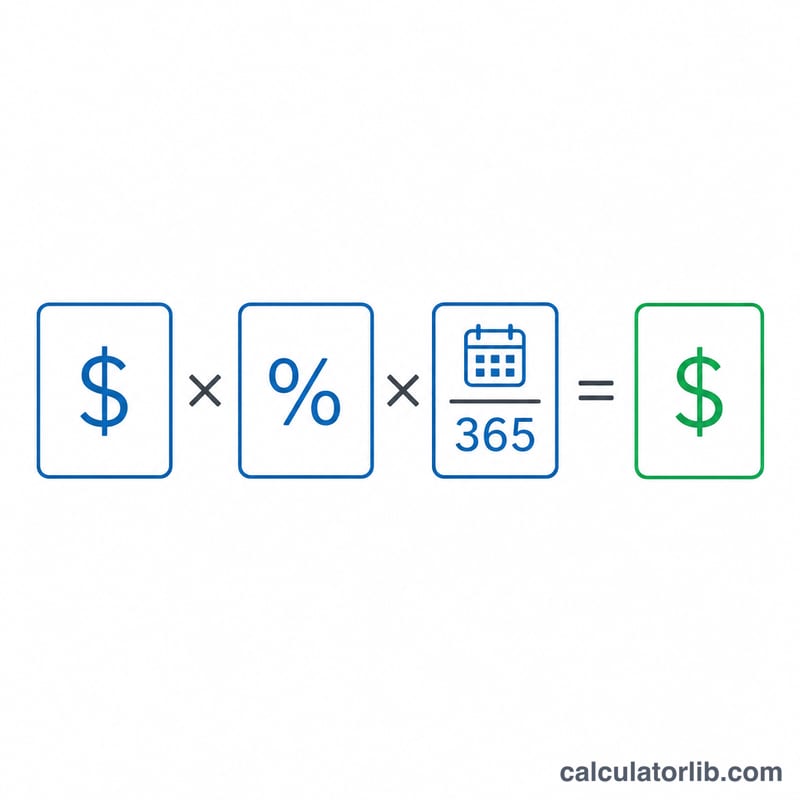
The core equation is $$\text{Penalty} = \text{Underpayment} \times \text{Annual Rate} \times \frac{\text{Days Late}}{365}$$ The daily portion converts the annual rate into the fraction of a year the balance was outstanding. In practice the IRS compounds daily and may use rates that change between quarters; this calculator uses a simple single-rate approximation for a quick estimate.
Worked Example
Suppose you underpaid by $5,000, the IRS annual rate is 8% (0.08), and the amount was 90 days late. $$\text{Penalty} = 5{,}000 \times 0.08 \times \frac{90}{365} = 5{,}000 \times 0.08 \times 0.246575 \approx \textbf{\$98.63}$$ Your total owed would be roughly $5,098.63.
FAQ
Is this the exact penalty the IRS will charge? No. The IRS compounds daily and may apply different rates per quarter. Use this as a close estimate and verify with Form 2210.
Where do I find the annual rate? The IRS announces rates quarterly in a news release; recent rates have ranged from about 3% to 8%.
Can I avoid the penalty? Often yes—by paying at least 90% of the current year's tax or 100% (110% for higher incomes) of last year's tax through timely estimated payments or withholding.