
What Is the FD Premature Withdrawal Penalty Calculator?
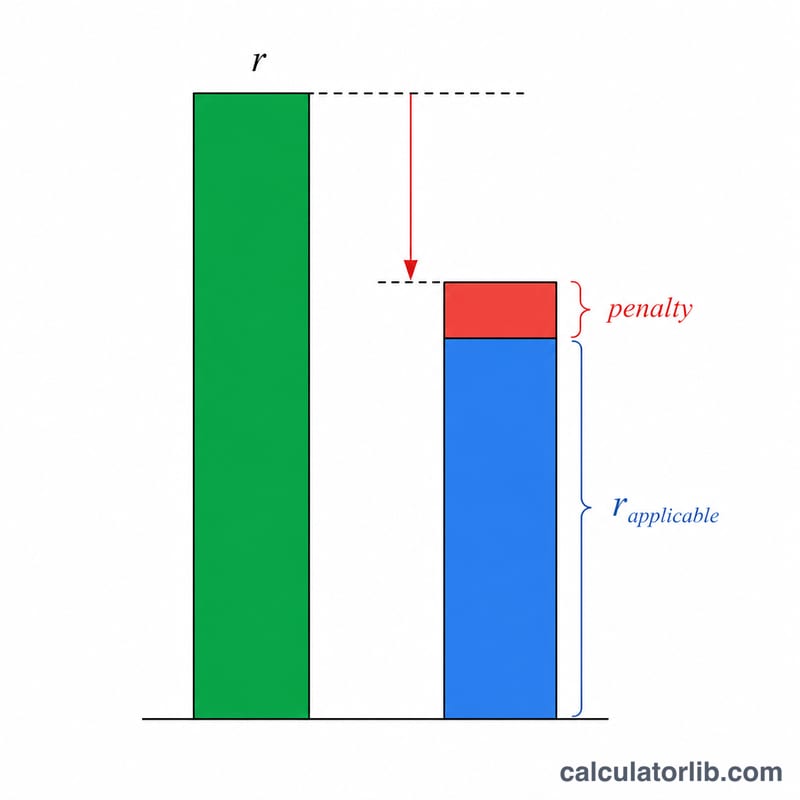
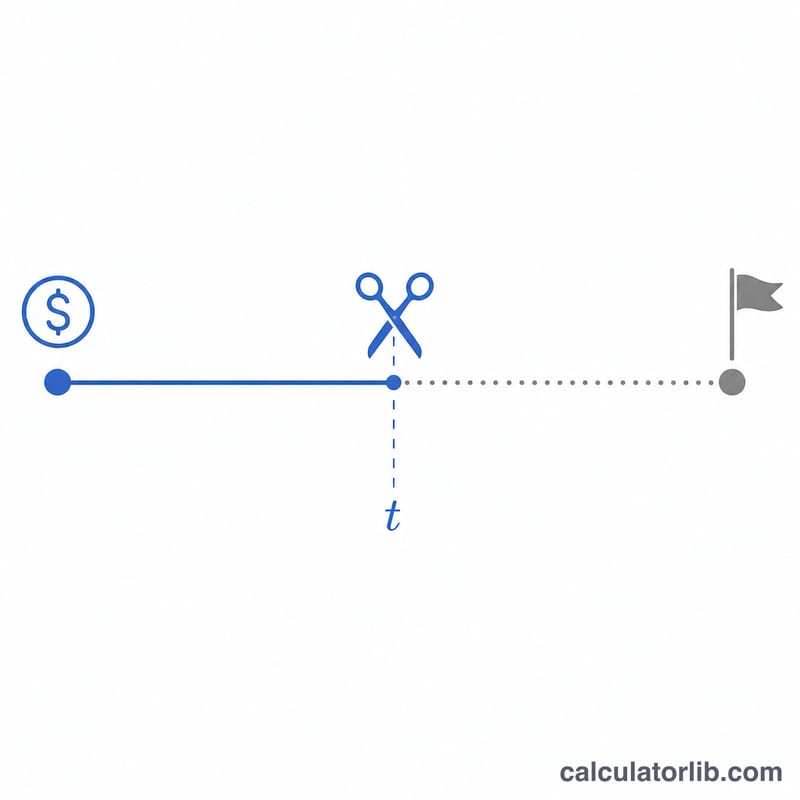
When you break a fixed deposit (FD) before its maturity date, banks usually pay interest at a reduced "applicable" rate — the rate that was in effect for the actual period your money stayed deposited — and then subtract a premature withdrawal penalty (commonly 0.5%–1% per annum). This calculator shows exactly how much interest you will receive, the final withdrawal value, and how much interest you lose because of the penalty.
How to Use It
Enter your deposit amount (principal), the original card rate quoted when you opened the FD, the applicable rate for the period actually held, the penalty rate, and the number of months you held the deposit before withdrawing. The tool computes interest using the reduced effective rate.
The Formula Explained
The effective rate is the applicable rate minus the penalty. Interest is calculated as simple interest prorated over the months held:
$$I = P \times \frac{r_{e}}{100} \times \frac{n}{12} \\[1.5em] \text{where}\quad \left\{ \begin{aligned} P &= \text{Principal} \\ r_{e} &= \max\!\left(\text{Applicable Rate} - \text{Penalty},\ 0\right) \\ n &= \text{Months Held} \end{aligned} \right.$$
The maturity (withdrawal) value adds this interest back to your principal.
Worked Example
Suppose you deposit 100,000 at a card rate of 7%, but for the 12 months you actually held it, the applicable rate is 6% with a 1% penalty. The effective rate is \(6\% - 1\% = 5\%\). $$I = 100{,}000 \times \frac{5}{100} \times \frac{12}{12} = \mathbf{5{,}000}$$ Without the penalty you would have earned 6,000, so you lose 1,000 to the penalty, and your withdrawal value is 105,000.
Penalty Impact Across Different Scenarios
All rows use a principal of 100,000 (any currency) and the simple-interest formula \(I = P \times \frac{r_e}{100} \times \frac{n}{12}\), where \(r_e = \max(\text{applicable rate} - \text{penalty},\ 0)\). Interest lost to the penalty is the interest at the applicable rate minus the interest at the effective rate. Withdrawal value is principal plus interest earned.
| Months held | Applicable rate (% p.a.) | Penalty (% points) | Effective rate (% p.a.) | Interest earned | Interest lost to penalty | Withdrawal value |
|---|---|---|---|---|---|---|
| 3 | 5.0 | 0 | 5.0 | 1,250 | 0 | 101,250 |
| 3 | 5.0 | 1.0 | 4.0 | 1,000 | 250 | 101,000 |
| 6 | 6.0 | 0.5 | 5.5 | 2,750 | 250 | 102,750 |
| 6 | 6.0 | 1.0 | 5.0 | 2,500 | 500 | 102,500 |
| 12 | 6.5 | 0.5 | 6.0 | 6,000 | 500 | 106,000 |
| 12 | 6.5 | 1.0 | 5.5 | 5,500 | 1,000 | 105,500 |
| 3 | 0.5 (hypothetical) | 1.0 | 0 (floored) | 0 | 125 | 100,000 |
Example substitution
For the 6-month, 6% applicable rate, 1% penalty row: \(r_e = \max(6 - 1,\ 0) = 5\), so \(I = 100000 \times \frac{5}{100} \times \frac{6}{12} = 2500\). Without the penalty, interest would be \(100000 \times \frac{6}{100} \times \frac{6}{12} = 3000\), so the loss is \(3000 - 2500 = 500\).
The last row shows the floor: when the penalty is larger than the applicable rate, the effective rate is set to 0 rather than going negative, so interest is 0 and the principal is returned in this simplified model.
Key pattern: for a fixed penalty, the interest lost grows in proportion to months held, and each 1 percentage point of penalty costs 1,000 per year on 100,000.
Key Terms: Card Rate, Applicable Rate and Penalty
- Principal
- The amount originally deposited in the fixed deposit (FD).
- Card rate (booked rate)
- The interest rate quoted on the deposit receipt for the full original tenure. It applies only if the deposit runs to maturity.
- Applicable rate
- The rate that corresponds to the period the money was actually held, usually taken from the bank's rate table for that shorter tenure. It can be lower than the card rate.
- Premature withdrawal penalty
- A reduction in the interest rate, expressed in percentage points per annum (for example 0.5 or 1.0), applied when the deposit is closed before maturity.
- Effective rate
- The rate actually used to compute interest: \(r_e = \max(\text{applicable rate} - \text{penalty},\ 0)\).
- Months held
- The number of months the deposit stayed in place before withdrawal, used as \(\frac{n}{12}\) of a year.
- Withdrawal (maturity) value
- Principal plus the interest earned at the effective rate for the months held.
Important: the penalty is deducted from the applicable rate for the period held, not from the card rate. If the applicable rate is already lower than the card rate, the card rate no longer drives the result.
Interpreting Your Result
The calculator reports interest at the effective rate, \(I = P \times \frac{r_e}{100} \times \frac{n}{12}\). To see what the penalty cost you, compare it with the interest you would have earned at the applicable rate for the same months with no penalty. The difference isolates the loss:
$$\text{Loss} = P \times \frac{ \text{applicable rate} - r_e}{100} \times \frac{n}{12}$$
When the penalty is smaller than the applicable rate, this equals \(P \times \frac{\text{penalty}}{100} \times \frac{n}{12}\). When the penalty exceeds the applicable rate, the floor at 0 caps the loss at the full interest that would otherwise have been earned.
The withdrawal value is the principal plus the interest at the effective rate. It is not a comparison with the interest you would have received at the card rate over the full term; that figure is higher because it uses a longer period and often a higher rate.
Why a bank's actual payout may differ
- Many banks pay no interest if the deposit is withdrawn before a minimum holding period.
- Compounding conventions (for example quarterly) differ from the simple interest used here.
- Tax deducted at source (TDS) or similar withholding, where it applies in your country, reduces the amount received.
- Penalty rules, rate tables and rounding vary by bank and jurisdiction, and may be applied differently to different deposit types.
Treat the result as an estimate and check your bank's terms or deposit receipt for the exact payout. This is general information, not personal financial advice.
FAQ
Why is the rate lower than my booked rate? Banks pay the rate applicable to the period the deposit actually ran, not the original tenure rate, which is often lower for shorter periods.
Is interest simple or compound here? This calculator uses simple-interest proration for the held period, which closely matches how banks compute penalty payouts for short tenures.
Can the penalty be waived? Some banks waive penalties for senior citizens, sweep-in accounts, or in genuine emergencies — set the penalty to 0 to model that.