
What Is a CD Early Withdrawal Penalty?
A certificate of deposit (CD) locks your money for a fixed term in exchange for a guaranteed interest rate. If you withdraw before the maturity date, banks typically charge an early withdrawal penalty expressed as a number of days' worth of interest. This calculator estimates that penalty so you can decide whether breaking the CD is worth it.
How to Use the Calculator
Enter three values: your CD principal (the amount deposited), the APR (annual percentage rate as a percent), and the penalty days — the number of days of interest your bank charges (commonly 90, 180, or 365 days depending on the term). The tool shows the dollar penalty, the net amount you would keep, and the daily interest rate used.
The Formula Explained
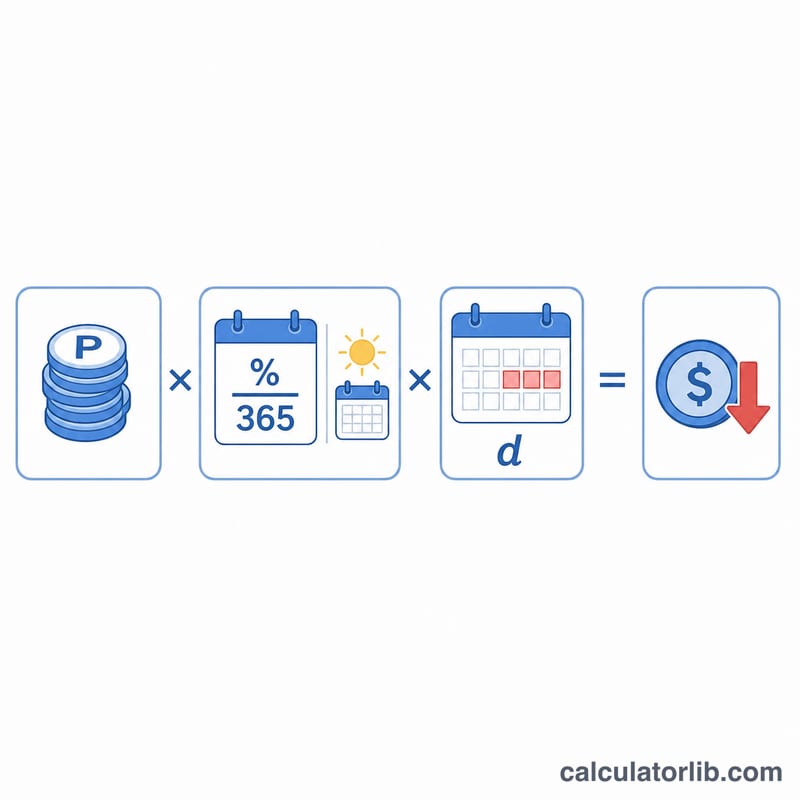
The penalty is based on simple daily interest. First the daily rate is found by dividing the APR by 365. That daily rate is multiplied by the principal to get one day of interest, then multiplied by the number of penalty days:
$$\text{Penalty} = \text{Principal} \times \frac{\text{APR}/100}{365} \times \text{Penalty Days}$$
This mirrors how most US banks compute the forfeited interest. Note that some institutions penalize a portion of principal if the accrued interest is too small to cover the penalty — this calculator assumes the standard interest-based method.
Worked Example
Suppose you hold a $10,000 CD at 4.5% APR with a 90-day penalty. The daily rate is \(0.045 / 365 = 0.00012329\). The penalty is $$10{,}000 \times 0.00012329 \times 90 = \$110.96.$$ You would keep about $9,889.04 of your principal.
FAQ
Can a penalty reduce my principal? Yes. If you withdraw very early and have earned little interest, the penalty can exceed accrued interest and eat into your principal.
How many days of interest is typical? Short-term CDs often penalize 90 days; longer terms may charge 180 or 365 days. Check your account disclosure.
Is this US-specific? The day-count and disclosure conventions reflect typical US bank CDs, but the simple-interest formula applies anywhere a penalty is quoted in days of interest.