
What the Loan Payoff Time Calculator does
This tool tells you how many months (and years) it will take to clear a loan, given your current balance, annual interest rate, and a fixed monthly payment. It works for any fully-amortizing fixed-rate debt — personal loans, auto loans, mortgages, or credit-card balances you intend to pay off at a steady amount.
How to use it
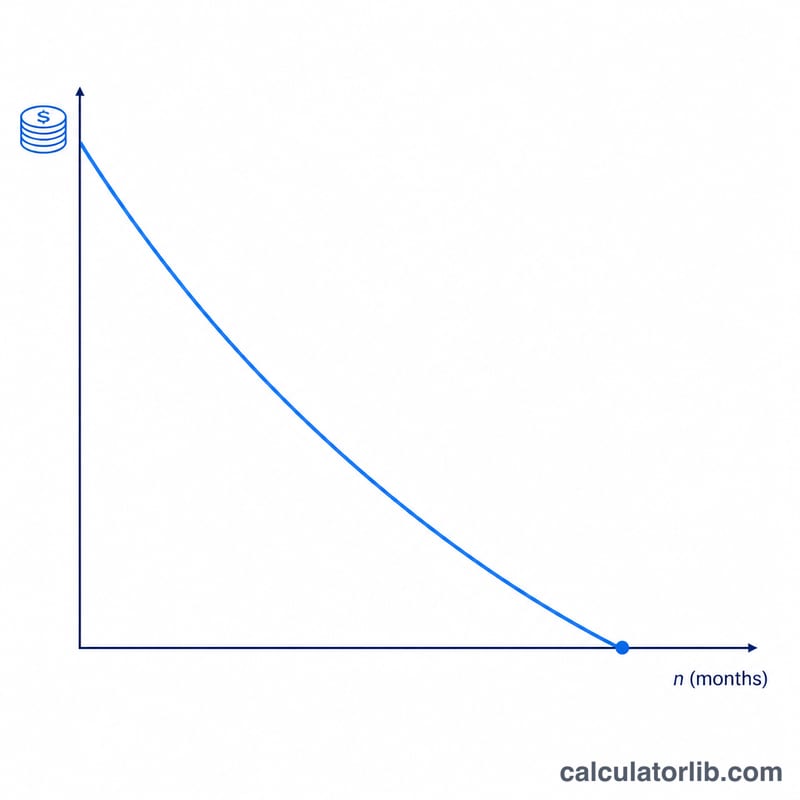
Enter your current outstanding balance, the loan's annual interest rate (APR as a percentage), and the amount you plan to pay every month. The calculator returns the number of months to reach a zero balance, the same figure split into years and months, the total amount you will pay, and the total interest cost. If the payment is too small to even cover one month of interest, you'll see a warning instead — the loan would never be repaid.
The formula explained
The number of payments is derived from the amortization equation:
$$n = \frac{-\ln\!\left(1 - \dfrac{r \cdot PV}{PMT}\right)}{\ln(1 + r)}$$
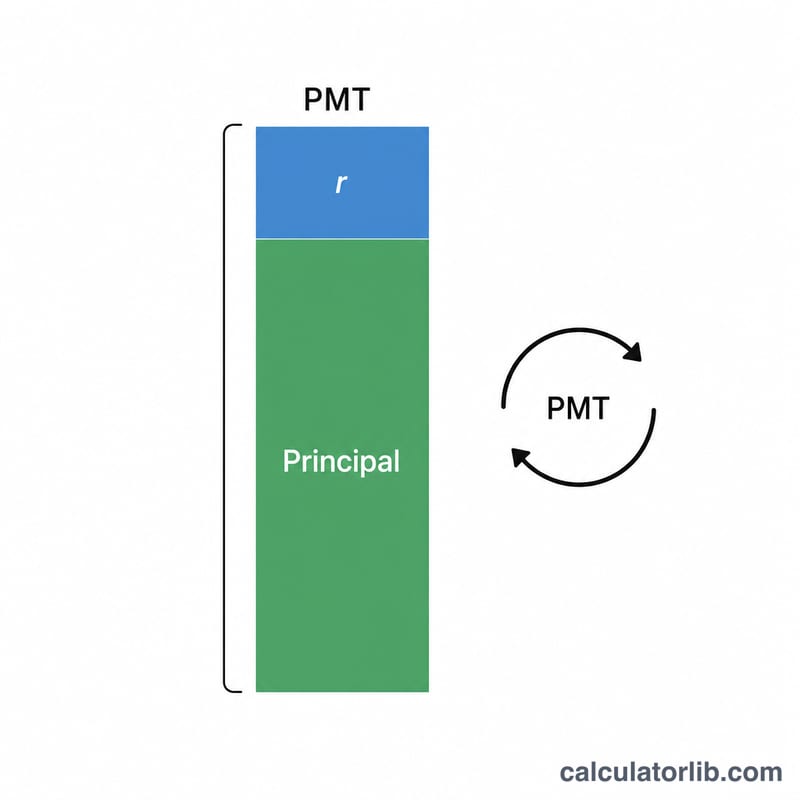
where PV is the present balance, PMT is the monthly payment, and r is the monthly interest rate (annual rate ÷ 100 ÷ 12). If \(r \cdot PV \ge PMT\), the term inside the logarithm is zero or negative and the loan can never be repaid. When the rate is 0%, the result simplifies to \(PV \div PMT\).
Worked example
Balance $20,000, 6% APR, $400/month. Monthly rate \(r = 0.06 / 12 = 0.005\).
$$n = \frac{-\ln\!\left(1 - \dfrac{0.005 \times 20000}{400}\right)}{\ln(1.005)} = \frac{-\ln(0.75)}{\ln(1.005)} \approx \frac{0.287682}{0.0049875} \approx 57.68$$
rounded up to 58 months (4 years 10 months). Total paid \(\approx 58 \times \$400 = \$23{,}200\), so interest \(\approx \$3{,}200\).
FAQ
Why does it round up? The final payment is usually smaller than a full installment, so the loan finishes during the last whole month — we round up to that month.
What if my payment is too low? If your payment is less than or equal to the monthly interest, the balance never shrinks. The calculator flags this so you can raise the payment.
Does it assume monthly compounding? Yes — interest is compounded once per month on the remaining balance, the standard convention for most installment loans.