What Is the Debt Snowball Payoff Time Calculator?
This calculator estimates how many months it will take to pay off a single debt (such as a credit card or loan) given its current balance, annual interest rate (APR), and a fixed monthly payment. It uses the standard amortization formula to account for interest accruing on the remaining balance each month.
How to Use It
Enter your current outstanding balance, the annual percentage rate (APR), and the fixed amount you plan to pay each month. The calculator returns the number of months to full payoff, the equivalent in years, the total amount you'll pay, and the total interest. If your payment is too low to cover the monthly interest, the calculator will warn you that the debt can never be paid off.
The Formula Explained
The number of payments is derived from the loan amortization equation:
$$N = \frac{-\ln\!\left(1 - \dfrac{B \cdot r}{P}\right)}{\ln(1 + r)}$$
where \(B\) is the balance, \(P\) is the monthly payment, and \(r = \dfrac{\text{APR}}{100 \times 12}\) is the monthly interest rate.
The term inside the logarithm must be positive, which requires that your payment exceeds the first month's interest charge (\(B \cdot r\)). Otherwise the balance never shrinks.
Worked Example
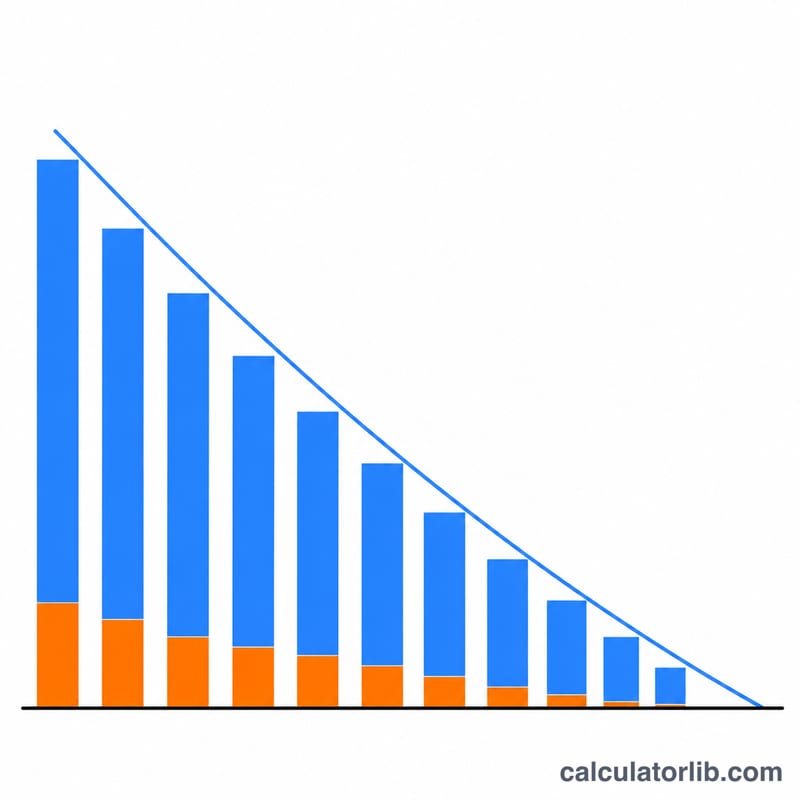
Suppose you owe $5,000 at 18% APR and pay $200 per month. The monthly rate is \(r = 0.18 / 12 = 0.015\). Then $$N = \frac{-\ln\!\left(1 - \dfrac{5000 \times 0.015}{200}\right)}{\ln(1.015)} = \frac{-\ln(1 - 0.375)}{\ln(1.015)} = \frac{-\ln(0.625)}{0.0148886} \approx \frac{0.47000}{0.0148886} \approx 31.57.$$ Rounding up, it takes 32 months to clear the debt.
Interpreting Your Payoff Result
Each month, interest is charged first: balance × monthly rate. The rest of the payment reduces principal. Early in repayment most of the payment may go to interest; as the balance falls, interest shrinks and a growing share goes to principal. A longer payoff time means more months of interest accrual, so total interest rises faster than the time itself.
The payment must exceed the monthly interest. The formula only works when \(P > B \cdot r\). If the payment equals or is below balance × monthly rate, the logarithm argument \(1 - Br/P\) is zero or negative, and the balance never shrinks, so there is no payoff date. For $5,000 at 18% APR, the threshold is $75 per month.
Total interest equals total amount paid minus the original balance: \(\text{Interest} = \text{Total paid} - B\). Using the $300 row: about $5,797.20 − $5,000 = $797.20.
The final payment is usually smaller. The formula gives a fractional number of months (for example 19.32). Rounding up to 20 means the first 19 payments are the full fixed amount, and the 20th only clears what is left (about $97 in that case). A calculator that multiplies months × payment will therefore slightly overstate the total paid.
This result assumes a fixed APR, monthly compounding, equal monthly payments, and no new charges, fees, or missed payments. Real accounts may differ. This is general information only.
Key Terms: APR, Principal, Amortization
- Balance / principal
- The amount of money still owed, not counting future interest. Each payment's principal portion reduces this figure.
- APR (annual percentage rate)
- The yearly cost of borrowing expressed as a percentage. For this calculator, APR is divided by 12 to get the monthly rate.
- Monthly periodic rate
- The rate applied each month: \(r = \text{APR}/1200\) when APR is entered as a percentage. At 18% APR, \(r = 0.015\) (1.5% per month).
- Amortization
- The process of paying off a debt through scheduled payments, where each payment covers that month's interest and reduces principal until the balance reaches zero.
- Fixed monthly payment
- A constant amount paid each month. Because interest declines as the balance falls, the principal share of a fixed payment grows over time.
- Total interest
- The sum of all interest charged over the life of the debt, equal to total paid minus the original balance.
- Debt snowball method
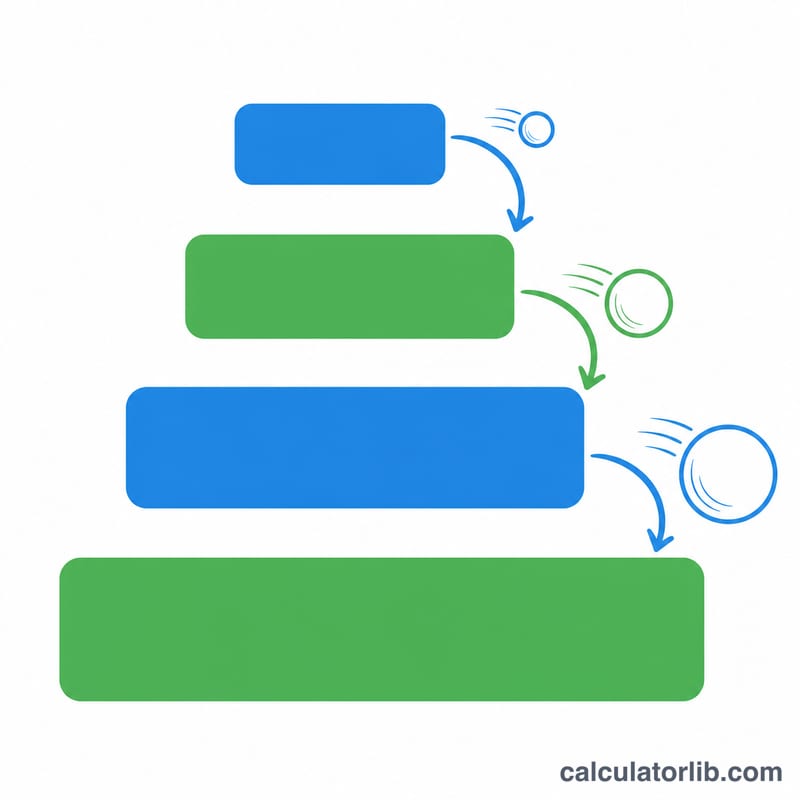
- A repayment strategy that pays the minimum on all debts and directs extra money to the smallest balance first. When it is cleared, its payment is rolled into the next smallest debt.
- Debt avalanche method
- A repayment strategy that directs extra money to the debt with the highest interest rate first. This typically minimizes total interest compared with other orderings.
Central bank policy rates today
The latest official policy rates of major central banks, updated automatically — the benchmark that bank deposit and loan rates follow.
- Federal Reserve · United States
- 3.75–4.00%
- As of
- 2026-11-13
- Change in 1 year
- 0 pp
Latest change Up +25 bp Federal Reserve changed its rate on 2026-09-17: from 3.50–3.75% to 3.75–4.00%.
| Central bank | Policy rate | As of | Change in 1 year |
|---|---|---|---|
| Banco Central do Brasil (Selic) · Brazil | 13.75% | 2026-11-16 | −1.25 pp |
| Banco de México · Mexico | 6.25% | 2026-11-10 | −1.00 pp |
| Federal Reserve · United States | 3.75–4.00% | 2026-11-13 | 0 pp |
| ECB | 2.50% | 2026-11-16 | +0.50 pp |
| Sveriges Riksbank · Sweden | 2.00% | 2026-11-16 | +0.25 pp |
| Saudi Central Bank (SAMA) · Saudi Arabia | 4.50% | 2026-10-29 | 0 pp |
| Reserve Bank of Australia · Australia | 4.60% | 2026-10-31 | +1.00 pp |
| Central Bank of the Republic of Türkiye · Türkiye | 36.00% | 2026-11-06 | −3.50 pp |
| Bank of Russia · Russia | 14.00% | 2026-11-10 | −2.50 pp |
| People’s Bank of China · China | 3.00% | 2026-11-10 | 0 pp |
| Bank of Canada · Canada | 2.50% | 2026-11-13 | +0.25 pp |
| Reserve Bank of India · India | 5.50% | 2026-10-19 | 0 pp |
| Bank of England · United Kingdom | 4.00% | 2026-11-16 | 0 pp |
| Bank of Japan · Japan | 1.25% | 2026-11-10 | +0.75 pp |
| Bank of Korea · South Korea | 3.00% | 2026-11-02 | +0.50 pp |
Federal Reserve: key rates and overnight market rates
The rates that frame monetary policy and the overnight market rate they steer, each with the date of its latest published value.
| Rate | Level | As of | Change in 1 year |
|---|---|---|---|
| Federal funds target range | 3.75–4.00% | 2026-11-13 | 0 pp |
| Effective federal funds rate (EFFR) | 3.88% | 2026-11-13 | 0 pp |
| Secured Overnight Financing Rate (SOFR) | 3.90% | 2026-11-13 | −0.10 pp |
Each rate keeps the date of its own latest published value; overnight market rates are published on the next business day.
Latest figure: 2026-11-13 Data last updated 2026-11-16 · current
Source: Banco Central do Brasil ODbL; Bank for International Settlements (BIS) Terms of permitted use of BIS statistics; Federal Reserve Bank of New York New York Fed Terms of Use; Board of Governors of the Federal Reserve System Public domain (U.S. government work); European Central Bank ECB reuse policy; Sveriges Riksbank Riksbank open data terms; The World Bank Group CC BY 4.0; Reserve Bank of Australia 2026 RBA copyright terms (Cash Rate); Bank of Canada Bank of Canada terms of use; Bank of England Open Government Licence v3.0
The one-year change is computed by CalculatorLib from these data. The EFFR and SOFR are subject to the Terms of Use posted at newyorkfed.org. The New York Fed is not responsible for publication of the EFFR and SOFR by CalculatorLib, does not sanction or endorse any particular republication, and has no liability for your use.
Source details and methodology
- Banco Central do Brasil
- Bank for International Settlements (BIS) — Central bank policy rates
- Federal Reserve Bank of New York — Reference rates (EFFR, SOFR)
- Board of Governors of the Federal Reserve System
- European Central Bank
- Sveriges Riksbank
- The World Bank Group — World Development Indicators (FR.INR.LEND, FR.INR.RINR)
- Reserve Bank of Australia 2026
- Bank of Canada
- Bank of England
FAQ
Why does the calculator round up? You can't make a partial final payment in practice, so months are rounded up to the next whole payment.
What if my payment never pays off the debt? If your monthly payment is less than or equal to the interest accruing each month, the balance grows and the debt is never repaid — the tool flags this.
Is this the snowball or avalanche method? This computes payoff time for one debt. The snowball/avalanche methods order multiple debts; this calculator handles each individual balance.