
What This Calculator Does
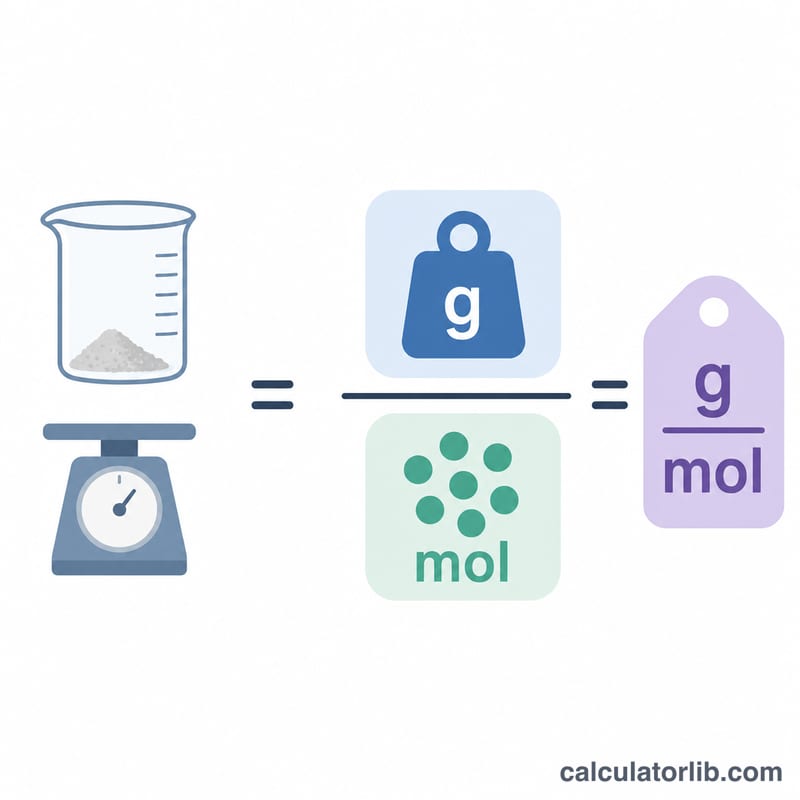
This tool computes the molar mass (M) of a substance when you know its mass (m, in grams) and the amount of substance (n, in moles). Molar mass is the mass of one mole of a substance, expressed in grams per mole (g/mol). It is a universal chemistry quantity and the same formula works for any element, compound, or mixture.
How to Use It
Enter the measured mass of your sample in grams and the number of moles it represents. Click calculate, and the result is the molar mass in g/mol. For example, if a laboratory sample weighs 18 g and contains 1 mole of particles, the molar mass is 18 g/mol — the value for water (H₂O).
The Formula Explained
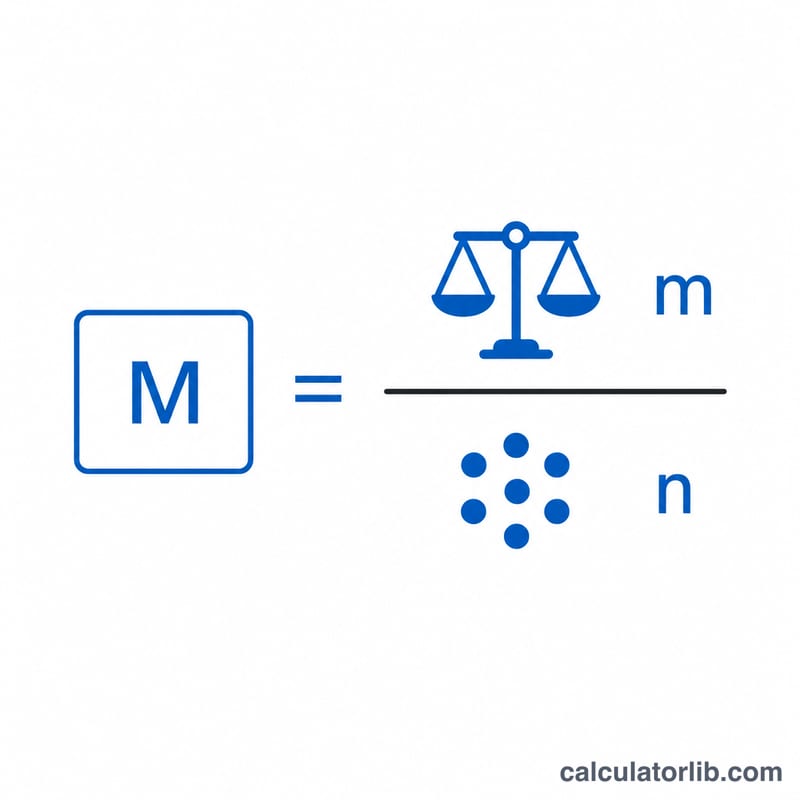
The relationship comes directly from the definition of the mole:
$$M = \frac{m}{n}$$
where M is molar mass (g/mol), m is mass (g), and n is the amount of substance (mol). Rearranging gives \(m = M \times n\) and \(n = m / M\), so the same equation lets you find any one quantity from the other two.
Worked Example
Suppose you have 44 g of carbon dioxide and you know this is exactly 1 mole. Then \(M = 44 \div 1 = 44\) g/mol, which matches the accepted molar mass of CO₂. If instead you had 88 g representing 2 moles, \(M = 88 \div 2 = 44\) g/mol — the molar mass is unchanged because it is an intensive property.
FAQ
What units does the answer use? Grams per mole (g/mol), the standard SI-derived unit for molar mass.
Can moles be a decimal? Yes. You can enter fractional amounts such as 0.25 mol; the calculator handles any positive value.
Why can't moles be zero? Dividing by zero is undefined, so the amount of substance must be greater than zero to obtain a valid molar mass.