
What Is the Money Doubling Time Calculator?
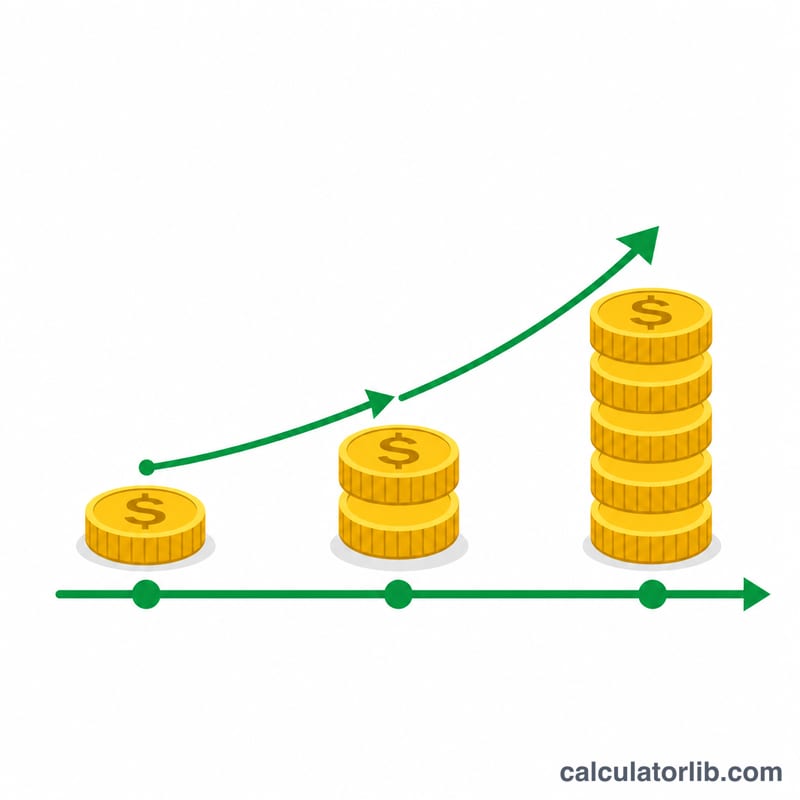
This calculator tells you roughly how long it takes an investment or deposit to double in value at a fixed annual compound interest rate. It uses the famous Rule of 72 for a quick estimate and the exact logarithmic formula for a precise answer. It works for any currency and any country since it relies on pure compound-interest math.
How to Use It
Enter your expected annual interest rate as a percentage (for example, enter 6 for 6%). The calculator returns two numbers: the Rule of 72 estimate and the mathematically exact doubling time. Compare them to see how close the shortcut is at your rate.
The Formula Explained
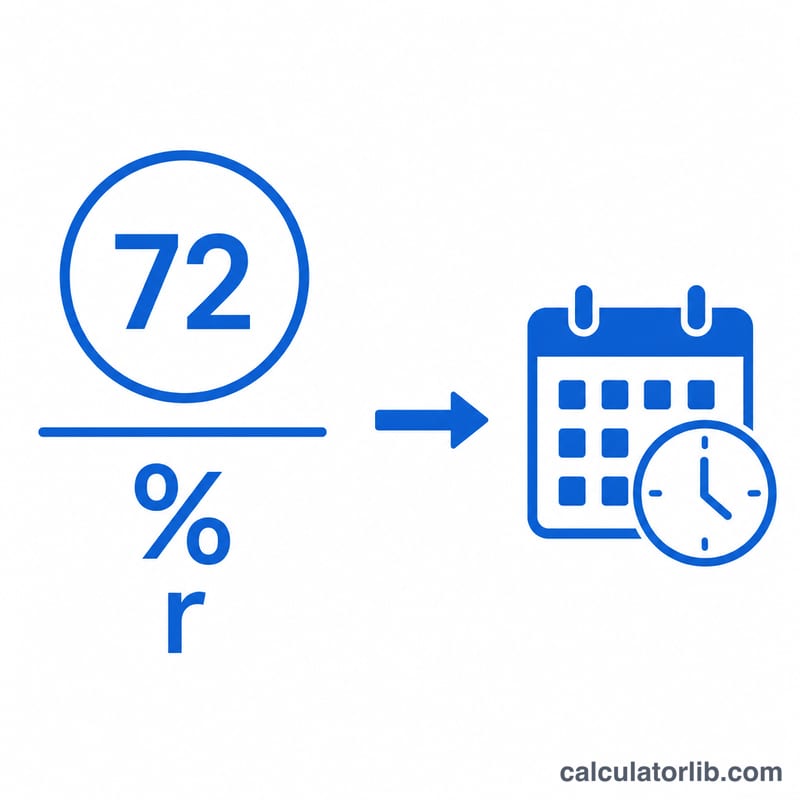
The Rule of 72 says: years to double ≈ 72 ÷ rate%. So at 8%, money doubles in about \(72/8 = 9\) years. The exact version comes from solving \(2 = (1 + r)^{t}\) for \(t\), giving
$$t = \frac{\ln 2}{\ln(1 + r)}$$where \(r\) is the rate written as a decimal (6% = 0.06). The Rule of 72 is most accurate for rates between roughly 6% and 10%.
Worked Example
Suppose you earn 6% per year. Rule of 72:
$$\frac{72}{6} = 12 \text{ years}$$Exact:
$$\frac{\ln 2}{\ln(1.06)} = \frac{0.6931}{0.0583} \approx 11.9 \text{ years}$$The estimate is within about a tenth of a year — close enough for quick mental math.
FAQ
Why 72 and not 70? 72 is chosen because it divides evenly by many common rates (2, 3, 4, 6, 8, 9, 12), making mental math easy. The "true" constant is closer to 69.3 for continuous compounding.
Does it account for taxes or inflation? No. It assumes a fixed nominal rate with annual compounding. For real (inflation-adjusted) growth, use your rate minus inflation.
What rate should I use? Use the effective annual yield you actually expect from your savings account, bond, or investment.