
What Is a Molar Ratio?
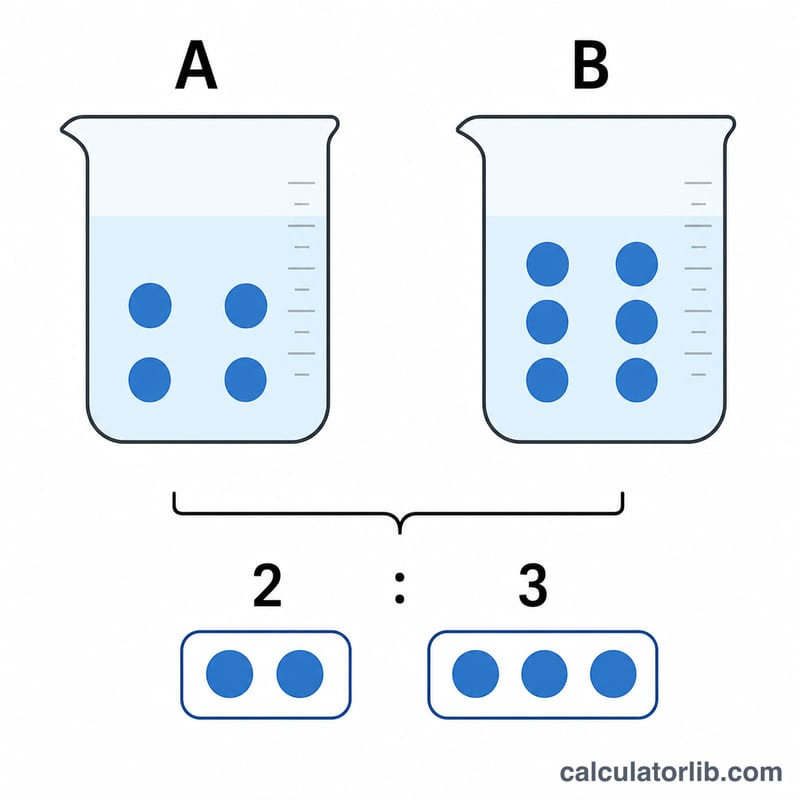
A molar ratio expresses the relative number of moles of two substances. It is a cornerstone of stoichiometry, letting chemists relate the quantities of reactants and products in a balanced chemical equation. This calculator converts the masses of two substances into moles and then divides them to give the molar ratio of A to B.
How to Use the Calculator
Enter the mass (in grams) and molar mass (in grams per mole) of substance A, then do the same for substance B. The tool computes the moles of each substance and reports the molar ratio expressed as "A : 1". You can find molar masses by summing the atomic masses of each element in the compound's formula.
The Formula Explained
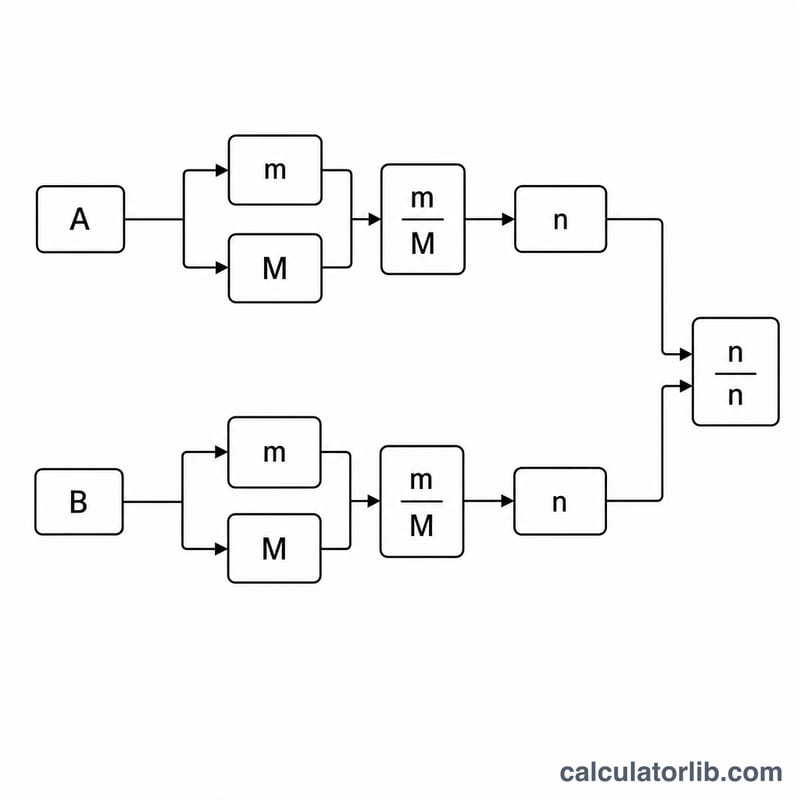
First, moles are found with \(n = m / M\), where m is mass and M is molar mass. The molar ratio is then \(\text{ratio} = n_A / n_B\). Because dividing mass by molar mass cancels grams, the result is a pure unitless ratio that tells you how many moles of A correspond to one mole of B.
$$\text{Molar Ratio} = \dfrac{n_A}{n_B} = \dfrac{m_A / M_A}{m_B / M_B}$$
Worked Example
Suppose you have 18 g of water (M = 18.015 g/mol) and 32 g of oxygen (M = 32 g/mol). Moles of water = \(18 / 18.015 \approx 0.99917\) mol. Moles of oxygen = \(32 / 32 = 1\) mol. The molar ratio is \(0.99917 / 1 \approx 0.9992\), meaning there are about 0.999 moles of water per mole of oxygen.
FAQ
Can I use moles directly? Yes — set each molar mass to 1 and enter your mole counts as the masses; the ratio will then equal moles A divided by moles B.
What if the ratio is less than 1? That simply means there are fewer moles of A than of B. A ratio of 0.5 means one mole of A for every two moles of B.
Does this account for a balanced equation? No. It gives the actual sample ratio. Compare it to the stoichiometric coefficients to identify limiting reagents.