
What Is the Debt Snowball Method?
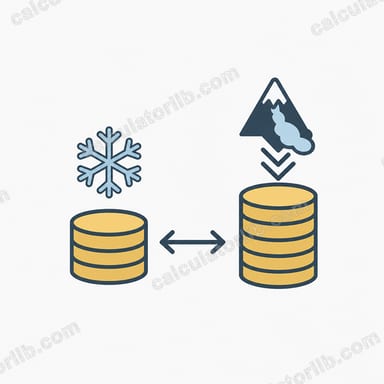
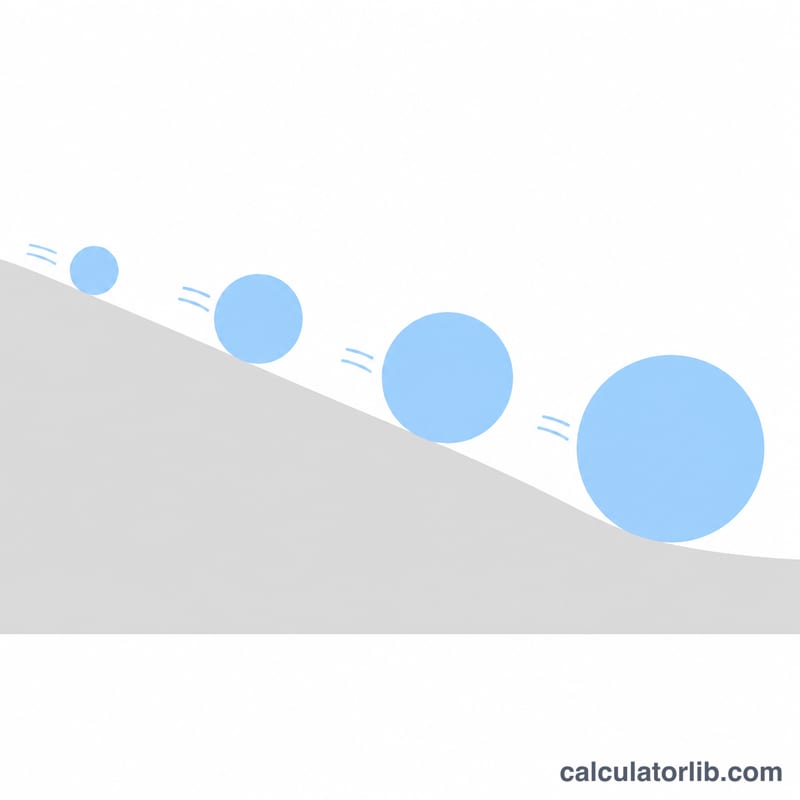
The debt snowball is a popular debt-payoff strategy: you make minimum payments on every debt, then throw all your extra money at the debt with the smallest balance first. Once that debt is gone, you roll its payment onto the next-smallest debt — the payment "snowballs" and grows larger as each balance is cleared. This calculator simulates that process month by month and tells you when you'll be debt-free, how long it takes, and how much interest you'll pay.
How to Use This Calculator
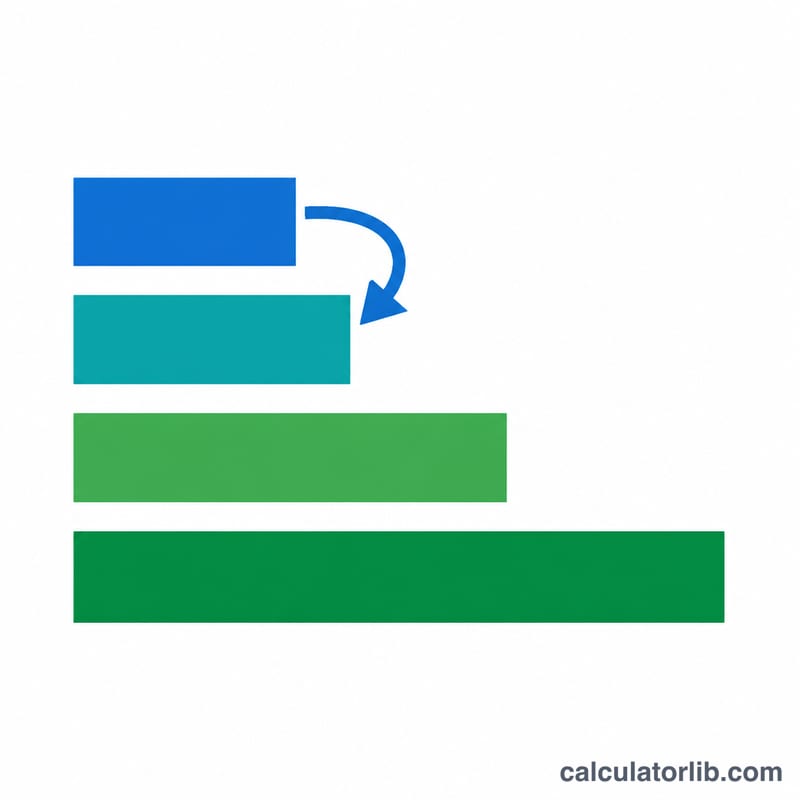
Enter the balance, annual percentage rate (APR), and minimum monthly payment for up to three debts. Add any extra amount you can put toward debt each month. The calculator sorts your debts smallest-to-largest, applies minimums everywhere, and directs the extra (plus freed-up minimums) to the smallest balance until everything is paid off. Leave a debt's balance blank or zero to ignore it.
The Formula Explained
For a single debt, the number of months to pay it off is $$n = \frac{-\ln\left(1 - \dfrac{rB}{P}\right)}{\ln(1+r)}$$ where \(B\) is the balance, \(P\) is the total monthly payment, and \(r\) is the monthly rate (\(\text{APR} \div 12 \div 100\)). The snowball part comes from raising \(P\) over time: every cleared debt's minimum is added to the payment on the next target. This tool runs a precise month-by-month simulation so interest accrual and rolled payments are handled exactly.
Worked Example
Suppose you owe \(\$1{,}000\) at 18% APR (min \(\$40\)), \(\$5{,}000\) at 12% (min \(\$120\)), and \(\$10{,}000\) at 6% (min \(\$200\)), with \(\$200\) extra per month. The \(\$1{,}000\) card is attacked first with \(\$240/\text{month}\) and clears in about 5 months. Its \(\$40\) minimum then rolls forward, accelerating the \(\$5{,}000\) debt, and so on. The result shows your full payoff timeline and total interest cost.
FAQ
Snowball vs. avalanche — which is better? The avalanche method targets the highest interest rate first and saves slightly more money. The snowball targets the smallest balance first for quick wins and motivation. This tool uses the snowball order.
Does extra payment really matter? Yes — even a small extra amount dramatically shortens payoff time and cuts total interest because it attacks principal directly.
Is this currency-specific? No. The math is universal; use any currency consistently for balances and payments.