
What Is the Debt Avalanche Method?
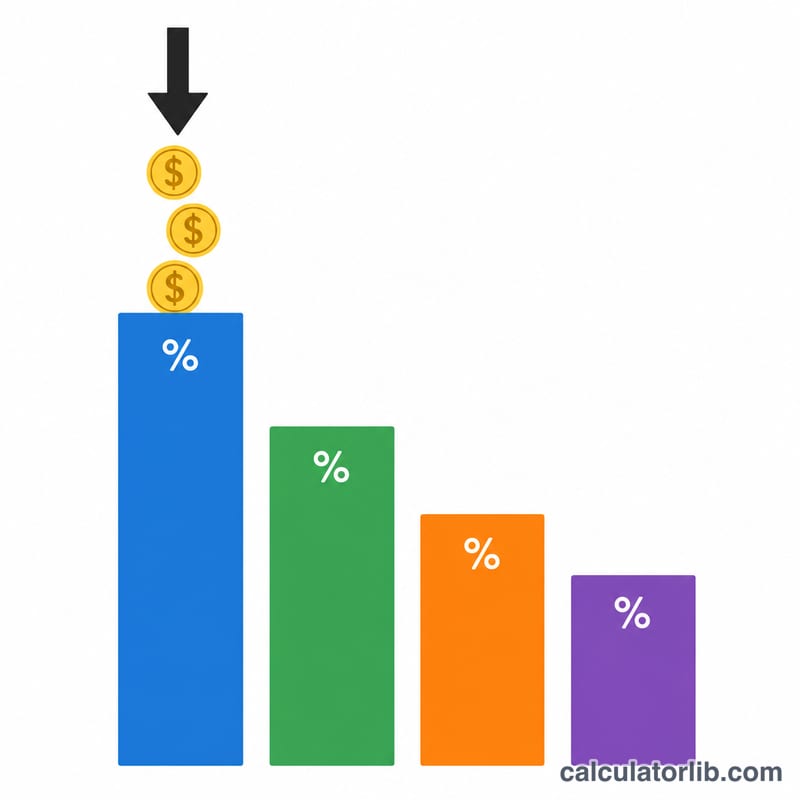
The debt avalanche is a payoff strategy that targets your most expensive debt first. You make the minimum payment on every account, then funnel any extra money toward the debt with the highest annual percentage rate (APR). Once that balance hits zero, the freed-up cash rolls onto the next-highest-rate debt, and so on. Because interest is what makes debt grow, attacking the highest rate first mathematically minimizes the total interest you pay and usually clears your debt fastest.
How to Use This Calculator
Enter your extra monthly payment — the amount above all minimums you can commit each month. Then list up to four debts, giving each one a balance, APR, and minimum payment. The calculator sorts your debts by APR, simulates the payoff month by month, and reports how long it takes to be debt-free, plus the total interest and total amount you'll pay.
The Formula Explained
Each month every active balance accrues interest equal to \(\text{balance} \times (\text{APR} \div 1200)\) — dividing by 1200 converts the annual percentage into a monthly decimal rate. After interest is added, the calculator pays the minimum on each debt, then directs all remaining money (leftover minimums plus your extra payment) to the highest-APR debt. This repeats until every balance reaches zero.
$$\begin{gathered} \text{Each month: } B_i \leftarrow B_i\left(1 + \frac{\text{APR}_i}{1200}\right) - \text{Payment}_i \\[1.5em] \text{where}\quad \left\{ \begin{aligned} \text{Pool} &= \sum_{i}\text{Min}_i + \text{Extra} \\ \text{APR}_i &\in \{\text{APR}_1,\,\text{APR}_2,\,\text{APR}_3,\,\text{APR}_4\} \\ \text{Extra} &\to \text{highest-APR debt first} \end{aligned} \right. \end{gathered}$$Worked Example
Suppose you owe \(\$5{,}000\) at 22% APR (min \(\$100\)) and \(\$8{,}000\) at 12% APR (min \(\$160\)), with \(\$100\) extra per month. The avalanche targets the 22% card first. The simulation shows roughly how many months until both are clear and how much interest the strategy saves compared with spreading the extra across both.
FAQ
Avalanche vs. snowball — which is better? Avalanche saves the most money by targeting the highest rate. Snowball targets the smallest balance first for quick motivational wins. Avalanche is the optimal choice purely on cost.
What counts as the "extra" payment? Any amount you can pay above the sum of all minimum payments each month.
Does this account for new charges? No — it assumes you stop adding to the balances. New spending will extend your payoff timeline.