
What Is a Growing Perpetuity?
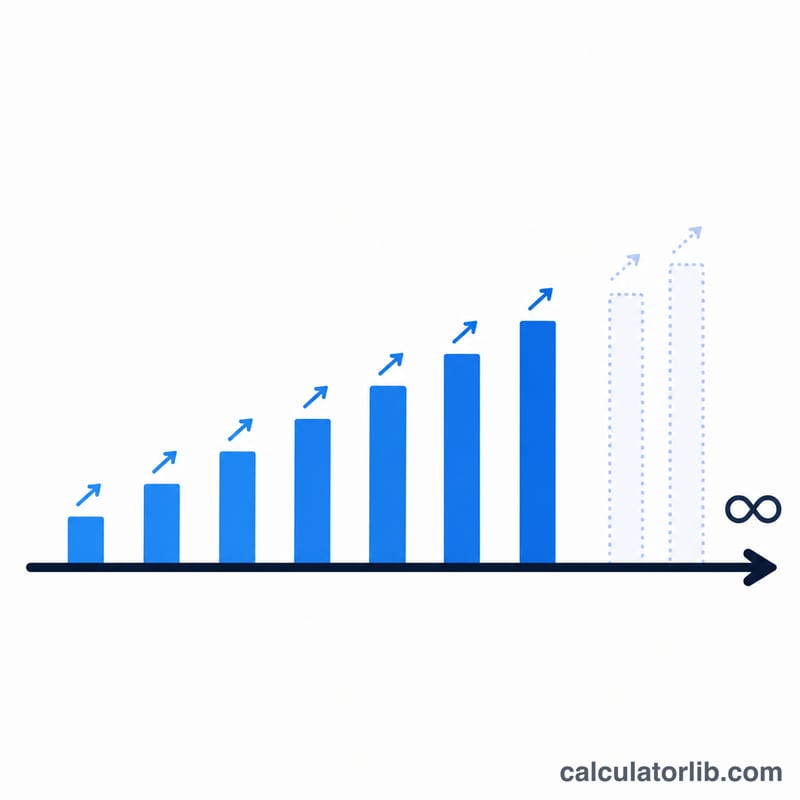
A growing perpetuity is a stream of cash flows that continues forever and grows at a constant rate every period. The classic example is a dividend-paying stock whose dividend rises by a steady percentage each year. This calculator finds the present value (PV) of that infinite, growing stream using the Gordon Growth model.
The Formula
The present value of a growing perpetuity is:
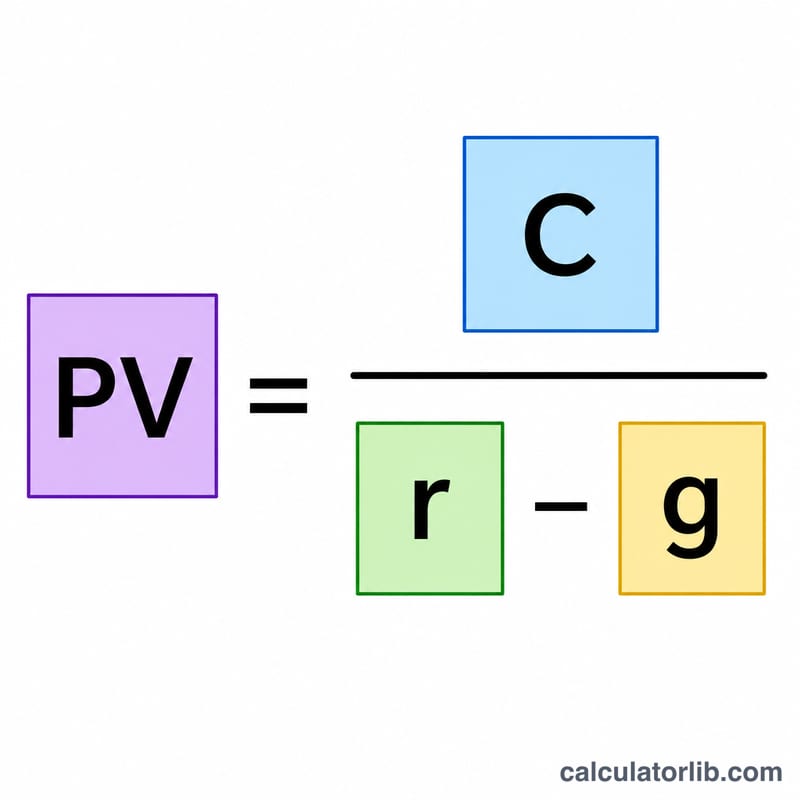
$$PV = \dfrac{C}{r - g}$$
where \(C\) is the cash flow received one period from now, \(r\) is the discount rate (your required return), and \(g\) is the constant growth rate of the cash flow. The formula only converges to a finite number when \(r > g\) — if growth meets or exceeds the discount rate the value is infinite (or undefined), so the calculator flags that case.
How to Use It
Enter the next period's cash flow, your discount rate as a percentage, and the expected growth rate as a percentage. The tool divides the cash flow by the spread between the two rates and returns today's value of the entire infinite stream.
Worked Example
Suppose a company will pay a dividend of $100 next year, you require an 8% return, and the dividend is expected to grow 3% per year forever. Then $$PV = \dfrac{100}{0.08 - 0.03} = \dfrac{100}{0.05} = \$2{,}000.$$ That is the most you should pay today for the growing dividend stream.
FAQ
Why must r be greater than g? If growth equals or exceeds the discount rate, the cash flows grow at least as fast as they are discounted, so their total present value diverges to infinity.
Is C this year's or next year's cash flow? \(C\) is the cash flow one period from today (the first payment). If you have the current payment, multiply it by \((1 + g)\) first.
How is this related to the Gordon Growth Model? It is the same equation. Stock valuation uses \(P = \dfrac{D_1}{r - g}\), which is exactly the growing perpetuity formula applied to dividends.