
What Is a Perpetuity?
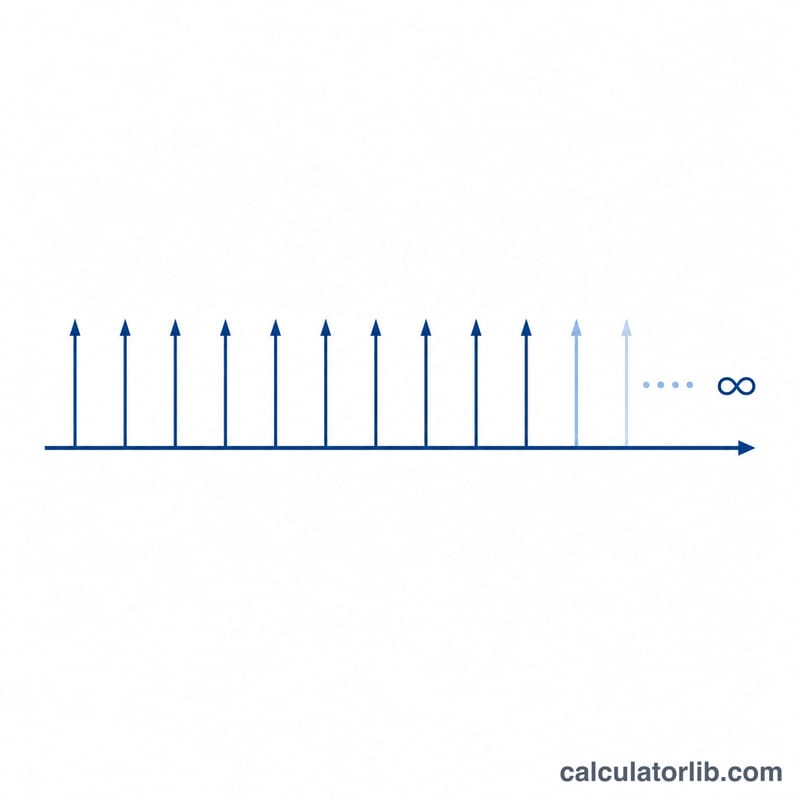
A perpetuity is a stream of equal cash payments that continues forever. Although no payment truly lasts to infinity, the concept is widely used in finance to value things that behave like endless income — such as certain preferred shares, government consols, or stable dividend streams. This calculator finds the present value (PV): the lump sum today that is financially equivalent to receiving those payments indefinitely.
How to Use This Calculator
Enter the periodic payment you expect to receive each period (for example, each year), and the discount rate per period as a percentage. If your payments are expected to grow every period — like an inflation-linked income — enter an optional growth rate. Leave growth at 0 for a standard fixed perpetuity. The result updates instantly to show the present value.
The Formula Explained
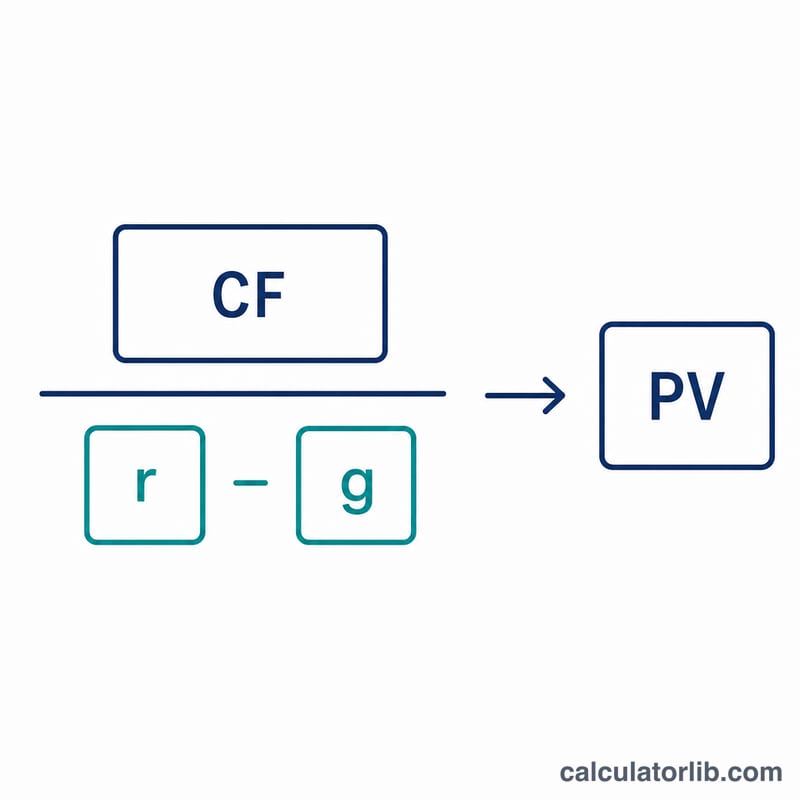
For a standard perpetuity, \(PV = \text{Payment} \div r\), where \(r\) is the discount rate. For a growing perpetuity, $$PV = \frac{\text{Payment}}{\frac{\text{Rate (\%)}}{100} - \frac{\text{Growth (\%)}}{100}}$$ where \(g\) is the per-period growth rate. The growth version only makes sense when the discount rate exceeds the growth rate (\(r > g\)); otherwise the value is infinite and the calculator returns zero as a safeguard.
Worked Example
Suppose you receive $1,000 every year forever and your discount rate is 5% (0.05). The present value is $$1{,}000 \div 0.05 = \$20{,}000$$ If those payments instead grow 2% per year, $$PV = 1{,}000 \div (0.05 - 0.02) = 1{,}000 \div 0.03 \approx \$33{,}333.33$$
FAQ
Why does a higher discount rate lower the value? A higher rate means future money is worth less today, so the same payments are worth a smaller lump sum now.
What if growth equals or exceeds the discount rate? The formula breaks down (value becomes infinite). This calculator returns 0 in that case to flag the invalid input.
Is a perpetuity realistic? Pure perpetuities are rare, but the formula is a useful approximation for very long-lived or stable income streams and underpins terminal-value calculations in stock valuation.