
What is the Debt-Free Date Calculator?
This calculator tells you how many months it will take to pay off a credit card or loan given your current balance, annual interest rate, and a fixed monthly payment. It also projects your debt-free date, the total amount you will pay, and the total interest cost.
How to use it
Enter your current balance, the annual interest rate (APR) as a percentage, and the fixed amount you pay each month. The tool assumes interest compounds monthly and that your payment stays constant. If your payment does not cover the monthly interest, the debt will never be repaid and the calculator warns you.
The formula explained
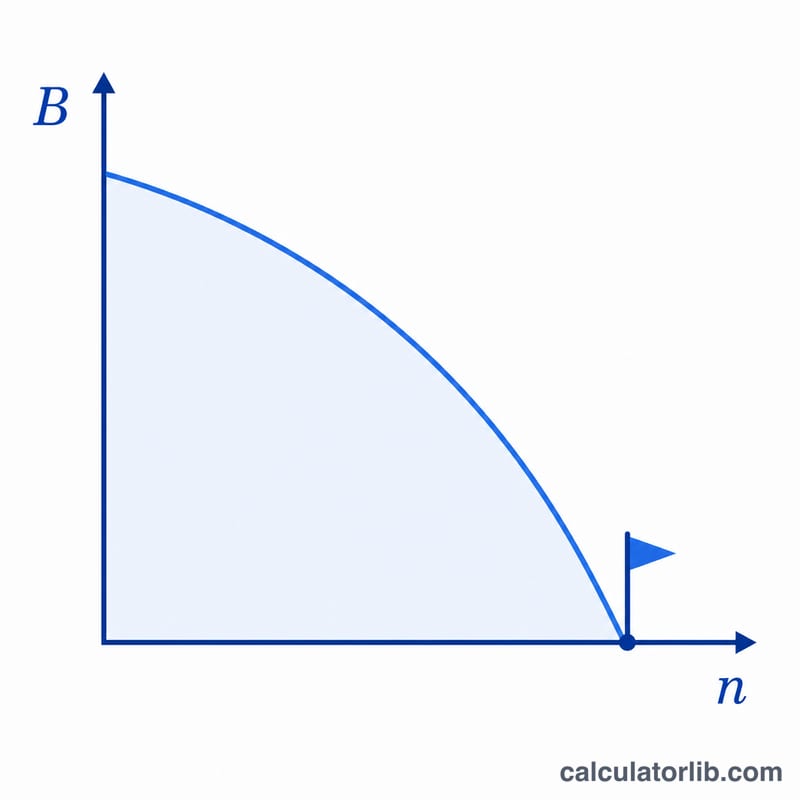
The number of months to repay a fixed-payment loan is derived from the amortization equation:
$$n = \left\lceil \frac{-\ln\!\left(1 - \dfrac{B \cdot i}{\text{pmt}}\right)}{\ln(1 + i)} \right\rceil$$
where \(B\) is the balance, \(i\) is the monthly interest rate (\(\text{APR} \div 12 \div 100\)), and \(\text{pmt}\) is the monthly payment. The debt-free date is simply today plus \(n\) months.
Worked example
Balance $10,000, APR 18% (\(i = 0.015\)), payment $300. Minimum interest payment is \(10{,}000 \times 0.015 = \$150\), so $300 comfortably covers it. $$n = \frac{-\ln\!\left(1 - \dfrac{10{,}000 \times 0.015}{300}\right)}{\ln(1.015)} = \frac{-\ln(0.5)}{\ln(1.015)} \approx 46.55$$ rounded up to 47 months — about 3 years and 11 months.
FAQ
What if my payment is too small? If the payment is less than or equal to the monthly interest, the balance grows forever and the calculator returns -1 months with a warning.
Why is total interest approximate? The final payment is usually smaller than a full payment, so interest is estimated as total payments minus the original balance.
Does it handle 0% interest? Yes — it simply divides the balance by the payment and rounds up.