
What Is the Cricket Run Rate Calculator?
Run rate is the average number of runs a team scores per over. It is one of the most-watched statistics in limited-overs cricket because it shows how quickly runs are being accumulated and helps compare innings of different lengths. This calculator turns a runs total and overs faced into a clean runs-per-over (RPO) figure and even projects what the final score would look like over a full 50-over innings.
How to Use It
Enter the total runs scored and the number of overs bowled, then read off the run rate. Overs are entered in decimal form (e.g. 20 overs = 20). The tool divides runs by overs and also estimates a projected score if the same rate continued for 50 overs.
The Formula Explained
The core formula is simply \(\text{Run Rate} = \frac{\text{Runs}}{\text{Overs}}\). Because a cricket over has six legal balls, partial overs in scorecards are written like 12.3 (12 overs and 3 balls). For an exact calculation those balls should be converted to a fraction of an over (3 balls = 0.5 over), but the headline run rate uses runs divided by overs completed.
$$\text{Run Rate} = \frac{\text{Runs Scored}}{\text{Overs Bowled}}$$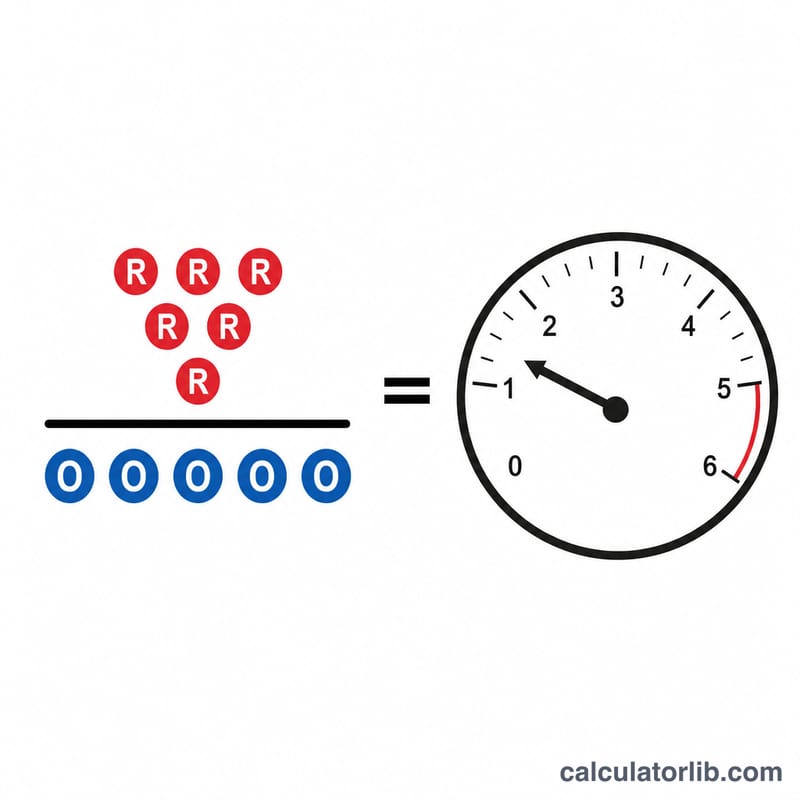
Worked Example
Suppose a team scored 180 runs in 20 overs. Run rate = \(180 \div 20 = \mathbf{9.00}\) runs per over. Projected over 50 overs = \(9 \times 50 = 450\) runs. That tells you the batting side is going at an exceptional T20 pace.
$$\text{Projected Score} = \frac{\text{Runs Scored}}{\text{Overs Bowled}} \times 50$$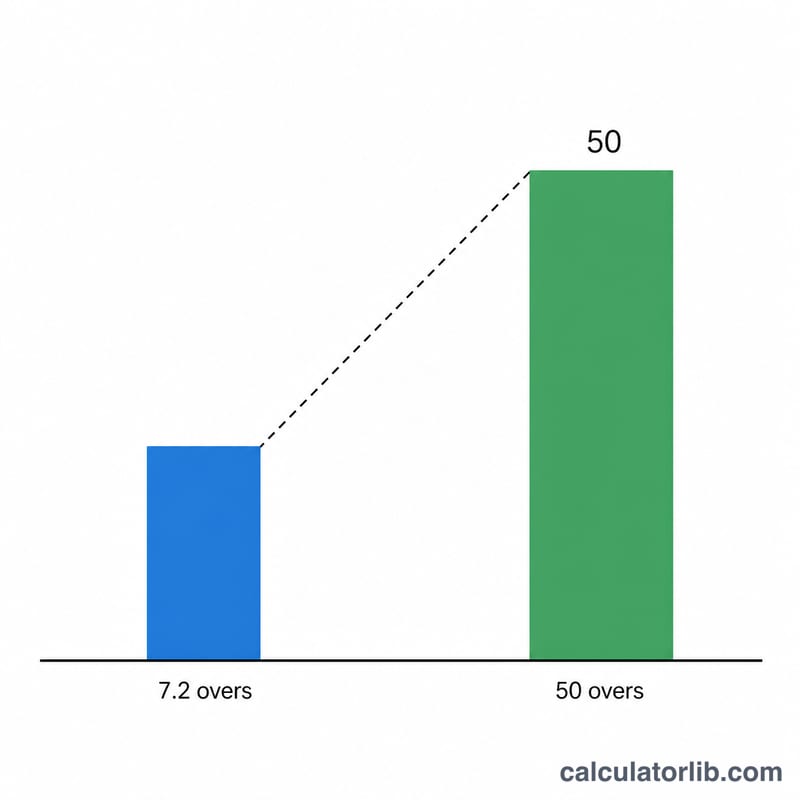
FAQ
What is a good run rate? In ODIs, 6 RPO is healthy; in T20s, 8–10 RPO is competitive.
How do I handle part-overs? Convert balls to a fraction (each ball = \(\tfrac{1}{6}\) over). For example, 18.3 overs \(\approx\) 18.5 overs.
Is this the same as required run rate? No. Required run rate is runs still needed divided by overs remaining; this tool computes the current/achieved run rate.